How the Five Compare on the Numbers
The qualifier is barely present in the data. Read all eight listings and exactly two mention carrying anything anywhere: one states a personalized design for easy carrying, and a four piece set states its cups are easy to carry on the go. No listing publishes a packed size, a lid, a sleeve or a case, and a frothing pitcher does not nest into anything, so the page ranks on what a bag actually notices, which is weight and upright height.
Three listings were left out. A four piece set and a two piece set are both bulk buys for a counter rather than a kit, and their dimension fields describe cartons: 5.0 by 5.0 by 3.5 inches for the four pack and 5.5 by 5.5 by 4.5 for the pair. A third 20 oz listing repeats almost the same bullets as one of the picks here, down to the narrow mouth and the latte art pen.
What the table cannot tell you is wall thickness, and on a pitcher that lives in a bag that is the specification that decides whether a dent becomes permanent. Nobody publishes it. Nor does any listing publish a base diameter separately from the body, which is what determines whether a pitcher stands up on an uneven surface, and nobody states whether the spout is formed or welded.
What a Travel Kit Actually Cares About
Weight Varies by More Than Double
HOFASON publishes 0.22 pounds and UMUACCAN 0.53, with De’Longhi at 0.37 and Amrules at 0.4 in between. Four of the five hold either 12 or 20 ounces, so the spread is mostly about how much steel the maker used, not how much milk fits. On a page about packing a kit, that is the single most useful figure published anywhere in this pool.
The exception is Adorever, which publishes no weight at all while stating easy carrying as one of its five features. That is the kind of gap worth naming: a listing making a portability claim and then withholding the number that would support it. It does publish complete dimensions, 3.0 by 3.0 by 3.5 inches, which are the lowest three figures among the four picks that publish any.
Height Is Packed Height
Nothing in this category collapses, nests or folds. A frothing pitcher is a truncated cone with a handle and a beak, so the height in the field is the height in the bag. Adorever publishes 3.5 inches, Amrules 3.54 and HOFASON 3.58, which are effectively the same object from a packing point of view, all three on 12 ounce bodies.
UMUACCAN publishes 4.3 inches because it holds 600 ml rather than 350, and that is the honest trade: three quarters of an inch more height and a fifth of a pound more weight for enough milk to make two or three drinks instead of one or two. If the kit is for one person, the smaller bodies are the right answer on both counts.
Coatings, Marks and the Things That Fail in a Bag
Four Are Bare Steel and One Is Not
HOFASON is the only pick that publishes a coating, stating 304 stainless steel with a non stick coating, rust proof, stain proof and crash proof. In a kitchen that is a reasonable proposition. In a bag pressed against a hand grinder and a tamper it is a surface that can be scratched, and a scratched non stick interior in a milk pitcher is harder to live with than a marked steel one.
The other four are bare or chrome finished. Amrules names 18/8 food grade stainless with an external mirror finish and an internal hairline finish, which is the most specific surface description in the pool. Adorever states chrome finished 304. UMUACCAN states 304 stated rust proof, stain proof and heat resistant. De’Longhi states stainless steel and does not grade it.
The Scale Line Is a Cleaning Question
Amrules makes the best argument anyone here makes, and it is about a detail nobody else raises: its interior marks are laser printed without a groove, and it states this means the pitcher is easy to wash with no residual milk foam. An engraved line is a channel, and milk protein sits in channels. Away from a dishwasher, that difference is felt every day.
UMUACCAN states double scale lines and does not say how they are made. In the wider pool, a 20 oz listing states measurement engraved on both sides, which answers the question the other way. HOFASON, De’Longhi and Adorever publish no interior marking at all, which for measuring milk means eyeballing it, or pouring from something else first.
Capacity, Machines and What Each Listing Leaves Out
One Listing Explains Its Own Capacity
HOFASON is alone in translating a number into a drink, stating that 12 oz is perfect to steam milk for two double lattes and that you should not fill the milk higher than where the pour indentation begins. That second sentence is the practical one, because a pitcher filled to the brim cannot froth, and it is the only fill guidance published anywhere in this pool.
UMUACCAN frames its 600 ml as suiting a few friends at home or in the office, and the other 20 oz listing in the pool says two or three cups of cappuccino. Amrules, Adorever and De’Longhi publish a capacity and stop. For a kit you carry, knowing that one drink needs a third of a 12 oz pitcher is worth more than the capacity itself.
The Only Pitcher Named to a Machine
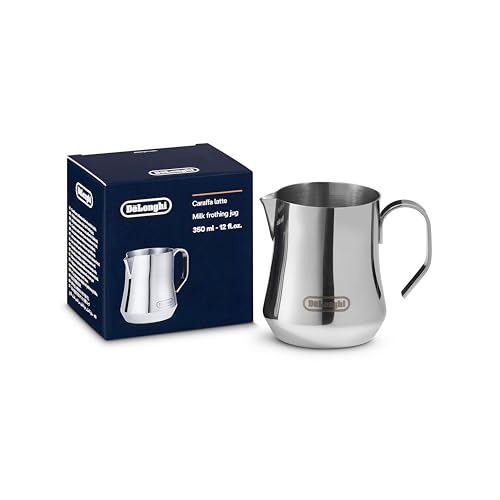
De’Longhi publishes five bullets and four of them are one line long, which makes it the thinnest listing among the picks. What it does publish is the only compatibility claim in the pool: it works with all De’Longhi pump espresso makers. If the machine at the other end of the trip is one of those, that sentence answers a question none of the others address.
Against it sit two problems. Its published dimensions read 1.55 by 1.55 inches, which no 350 ml jug is, so there is no usable size figure beyond the 0.37 pound weight. And it publishes nothing about the interior, the cleaning, the handle or the spout shape other than calling the spout convenient. You are buying a known brand and a stated capacity.
Which One Fits Your Kitchen
You are counting grams in a kit bag. HOFASON publishes 0.22 pounds, the lowest published weight of these five, on a 12 oz body measuring 3.07 inches across and 3.58 inches tall, and it is the only listing telling you what the capacity is for and where to stop filling. It carries a non stick coating.
You will be washing it in a sink, not a machine. Amrules publishes 3.2 by 3.2 by 3.54 inches and 0.4 pounds in 18/8 stainless, with interior marks laser printed without a groove so no milk foam sits in them, a mirror exterior, a hairline interior and a stainless latte art pen.
You want the most compact published figures. Adorever publishes 3.0 by 3.0 by 3.5 inches on a 12 oz body in chrome finished 304 stainless, with a point mouth, a firm welded handle joint, a latte art pen and its own claim of easy carrying. It publishes no weight to check that claim against.
Your kit is built around a De’Longhi machine. The DLSC060 is the only pitcher here stating compatibility with all De’Longhi pump espresso makers, at 0.37 pounds on a stated 350 ml, 12 oz capacity in stainless steel with a pour spout. Its published dimensions cannot be the jug and were set aside.
You are making drinks for two or three people. UMUACCAN publishes 3.1 by 3.1 by 4.3 inches and 0.53 pounds on a 600 ml, 20 oz body in 304 stainless, with double scale lines, a narrow V shaped mouth, a latte art pen, and the only handle in this pool stated not to get hot.
What We Could Not Verify
The qualifier is nearly absent from the category, and the figures that replace it are missing on two of the five.
- Only two of the eight listings mention carrying a pitcher, and neither publishes a packed size, a lid or a case.
- De’Longhi’s published dimension fields of 1.55 by 1.55 inches cannot describe a jug it states holds 350 ml.
- Adorever publishes no weight at all, on a listing whose own bullet claims easy carrying as a feature.
- HOFASON’s width field is empty, so only its 3.07 inch and 3.58 inch figures are published.
- No listing publishes a wall thickness, which is what separates a pitcher that dents from one that does not.
- No listing states whether its spout is formed from the body or welded on, which is where a pitcher leaks.