How the Five Compare on the Numbers
A heat rating is the baseline specification for a silicone liner, and it is the one figure every product on this keyword publishes. All five of these do, which makes this a rare page on this site: there is no absence to rank, only a spread. The spread is wide, running from 428 F at one end to 500 F at the other.
What separates them is everything around the figure. Four restate it in the second scale, so a reader can catch a rounding error. One publishes a lower limit as well, which nobody else mentions. One publishes two different ceilings in two different bullets. And three have dimension fields that disagree with their own sentences.
What the table cannot tell you is whether any of these ratings is ever tested. None of the five describes a method, a duration or a standard, so a ceiling is a manufacturer’s statement and nothing more. It also cannot tell you what the fryer reaches, because not one of these listings mentions the operating temperature of the appliance it is sold to sit inside.
The Figures at Each End
The Highest Rating, and the Only Real Warning
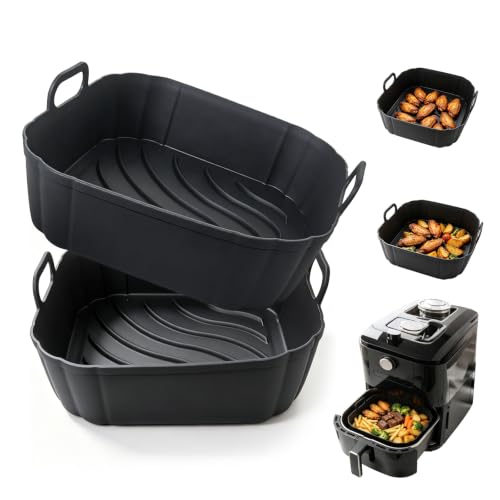
Redfly publishes 500 F and restates it as 260 C, which puts it at the top of this page. More useful than the number is the sentence at the end of its listing: place a quantity of food in the liner during use, or the liner will be blown up by the heat. That is a maker admitting that a lightly loaded liner lifts in the airflow, and no other listing here says it.
It discloses an odor on first use as well, and says to wash the liner once before cooking. The shape is published in full, at 8.46 by 8.46 inches across the top, 7.68 by 7.68 inches at the bottom and 2.36 inches high, for most 5-6.5QT fryers. Its dimension fields read 8.46 by 2.36 by 2.36 inches, which puts the height in the depth slot, so this page uses the sentence.
The Lowest Rating, and the Longest Promise
Buauty publishes 428 F, given as 220 C, which is the lowest figure on this page, and then spends the rest of the same bullet on durability rather than heat. It states that the liner is scratch, abrasion, tear and dirt resistant and will not deform or damage after hundreds of uses. That is the most specific wear claim across these five listings.
For a first accessory set that trade is defensible. A liner that keeps its shape is worth more than one rated higher than anything it will actually meet. Its shape is published twice and the two nearly agree: the size entry reads 7.9 by 7.9 by 2 inch and a bullet gives an 8 inch diameter with a 2 inch height, for 8 inch baskets and above and fryers from 3.6 to 6.8QT.
One Listing, Two Different Ceilings
A Floor Nobody Else Publishes
BOMSI is the only pick here that says anything about cold. Its first bullet gives a working range of minus 40 C to 240 C, which it also writes as minus 40 F to 464 F, and a liner cleared to that floor can come out of a freezer and go into heat. The other four listings are silent on the subject, so with them that is a use nobody has underwritten.
The same listing then undercuts itself. Its third bullet says the silicone is heat resistant up to 450 F, which is not the 464 F of the first bullet, and nothing on the page reconciles them. This guide credits the floor, treats the ceiling as uncertain and ranks the product second rather than first on that basis. The weight field reads 0.35 lb and the diameter is given as 8 inch for 3qt to 5qt fryers.
What a Placeholder Field Hides
All three of its dimension fields read 0.1 inches. That is not a measurement of anything: the maker’s own bullet gives an 8 inch diameter, and a liner the listing calls a pot has to have a height. Three identical figures at a round tenth are what a field looks like when somebody had to put something in it, and the sheet flags this listing for exactly that reason.
The practical loss is the height. BOMSI never publishes one, in a field or a sentence, so the only way to know whether its walls clear the food is to measure the arriving product. Everything else it commits to is clear enough: two liners in red and black, raised bottom lines for heat distribution and oil runoff, and clearance for a microwave, an oven, a skillet and a steamer.
Thickness, Perforation and Fields That Are Not Heights
The Only Published Thickness
Linda’s Essentials publishes the one thickness figure on this page, a thick 2mm design across three liners of 8.5 by 8.5 inches, alongside a 446 F rating and BPA free and PFOA free materials. Thickness is the right figure for what this product is, because it is a flat perforated mat rather than a walled cup, and a mat is judged on whether it lies flat.
It is also the only pick that expects you to change the product, saying the liners can easily be trimmed to fit your basket. That makes fit a non issue and makes the published 8.5 inch figure provisional. The perforated design is credited with air flow and even heat distribution, which is the opposite solution to the raised lines the other four use, and its 446 F rating is the only one here not restated in the second scale.
A Long Model List and a Height in the Wrong Field
Komzon gives 440 F and 226 C and then publishes the most useful compatibility paragraph in this pool. It names Gourmia, Ninja, Phillips, Nuwave, Gowise, Dash, Cozyna, Cosori, Ultrean, Vremi, Power XL, Chefman and Instant Pot, and a second bullet adds Ninja AF100, AF101, AF150, AF161, AF141, AF181, DZ201 and AG301, COSORI at 5QT and 6QT, and Instant Pot Vortex Plus 6QT.
Its shape comes from the bullets: a 7.3 inch bottom, an 8.4 inch top and a 2.1 inch height, for 4 QT fryers and larger, with three liners per pack and two sturdy side handles for lifting and hanging. The fields read 7.3 by 7.3 by 0.1 inches, which repeats the bottom twice and puts the material thickness where the height belongs. The weight field reads 0.88 lb.
Which One Fits Your Kitchen
A fryer that runs hot and a cook who reads notes. Redfly. It publishes 500 F, given as 260 C, a full shape at 8.46 by 8.46 inches at the top, and the only warning here that an unloaded liner lifts in the airflow.
Freezer to fryer in one dish. BOMSI. The only pick with a published floor, minus 40 F, at 0.35 lb and an 8 inch diameter. Treat its ceiling as unsettled, since its own bullets give 464 F and 450 F.
An odd basket shape. Linda’s Essentials. Three mats at 8.5 by 8.5 inches and 2mm thick, perforated for airflow, and the only ones the maker tells you to trim to fit.
An unknown model number. Komzon. A 440 F rating given as 226 C, a 7.3 inch bottom and 8.4 inch top, three liners, two handles, and more named fryers than anything else in this pool.
Daily use over several years. Buauty. The lowest rating here at 428 F, given as 220 C, against the only claim on this page that the liner will not deform or damage after hundreds of uses.
What We Could Not Verify
Everything above comes from each maker’s own listing. These are the things those listings leave unsettled, and this page does not resolve them by inference.
- Which BOMSI ceiling is correct, since its own bullets publish 464 F and 450 F for the same product.
- Any lower limit for four of these five, so nothing is known about taking them out of a freezer.
- Any height at all for BOMSI, whose three dimension fields are a placeholder and whose bullets give only a diameter.
- A thickness for four of these five, since only Linda’s Essentials publishes one at 2mm.
- Whether any of these ratings was tested, since none of the five describes a method, a duration or a standard.
- What temperature the fryers these fit actually reach, which not one of the five listings mentions.