How the Five Compare on the Numbers
Dishwasher safe is the easiest claim in this category to make, and all five of these listings make it. That makes it useless as a deciding specification, because a claim every product shares separates none of them. The question that does separate them is what each maker is willing to say once the dishwasher claim is out of the way.
On that, the five split cleanly. One publishes a hand washing method. One publishes a way to stop the residue forming at all. One sells a liner that comes apart into three pieces. One credits its base pattern and names both routes. One names the dishwasher and describes hand washing as a hassle it has eliminated.
What the table cannot tell you is whether any of these stains. Silicone picks up turmeric, tomato and chili oil, and a liner that has gone orange is not dirty so much as permanently marked. Not one listing in this pool addresses it. Redfly comes closest by disclosing an odor on arrival, which is a different problem, and the silence from the other fifteen listings on the sheet is not evidence that their silicone stays white.
What Each Maker Will Commit To
The One Hand Washing Method on the Page
Redfly is the only listing of these five that answers the question a full dishwasher creates. It states the liners can go completely into the dishwasher, and then gives a route with a method attached: add detergent and soak the liner in warm water for a while, which it says makes it easier to clean. That is two sentences more than anyone else offers and it is the difference between a claim and an instruction.
It is also the only pick that discloses something inconvenient, noting that a slight odor is normal when the liner arrives and that one wash clears it. A listing willing to say that has usually read its own returns. The same listing claims a 15 percent cut in cooking time with nothing to support it, so a willingness to disclose is not the same as reliability throughout.
The Instruction That Prevents the Problem
Golden Associate takes the opposite approach and it is arguably the better one. Its caution bullet states that a silicone liner must not be inside during preheat, because the heating element may cause smoke, and that the fryer should be left empty while it preheats. Preheating with a liner in the basket is exactly how food gets welded to silicone.
No other listing in this pool says it. The same bullet adds a handling note most makers skip, that the liner gets hot and should be lifted with oven mitts or tongs, which is the moment a cleanup usually becomes a spill. On washing itself it is ordinary: dishwasher safe, no sticky mess on the pan, no impact on food flavor, and no more scraping baked-on food off the basket.
One Piece or Three
The Stainless Steel Case
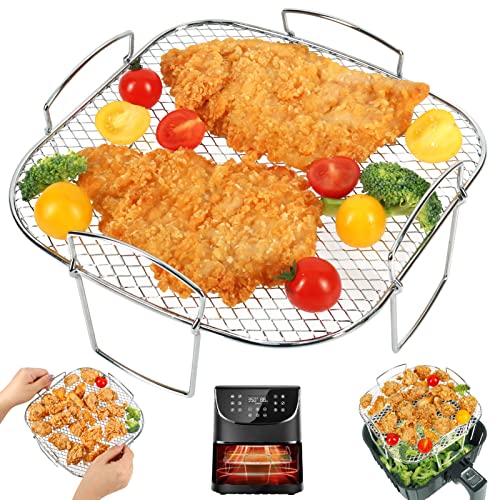
Suenozero is the only pick here that is not silicone and the only one where cleanup means washing more than one object. It is 304 stainless steel with a built-in rack and a detachable heat-resistant silicone handle, and the maker states that it is dishwasher safe and that the rack prevents sticking and burnt residue.
The rack is the interesting part. It separates food from grease, which means the grease ends up in the liner rather than on dinner, so the liner is doing the dirty work by design. The detachable handle is a real advantage, because a bonded silicone grip is where grease usually collects on a liner and this one comes off. The cost is that a purchase is three things in the dishwasher rather than one.
A Base That Does Cleaning Work
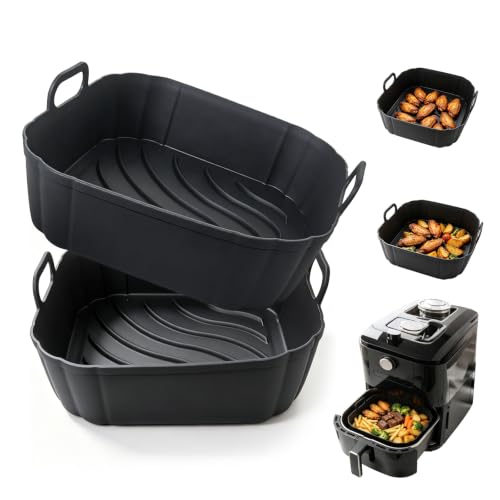
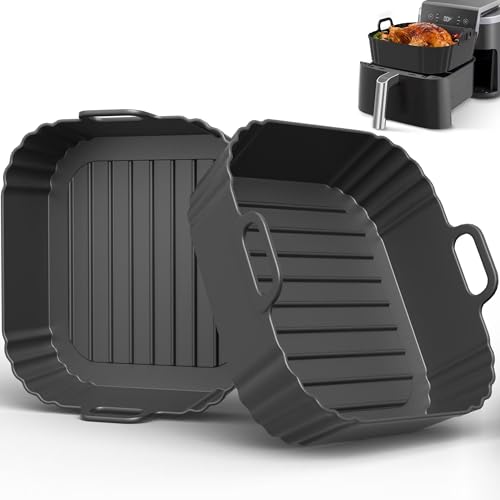
Three of these five credit the base pattern with the cleaning rather than the washing. luwrevc states that the striped design at the bottom facilitates cleaning either by hand or in the machine. Redfly states that raised patterns let excess oil run to the bottom and reduce oil adhesion. PINTAUR states that raised silicone strips separate food from the oil produced in cooking.
That is a cleaning feature described as a cooking one, and the reasoning holds: food sitting out of its own oil bakes less of it onto the surface underneath. None of the three tests the claim and none needs to, because it is a statement about shape rather than performance. luwrevc makes the strongest version of the broader argument, that the real benefit is never cleaning the inside of the fryer at all.
Where the Figures Contradict Themselves
A Height in the Depth Slot
Redfly publishes 8.46 inches across the top, 7.68 at the bottom and 2.36 inches high in its own bullet, and its dimension fields read 8.46 by 2.36 by 2.36 inches. The second figure is the height typed into the depth slot, because a liner 8.46 inches wide is not 2.36 inches deep. The sentence is right and the field is half wrong, which is the most common failure in this pool.
PINTAUR publishes the same three figures and its fields, 8.5 by 8.5 by 2.36 inches, agree with them to a rounding. Two listings describing what appears to be the same liner, one with a usable field set and one without. Golden Associate publishes a 0.1 inch height field on a liner that plainly has walls, which is a blank form rather than a measurement.
A Sentence an Inch Away From Its Own Fields
luwrevc is the clearest conflict here. The maker states 9.56 by 9.56 by 3.15 inches and the dimension fields read 8.66 by 8.27 by 2.95 inches. Those are not roundings of each other; they differ by most of an inch in two directions, and the field set is not even square while the sentence is. One of the two describes something else, and the listing gives no way to tell which.
PINTAUR is the opposite case and deserves credit for it. It is the only listing in this pool that names machines it will not fit, calling out the COSORI CAF-DC601 at 6QT and the Instant Vortex Plus at 6QT as incompatible, and it gives its basket limit in two units, up to 8.9 inches, written also as 22.7 cm. A maker prepared to lose a sale is a maker whose fit claims are worth more.
Which One Fits Your Kitchen
The dishwasher is always full. Redfly, the only pick with a published hand method: detergent and a soak in warm water. It also has the highest ceiling here at 500 F and the only odor disclosure in the pool.
You would rather not create the mess. Golden Associate, for one sentence no one else publishes: keep the liner out during preheat because the element may cause smoke. Published at 9 by 9 inches at the top.
Silicone has let you down before. Suenozero, in 304 stainless with a built-in rack and a handle that detaches for washing. Accept three pieces instead of one, and no published temperature figure.
A COSORI TurboBlaze and a textured base. luwrevc, which credits its striped bottom with easier cleaning either way and has the lowest published weight field here at 0.51 lb. Read both its size figures first.
You want the fit settled before the washing question. PINTAUR, at 8.46 top, 7.68 bottom and 2.36 high, and the only listing in this pool that names two machines it will not fit.
What We Could Not Verify
These are the specifications we went looking for in all five listings and did not find.
- Whether any of these stains. One listing mentions odor and not one mentions staining at all.
- A hand washing method from four of the five. Only Redfly publishes what to actually do.
- Whether the Suenozero rack and detachable handle are dishwasher safe, or only the liner body.
- Any temperature figure from Suenozero, the one stainless steel pick on this page.
- What supports the Redfly claim of a 15 percent cut in cooking time. Nothing else in that listing addresses it.
- Which of the luwrevc figures is the liner, its stated 9.56 inch square or its 8.66 by 8.27 inch fields.