How the Five Compare on the Numbers
Not one of these six listings uses the word apartment. Three of them name a pantry, a countertop or a cabinet, and that is as close as the published record gets. What an apartment kitchen really has is one small sink, so the question this page asks is what each set asks of you afterwards: how many lids and gaskets arrive, and what the maker will say about a dishwasher.
That second half is more interesting than it should be. Three of these five have bamboo lids, bamboo does not belong in a dishwasher, and all three listings mention a dishwasher anyway. Only one of them limits the claim to the part it can be true of. The other two picks never raise washing at all.
One published weight cannot be right and should not be read as one. CHEFSTORY publishes 0.29 lb for eight plastic containers with four lids, which is less than a single empty container of that size weighs. Everything else in that listing is quoted here and the weight is not used. Four of the five publish only a carton for dimensions.
What the Word Dishwasher Covers Here
Three Bamboo Lids and Three Different Sentences
SENTVEND is the careful one. Its bullet describes a dual seal bamboo design, a solid natural bamboo top with a thick food grade silicone ring, and then says dishwasher safe glass. The noun is doing real work: the glass goes in the machine and the bamboo lid does not, and the listing has written the limit into the sentence rather than leaving you to infer it.
Liuruiyu and KTMAMA both go further than that. Liuruiyu says the dishwasher safe design means less time on cleanup, in a set whose lids are bamboo. KTMAMA says its containers are easily cleaned in the dishwasher, with premium moisture proof bamboo lids and integrated silicone gaskets. Neither sentence separates the jar from the lid, and a bamboo lid put through a hot cycle is the part that will not last.
The Two That Do Not Mention Washing at All
ComSaf publishes nothing about washing. What it publishes instead is a metal clamp and a thick silicone gasket described as a true airtight seal, and a wide mouth that takes a standard 1 cup measuring scoop inside the jar. A clamp lid with a removable gasket is straightforward to clean by hand, and the listing simply never says so.
CHEFSTORY also says nothing, and it is the one where the omission matters most. It is food grade BPA free plastic, which is the material most likely to be fine in a machine, across eight containers and four side locking lids with black silicone gaskets. Eight containers is the largest washing up on this page and the listing offers no guidance on it.
How Many Pieces You Are Committing To
Three Large Jars Against Eight Small Containers
The purchases here are not the same shape of commitment. ComSaf is three jars of 78 oz each, described as sized for a 4 lb bag of sugar or a 5 lb bag of rice, at a published 7.47 lb empty. That is the fewest pieces to wash and the largest single object to get under a tap in a small sink.
CHEFSTORY is the opposite: eight containers in four sizes, two each at 2.5, 1.8, 1.5 and 0.7 quarts, with 24 reusable labels. That covers far more different jobs, and it also means eight bodies and four lids with gaskets circulating through one sink. In a kitchen with no dishwasher that difference is the whole decision.
Six of One Size, or Four
SENTVEND and Liuruiyu both sell six jars of 37 oz with bamboo lids, which is a lot of one size for a small kitchen and exactly right if what you store is six similar dry goods. Liuruiyu publishes 5.31 lb for the set. SENTVEND publishes no weight but gives a size field of 3.94 by 3.94 by 6.22 inches, and a 10 cm mouth.
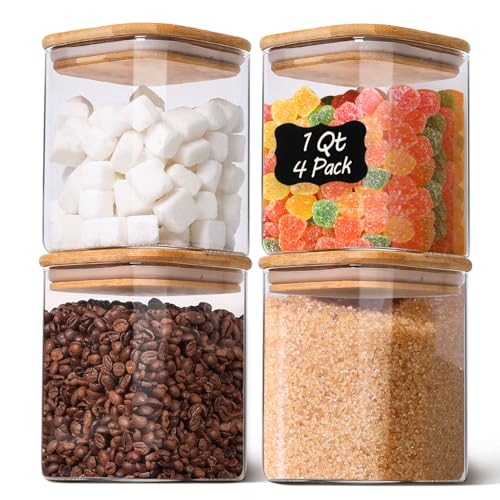
KTMAMA sits in between at four jars of 1 quart each, published at 3.88 lb, with bamboo lids and integrated silicone gaskets and a square stackable form it says wastes no shelf gaps. Four is the count that fits a single cabinet shelf in a rental kitchen without becoming a display, and it is the smallest glass set here.
Refilling, Scooping and Labeling
Two Listings Publish a Mouth Opening
A jar you cannot get a scoop into is a jar you decant from, which means a second vessel and more washing up. ComSaf makes that the point of one of its bullets, stating that the extra wide opening fits a standard 1 cup measuring scoop inside so you are not tilting a heavy jar. SENTVEND publishes a figure instead, a 10 cm wide mouth for scooping, pouring and cleaning.
The other three publish nothing about the opening. Liuruiyu and KTMAMA both describe square glass jars with bamboo lids and say the lids come off for thorough cleaning, which implies access without measuring it. CHEFSTORY describes see through containers and a side locking lid, and gives no opening figure for any of its four sizes.
Labels, and Who Supplies Them
Three of the five put labels in the box and the counts differ widely. CHEFSTORY supplies 24 reusable labels for eight containers, which is three per container and clearly meant to be re assigned. SENTVEND supplies 12 labels and one marker for six jars. ComSaf supplies reusable labels for tracking contents and purchase dates without stating how many.
Liuruiyu and KTMAMA supply none, and both rely on clear glass instead: see what is inside rather than read what is written. In a rental kitchen where the same six jars hold different things month to month, a marker and a rewritable label is the difference between a system and a row of similar jars.
Which One Fits Your Kitchen
The kitchen where the glass goes in the machine. SENTVEND is the only pick whose dishwasher claim names the part it applies to: dishwasher safe glass, with a solid bamboo top and a silicone ring kept out of it. Six 37 oz borosilicate jars, a 10 cm mouth, 12 labels and a marker.
The kitchen storing six similar things. Liuruiyu is six 37 oz square glass jars with bamboo lids at a published 5.31 lb, stating a dishwasher safe design and lids that come off for thorough cleaning. Read the dishwasher line as covering the glass, whatever the sentence says.
The kitchen with one cabinet shelf. KTMAMA is four 1 quart square jars at 3.88 lb, with bamboo lids over integrated silicone gaskets and a stated secure vertical stack. It is the smallest glass set here and the one with the fewest lids to look after.
The kitchen buying staples in bulk. ComSaf is three 78 oz jars, stated to hold a 4 lb bag of sugar or 5 lb of rice, with a metal clamp, a thick silicone gasket and a mouth wide enough for a 1 cup scoop. At 7.47 lb empty it is heavy in a small sink.
The kitchen that needs four different sizes. CHEFSTORY is eight plastic containers, two each at 2.5, 1.8, 1.5 and 0.7 quarts, with side locking lids, silicone gaskets and 24 labels. It says nothing about washing, and its published weight of 0.29 lb cannot be the set.
What We Could Not Verify
These are the figures and statements we went looking for in the manufacturer listings and could not find. Nothing below was estimated, and nothing on this page was measured by us.
- Whether the bamboo lids on three of these sets may go in a dishwasher, which two listings imply and none states.
- Any washing statement at all from the ComSaf and CHEFSTORY listings.
- A believable weight for the CHEFSTORY set, published at 0.29 lb for eight containers and four lids.
- Real jar dimensions from four of the five, whose fields describe a carton rather than a jar.
- A mouth opening for the Liuruiyu, KTMAMA and CHEFSTORY containers.
- Whether replacement gaskets or bamboo lids can be bought separately for any of these sets.