How the Five Compare on the Numbers
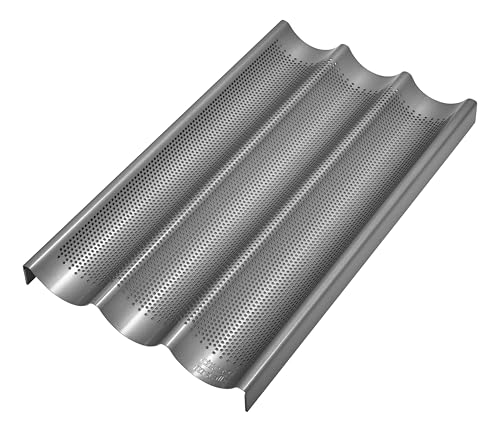
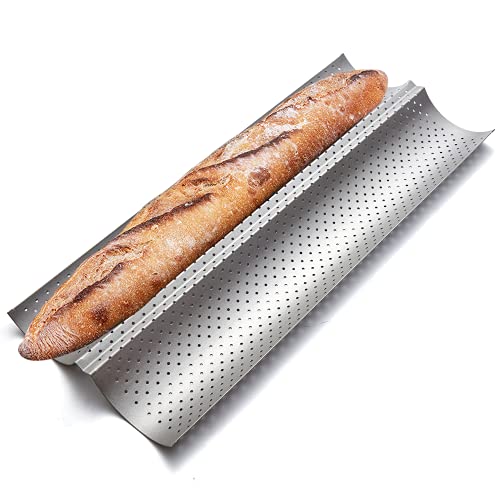
Not one of these five listings mentions a handle, a grip, a lip or a tab. A perforated baguette pan is a flat sheet of pressed metal and every maker here sells it as one, so there is nothing to carry it by. What you actually grip is the edge, and three of the five describe that edge in writing while the other two say nothing about it at all. That is where this page starts.
The other half of carrying a pan is how much of it there is. These run from a two channel pan at 0.46 lb to a four channel pan at 1.0 lb, and from 6.3 inches across to 13, which changes how far your hands are apart when the pan comes out of the oven. The table gives the maker’s own size wording, because several fields disagree with it.
What the table cannot tell you is how the rim is actually formed. A burr free edge, a rounded corner and a smooth crimping are the only three descriptions here, and none of those makers publishes a rim width, a fold or a rolled lip. Nobody states how much of the edge is free of perforations, which is the part your thumbs would sit on. Every judgement about grip below is drawn from an adjective.
No Pan Here Has a Handle
What the Listings Describe Instead
Every one of these five pans is a perforated tray, and the features they list are about airflow, coating and channel count. EAMQXERTOI lists six features and none is a handle. Pavsrmy lists five and none is a handle. Chicago Metallic, Gicyiit and KITESSENSU are the same. If a handle is the thing you need, this whole category does not supply it.
That is not a gap in the data so much as a fact about the product. A baguette pan sits on an oven rack with loaves proofing in its channels, and a raised handle would stop a second pan sliding above it. So the honest version of the question is what you hold when there is nothing to hold, and the answer is the edge and whatever oven glove you own.
Three Makers Describe the Edge You Hold
EAMQXERTOI is the only listing here that names the edge twice and gives a reason, stating smooth burr free edges for easy cleaning and repeating that smooth edges make cleanup easier. Burr free is a manufacturing claim about the cut line of pressed steel, and it is the closest thing on this page to a statement about handling a bare pan with a cloth.
Pavsrmy describes a rounded corners design and states it protects your hands, which is a claim about shape rather than finish. Gicyiit is the third, stating that a smooth crimping design ensures safe handling. Chicago Metallic and KITESSENSU say nothing: both describe coatings, perforations and metal and leave the edge unmentioned, so there is no published basis for preferring either of those two on grip.
Weight and Reach, the Two Things You Feel
From 0.46 Pounds to a Full Pound
Published weights give the only hard comparison on this page. KITESSENSU is the lightest of the five at 0.46 lb, EAMQXERTOI follows at 0.57 lb, Gicyiit at 0.8 lb, Chicago Metallic at 0.86 lb, and Pavsrmy is the heaviest of the five at 1.0 lb. Those are empty pans, and none of these makers publishes a loaded figure or a dough capacity.
A tenth of a pound sounds trivial until the pan is at oven temperature and held on outstretched arms. Pavsrmy at 1.0 lb carries four loaves and Chicago Metallic at 0.86 lb carries three, so the heavier pan is also the fuller one. KITESSENSU at 0.46 lb carries two. On published figures the lighter pans are lighter because they hold less.
How Far Apart Your Hands Have to Be
Reach matters as much as mass when there is no handle. Pavsrmy and EAMQXERTOI both state 15 by 13 inches, so both hands are 13 inches apart with the loaves running away from you. Chicago Metallic states 16 by 9 inches, Gicyiit 15 by 9.5 and KITESSENSU 15 by 6.3, which is a narrow enough pan to lift with a single cloth folded across it.
Only three of the five say anything about the oven this has to come out of. Pavsrmy states that the pan fits large home ovens of at least 1.2 cu ft, which is the one published constraint on this page. Gicyiit states its three slot design fits most home ovens better than a wider pan, and KITESSENSU says only that it suits a big or small oven.
What Happens After the Pan Comes Out
Which of These Can Go in a Machine
Chicago Metallic is the only listing here stating that the pan is dishwasher safe, and it immediately advises hand washing to preserve the nonstick coating and suggests oil or parchment before baking. It is also the only pan here made of heavy weight aluminum rather than carbon steel, and it names all three loaf channels in its heat conduction claim.
Pavsrmy and Gicyiit both recommend hand washing and state their pans withstand 446 F. EAMQXERTOI does not mention a dishwasher but ties its cleaning claim back to the edge, stating smooth edges make cleanup easier, which is the only place on this page where the edge and the washing up appear in the same sentence. KITESSENSU publishes nothing about cleaning at all.
Where One Listing Disagrees With Itself
Chicago Metallic states 16 by 9 by 1.5 inches in its own title and again in its features, while its published height field reads 1.0 inch. Half an inch of channel depth is the difference between a loaf that holds its shape and one that spreads, so the gap matters. The maker’s own wording is used above and the field is noted here rather than ranked.
EAMQXERTOI does the same thing in miniature. Its feature bullet states 15 by 13 by 0.87 inches, its size line reads 15.08 by 12.99 by 0.87 inches, and its separate dimension fields give 12.59 by 14.96 by 0.85 inches. That is one pan described three times with three answers, so this page quotes the bullet and records the other two here rather than ranking on any of them.
Which One Fits Your Kitchen
Handling a bare pan without a cloth. EAMQXERTOI is the only pick naming its edge, stating smooth burr free edges twice and tying them to cleaning. It bakes four loaves at a stated 15 by 13 by 0.87 inches and weighs 0.57 lb, which is light for a four channel pan in carbon steel.
Four loaves and a big oven. Pavsrmy states 15 by 13 inches, rounded corners, carbon steel to 446 F and, unusually, a minimum oven size of 1.2 cu ft. At 1.0 lb it is the heaviest of the five, and it is the only listing that tells you in advance whether your oven will take it.
Putting the pan in the dishwasher. Chicago Metallic is the only pick stating dishwasher safe, though it advises hand washing for the coating. It is heavy weight aluminum, states 16 by 9 by 1.5 inches for three loaves, and its published height field of 1.0 inch contradicts that wording.
Three loaves in an ordinary oven. Gicyiit states 15 by 9.5 inches, thickened carbon steel to 446 F and that its three slot design fits most home ovens better than wider pans. At 0.8 lb with hand washing recommended, it is the straightforward middle choice here.
Lifting with one hand. KITESSENSU is the lightest of the five at 0.46 lb and states 15 by 6.3 inches for two loaves, narrow enough to take out on a single folded cloth. It carries a stated ten year guarantee, and it publishes no metal, no temperature and nothing about washing.
What We Could Not Verify
All of this is from the makers’ own listing text. These are the questions it leaves unanswered.
- Not one of the five listings mentions a handle, a grip, a tab or a rolled lip of any kind.
- No maker publishes a rim width, or how much of the edge is free of perforations.
- Two of the five say nothing at all about the edge or the corners.
- No listing publishes a loaded weight or a dough capacity, only the weight of the empty pan.
- Chicago Metallic’s published height field of 1.0 inch contradicts the 1.5 inches in its own title.
- KITESSENSU publishes no metal, no oven temperature and no cleaning instruction.