How the Five Compare on the Numbers
Five liner sets sit on this page and the purchases could hardly be less alike. Two are eight piece kits with the same contents, one is six machine washable cotton liners, one is a pair of reversible cloths, and one is a bag of a hundred non woven sheets. Nothing in this category differs as much as the piece count, so that is where the comparison starts.
What decides a first kit is what actually arrives, and the first thing to know is that none of these five includes a basket. Exactly one says so out loud. BEABOO opens with a note that baskets and glass jars are not included, and Kemoterner, selling what looks like the identical eight piece set, never mentions it at all.
Two rows here need a caveat. BEABOO and Kemoterner both publish no weight at all, which on a set of eight cloth pieces is a small loss and on a purchase described as a set is still a gap. The Mozeat Lens publishes 9.8 in for two of its three dimension fields and nothing usable for the third, so its thickness is unstated. Neither listing for the eight piece sets says what the liners weigh alone.
What Actually Arrives
The One Listing That Says the Basket Is Not in the Box
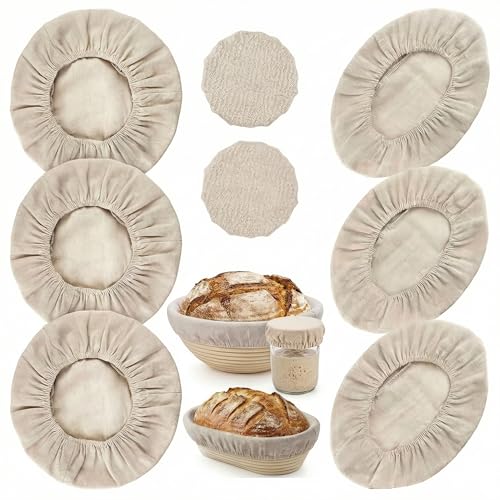
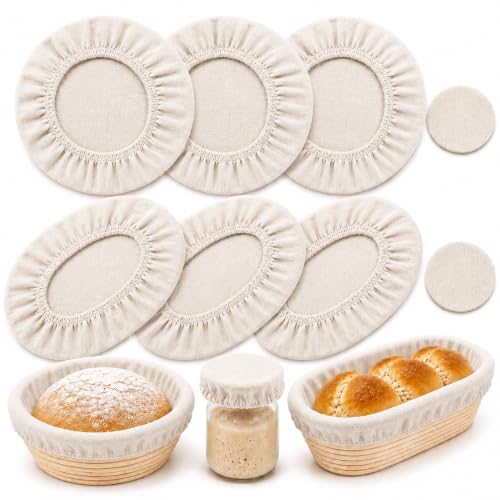
BEABOO puts it first, before any feature bullet: a note stating that baskets and glass jars are not included. For a first bread baking kit that is the sentence that saves an order. The set is eight pieces, six liners at 10 inches in three round and three oval, plus two elastic covers for sourdough starter jars, in a high density linen cotton blend the maker calls untreated.
Kemoterner sells what reads as the same set. Eight pieces, six 10 inch liners in three round and three oval, two sourdough starter jar covers, a textured linen cotton blend, elastic edges that wrap the basket rim. It never mentions a basket being absent. Between two listings for one configuration, only one tells a first time buyer what they still need to buy.
Two Cloths, Six Cloths, or a Hundred
Mozeat Lens is the smallest purchase here at two round 10 inch liners in untreated flax linen and cotton, and it is the only pick that states the liners are reversible, so each cloth has two usable faces. At 0.13 lb it is the lowest published weight on this page. Koackl ships six 9 inch liners in dense cotton with a textured finish, at 0.19 lb.
YUANSHAO is a different proposition entirely: 100 non woven liners in food grade PP, published at 0.75 lb, arriving in a reclosable airtight zipper lock bag. The listing calls them reusable or optional for replacement at any time, which is the only listing here that treats a liner as either. For a first kit that is a hundred chances to get the dusting wrong.
Cloth or Non Woven, and What Each Asks of You
Linen and Cotton Need Washing and Say So
Four of these five are woven fabric and three of the four publish a washing instruction. Koackl is the most specific, stating the liners are machine washable, to shake off excess flour, wash on a gentle cycle and air dry, and that they stay soft for the next bake. BEABOO says to wash before first use. Kemoterner says to wash before first use and after baking as needed.
Mozeat Lens says nothing about washing at all, which on untreated flax linen matters, because untreated linen is exactly the fabric that stiffens with dried dough if it is never washed. It does state that the cloths are reversible and eco friendly and that they replace disposable plastic wrap and foil. The care question is simply not addressed anywhere in the listing.
A Hundred Non Woven Liners Change the Question
YUANSHAO is food grade PP non woven, not cloth, and its case is stated directly: compared with a cloth liner, a non woven liner does not stick to a wet, high hydration dough. That is the real argument for it, and it is the dough a first time sourdough baker is most likely to be fighting with. The listing also states BPA free and food contact testing to US standards.
What it gives up is the textured surface a woven liner provides. Koackl builds its whole case on that, describing a dense cotton with a textured finish that creates a natural easy release surface once dusted with flour. So the two approaches are opposed: one avoids sticking by not being cloth, the other by being a particular kind of cloth, and both publish the claim and neither publishes a test.
Shapes, Sizes, and What a First Basket Usually Is
Three Round and Three Oval, or Six Round
BEABOO and Kemoterner are the only picks that include oval liners, three each alongside three round, which matters because a first sourdough purchase is often a round basket and a batard basket together. Koackl is six round liners at 9 inches. Mozeat Lens is two round liners at 10 inches. Neither covers an oval basket at all.
YUANSHAO sidesteps shape by being elastic, stating that it stretches to a maximum of 19 inches in diameter and satisfies various shapes or sizes of banneton. That is a genuine advantage for a baker who does not yet know what basket they will end up with, and it is also the reason its stated size is not the size of a cloth but the largest rim it will reach over.
Nine Inches, Ten Inches, and Which One a Beginner Owns
The two sizes on this page are 9 and 10 inches, and they are not interchangeable. Koackl is the only 9 inch pick, stated to fit standard round proofing baskets. BEABOO, Kemoterner and Mozeat Lens are all 10 inch. A liner cut for a 10 inch basket in a 9 inch one gathers and creases, and Koackl specifically claims less wrinkling or slipping during proofing.
The safest answer for someone who has not bought a basket yet is the elastic one, and the safest answer for someone who has is to measure the rim first. Nothing in any of these five listings gives a tolerance, so there is no published margin either side of 9 or 10 inches to work with.
Which One Fits Your Kitchen
A first order you do not want to get wrong. BEABOO, eight pieces of six 10 inch liners in three round and three oval plus two elastic jar covers, in an untreated high density linen cotton blend, with a note stating the basket is not included.
The same eight piece set with the washing spelled out. Kemoterner, six 10 inch liners in three round and three oval with two sourdough jar covers, in a textured linen cotton blend with elastic edges, washed before first use and after baking as needed.
A cloth you can put in the machine. Koackl, six 9 inch liners in dense cotton with a textured finish, machine washable on a gentle cycle and air dried, published at 0.19 lb, stated to resist wrinkling and slipping.
Two liners with two usable faces each. Mozeat Lens, two reversible 10 inch liners in untreated flax linen and cotton at 0.13 lb, the smallest purchase here. It publishes no washing instruction of any kind.
Wet dough and no basket yet. YUANSHAO, 100 food grade PP non woven liners stretching to a maximum of 19 in, published at 0.75 lb in a reclosable airtight zipper lock bag, stated not to stick to high hydration dough.
What We Could Not Verify
Every figure above comes from the maker’s own listing text. These are the things we went looking for and could not source in any of them.
- Only BEABOO states that the proofing basket is not included, and not one of the five includes one.
- BEABOO and Kemoterner publish no weight at all, for the liners or for the eight piece set.
- Mozeat Lens publishes no washing instruction, on a fabric it describes as untreated flax linen.
- YUANSHAO calls its liners reusable or replaceable and never says how many bakes one is expected to survive.
- Not one of the five publishes a fabric weight, a thread count or a thickness, so how much moisture each cloth will absorb is unstated.
- No listing gives a fit tolerance, so there is no published margin either side of the stated 9 or 10 inches.