How the Five Compare on the Numbers
The word braiser covers two unrelated pans. Lodge, CAROTE and Crock-Pot are enameled cast iron pots between about 3 and 5 quarts, made to go from hob to oven to table. COOKER KING is a tri-ply stainless saute pan at 5 quarts, and Winware is a 15 quart commercial brazier. The span from the smallest to the largest here is more than four times the capacity.
Weight does not follow capacity, and that is the most useful thing on this page. The 15 quart commercial pan publishes 11.6 lb. The 3.4 quart cast iron pot publishes 13.6 lb. Whatever you gain in heat retention from cast iron, you pay for in a pan that is heavier empty than a pan holding four times as much, which matters every time you lift it out of an oven.
The published dimension figures above are given in the order each listing publishes them, because not one of these five says which figure is the diameter and which is the height. On the Lodge pot the 14.4 inch figure is plainly the span across the handles rather than the pan, and on the Crock-Pot the 4 inch figure cannot be a width on a 5 quart pot. Treat all of them as a rough envelope, not as a measurement.
Cast Iron, Clad Steel, or Aluminum
The three cast iron pots
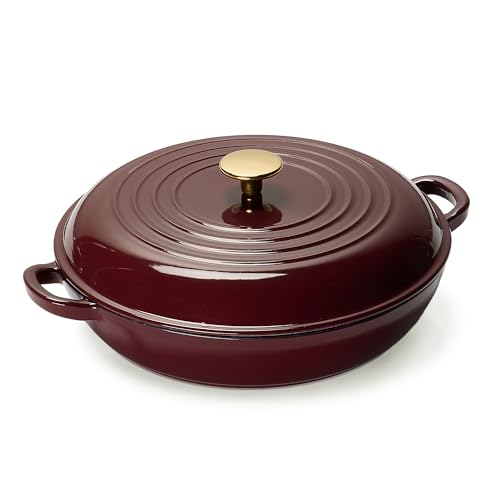
Lodge, CAROTE and Crock-Pot are the same idea executed three ways: iron for heat retention, enamel so it needs no seasoning, two handles because a full one is too heavy for one hand. Lodge and CAROTE both state explicitly that the porcelain surface removes the seasoning step, and both describe hand washing a smooth enamel rather than scrubbing bare iron.
Their published weights sit between 13.23 and 15 lb, which is a narrow band for pots of 3 to 5 quarts, and tells you the iron is thick on the small one rather than thin on the large one. Crock-Pot is the heaviest of the four that publish a weight at 15 lb, and it is also the largest of the three cast iron pots at 5 quarts.
The two metal pans
COOKER KING is a tri-ply clad stainless pan, and its argument is heat response rather than heat retention: it warms up fast and stays consistent, and it takes metal utensils without marking. It publishes the highest oven limit on this page, 900 F for the body with the lid rated to 400 F, where the CAROTE pot states 503 F, and it is the only one of the five with a rivet free interior so nothing catches food.
Winware is a different animal again, a 15 quart commercial brazier with 6 point riveted handles, NSF listing and a wide flat base built for browning in quantity with only a little liquid. At 11.6 lb it is the lightest of the four pans here that publish a weight, despite holding the most, which is exactly what commercial aluminum is for.
Lids, and What Each One Claims to Do
Three cast iron lids, three different claims
Braising is a lid problem more than a pan problem, and the three cast iron listings all know it. Lodge calls its lid moisture locking and ties that to broiling, braising, baking and roasting. Crock-Pot calls its lid self basting and describes a continuous basting environment. CAROTE is the most specific, naming a condensation design on the inner lid.
None of the three publishes anything measurable about it, so these are three descriptions of the same mechanism: steam condenses on the underside and falls back onto the food. What would separate them is whether the underside is ribbed, dimpled or smooth, and how well the lid seats, and none of the five says a word about either.
The two metal pans say nothing about their lids
Both metal pans ship with a lid and neither describes it. COOKER KING mentions its lid only to give it a separate oven rating of 400 F against the pan’s 900 F, which is useful information about a handle or a knob but says nothing about how it behaves during a long braise. Winware simply says with lid in its title.
For a pan being used as a rondeau on a hob, that may not matter much. For a braise, where the lid is doing half the work, it is a real gap, and it is the clearest reason to buy cast iron for this job even though the cast iron pots are heavier and publish fewer figures elsewhere.
Where These Listings Contradict Themselves
A brazier that is stainless and aluminum at once
The Winware listing calls the pan stainless steel in its title and then states in its own features that it is made from extra heavyweight 6 mm thick 3003 aluminum. Those are not the same metal, and 3003 is a specific aluminum alloy, so one of the two statements is simply wrong. The alloy detail in the feature text is the more likely one to be true, because nobody invents an alloy number.
The published weight supports the aluminum reading. This pan holds 15 quarts with 6 mm walls and publishes 11.6 lb, against the Crock-Pot’s 15 lb at 5 quarts and the CAROTE’s 13.6 lb at 3.4 quarts. Stainless of that wall thickness and that diameter would not come in under either of them. Treat the alloy number as the real specification and the title as loose, and confirm it with the seller if it matters to you.
Lodge publishes two capacities
The Lodge braiser is listed as 3.6 quart in its title and 3 quart in its size field, and both are the maker’s own words. That is a 20 percent disagreement about the single most important number on a braising pan, and there is no way to resolve it from the listing. Its published weight of 13.23 lb is consistent with either.
The practical answer is to plan around the lower of its two figures, 3 quarts, and to buy it for two or three people rather than four. CAROTE, Crock-Pot, COOKER KING and Winware each publish the same capacity twice, in the title and in the size field, at 3.4, 5, 5 and 15 quarts, so Lodge is the one pick where you have to pick which of the maker’s own numbers to believe.
Which One Fits Your Kitchen
A small braise you carry to the table. Lodge. Enameled cast iron with a moisture locking lid and dual assist handles, PFAS free, with a porcelain surface that needs no seasoning, at 13.23 lb. Note that its own listing gives two different capacities.
Searing before the liquid goes in. CAROTE. Enameled cast iron at 3.4 quarts in both its title and its size field, with a condensation design on the inner lid, a published oven limit of 503 F, and a porcelain surface ready to use with no seasoning.
A braise for four or more. Crock-Pot. Five quarts of enameled cast iron with a self basting lid and generously sized handles, hand wash recommended. At 15 lb it is the heaviest of the four that publish a weight, so plan where it lives.
Searing hot, then straight into the oven. COOKER KING. Tri-ply clad stainless at 5 quarts, with the highest oven limit published here at 900 F for the body against CAROTE’s 503 F, plus 400 F for the lid and a rivet free interior.
Browning in catering quantities. Winware. Fifteen quarts on a wide flat base with 6 point riveted handles and an NSF listing, published at 11.6 lb against the Crock-Pot’s 15 lb at 5 quarts, which is a third of the volume.
What We Could Not Verify
Six things a buyer would reasonably ask that these five listings never answer.
- The actual capacity of the Lodge pot, whose title and size field disagree.
- Whether the Winware pan is aluminum or stainless, since its listing says both.
- An oven temperature limit for the Lodge or the Crock-Pot pot, where CAROTE states 503 F.
- Which published figure is a diameter and which is a height, on any of the five.
- A published weight for the COOKER KING pan, the only one of the five without one.
- How any lid is finished underneath, which is the whole mechanism of a braise.