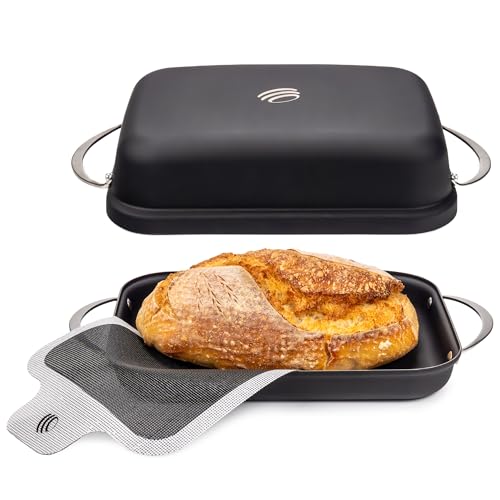
Brod & Taylor Ultralight Baking Shell for Sourdough ...
Publishes 1 pound of aluminum, a 550 F limit, and states that no preheating is required.
- Batard
- 1 lb
The deciding figure is published weight, because a first loaf means moving something very hot with dough inside it.
By the Lush Editorial Team·Researched & Compared
Five bread cloches compared on published weights, materials, temperature limits and what each one includes.
Publishes 1 pound of aluminum, a 550 F limit, and states that no preheating is required.

Ceramic at 6.5 pounds, sized for a loaf made with 3 cups of flour, with a 270 C ceiling.
Publishes 8.5 pounds of nitrided carbon steel over an aluminum core, with a sling included.

Publishes a built in oven thermometer and a water tray with a 9 quart enameled steel body.

Publishes 17.2 pounds of enameled cast iron, 11.8 inches across with a ridged shallow base.
| Model | Brand | Size (Capacity) | Weight | Best For |
|---|---|---|---|---|
| Brod & Taylor Ultralight Baking Shell for Sourdough ... | Brod & Taylor | Batard | 1 lb | Best for a first loaf |
| Emile Henry Ceramic Bread Cloche 13.2" x 11.2" x 7" | Emile Henry | 13.2" x 11.2" x 7" | 6.5 lb | Best for proofing and baking in one dish |
| Bulka Carbon Steel Dutch Oven for Bread Baking | Bulka | Large | 8.5 lb | Best cast iron alternative |
| LoafNest inTune Precision Baker : 9 qt (4+5) Multipu... | LoafNest | 4+5 quart | 15 lb | Best for seeing what the oven does |
| HAWOK Cast Iron Bread Oven with Cloche Lid | HAWOK | Dia.12" | 17.2 lb | Best heat retention in the group |
Publishes 1 pound of aluminum, a 550 F limit, and states that no preheating is required.
Ceramic at 6.5 pounds, sized for a loaf made with 3 cups of flour, with a 270 C ceiling.
Publishes 8.5 pounds of nitrided carbon steel over an aluminum core, with a sling included.
Publishes a built in oven thermometer and a water tray with a 9 quart enameled steel body.
Publishes 17.2 pounds of enameled cast iron, 11.8 inches across with a ridged shallow base.
Brod and Taylor publishes 1 pound and states no preheating is required, so nothing hot is lifted with dough in it. Emile Henry publishes 6.5 pounds of ceramic you can proof in, sized for a 3 cup flour loaf. Bulka publishes 8.5 pounds of nitrided carbon steel with a sling included. LoafNest adds a thermometer and water tray at 15 pounds. HAWOK publishes 17.2 pounds of enameled cast iron.
“The first loaf is a handling problem before it is a baking one.”
Lush Food & Drink
Two of these five answer the question. Brod and Taylor states that no preheating is required: you preheat a stone or steel, place the risen dough on it, cover with the shell, and remove the shell after 20 minutes to finish uncovered. Its listing contrasts this with 30 to 45 minutes of preheating a Dutch oven. Bulka states that it preheats in about 15 minutes. Emile Henry, LoafNest and HAWOK publish nothing.
That depends on your oven and your confidence, but the range here is unusually wide. Brod and Taylor publishes 1 pound, Emile Henry 6.5 pounds, Bulka 8.5 pounds, LoafNest 15 pounds and HAWOK 17.2 pounds. A 17.2 pound cast iron dome comes out of a hot oven twice per loaf, once to add the dough and once to uncover it, and the published weight is the only warning you get.
Each pick answers it differently. Emile Henry lets you proof the loaf directly in the cloche, so it is never moved. Bulka includes a silicone coated sling that lowers dough in and lifts the loaf out. LoafNest includes a stainless wire mesh tray for the same purpose. HAWOK publishes a shallow base it says lets you transfer dough without degassing it. Brod and Taylor avoids the problem entirely.
Only Emile Henry says, stating that its cloche is sized for a round loaf made with 3 cups of flour. LoafNest publishes volume instead, 9 quarts split as 4 in the base and 5 in the dome, with a 12 inch inner length. HAWOK publishes 11.8 inches across and Bulka publishes only 3.7 inches of interior headroom. For a starter kit, the flour figure is the most useful because recipes are written in flour.
Not one of these five does. Bulka explains why most clearly, stating that its nitrided carbon steel is hardened all the way through rather than coated, so there is nothing to season, chip or flake, and it stays rust resistant. The others are aluminum, ceramic, enameled steel and enameled cast iron, all of which are inert surfaces. That is one fewer thing to learn on a first bake.
Because the fields and the copy are filled in separately. Emile Henry publishes 13.2 by 11.2 by 7 inches in its own title and 5.2 by 4.41 by 2.76 inches in its dimension fields, which cannot be the same object. LoafNest publishes 15 pounds in its weight field and describes a fine tuned 12 lbs weight in a bullet. In both cases the maker's sentence is the more considered figure.
Specifications come from the manufacturers' own published listings. Lush Food & Drink may earn a commission if you buy through a link on this page, at no extra cost to you. How we research.
The first loaf anybody bakes in a cloche involves moving something very hot with dough in it, so for a first kit the published weight is a safety figure rather than a convenience one. These five span almost the whole possible range: Brod and Taylor publishes 1 pound, Emile Henry 6.5 pounds, Bulka 8.5 pounds, LoafNest 15 pounds and HAWOK 17.2 pounds.
Only two publish a temperature limit. Brod and Taylor states that its food safe aluminum withstands up to 550 F. Emile Henry states a maximum of 270 C and a minimum of -20 C. Bulka, LoafNest and HAWOK publish no ceiling, which for cast iron and steel is rarely a practical limit but is still a figure a beginner would like to see.
| Specification | Brod and Taylor | Emile Henry | Bulka | LoafNest | HAWOK |
|---|---|---|---|---|---|
| Published weight | 1 lb | 6.5 lb | 8.5 lb | 15 lb | 17.2 lb |
| Material | Food safe aluminum | Ceramic | Nitrided carbon steel, aluminum core | Enameled steel, 304 trays | Enameled cast iron |
| Preheating | None required, stated | not published | About 15 minutes, stated | not published | not published |
| Temperature stated | Up to 550 F | 270 C maximum, -20 C minimum | not published | not published | not published |
| Size in the maker’s words | 12.5 x 8 x 5.5 in | 13.2 x 11.2 x 7 in | 3.7 in of headroom only | 12 in inner length | 11.8 in across, 7.48 in tall |
| The published dimension fields | 12.5 x 5.5 x 5.5 in | 5.2 x 4.41 x 2.76 in | 11.3 x 11.3 x 5.2 in | 13.8 x 12.8 x 7.5 in | 12 x 14.8 x 7.7 in |
| Capacity stated | not published | A round loaf from 3 cups of flour | not published | 9 qt, 4 in the base and 5 in the dome | not published |
| What else is in the box | Doubles as a bread cover | Recipe and instruction booklet | Silicone coated sling | Oven thermometer, water tray, mesh tray | not published |
| Seasoning needed | No | No | No, hardened rather than coated | No, enameled | No, enameled inside |
| Cleaning as stated | A quick wipe | Dishwasher safe | Hand wash and dry | not published | Smooth enamel inner wall |
Two field rows contradict their own listings. Emile Henry publishes 5.2 by 4.41 by 2.76 inches in its fields against a stated 13.2 by 11.2 by 7 inches in its own title and text, so the fields are describing something else entirely. LoafNest publishes 15 pounds in its weight field while its own bullet describes a fine tuned 12 lbs weight, a three pound gap on the same product.
Brod and Taylor publishes 1 pound and builds its whole listing around the consequence. It states no preheating is required, contrasts that with 30 to 45 minutes of preheating a Dutch oven, and says you place risen dough on an already hot stone or steel and cover it with the shell. Nothing hot is lifted with dough in it, which for a first attempt removes the main hazard.
HAWOK publishes 17.2 pounds of enameled cast iron at 11.8 inches across and 7.48 inches tall, with a dome lid 3.8 inches high over a base 1.6 inches deep. That is a two handed lift at oven temperature, twice, and it is also the pick with the most heat retention. Both things follow from the same figure.
Bulka publishes 8.5 pounds and makes the comparison explicit, saying it is half the weight of a typical 15 to 20 pound cast iron pot with no loss of performance, using nitrided carbon steel over an aluminum core. It also states that the material heats faster than cast iron, that it preheats in about 15 minutes, and that a silicone coated sling is included for lowering dough in.
Emile Henry publishes 6.5 pounds of ceramic and takes the opposite approach to the dough handling problem: its bell shaped cover lets you proof the loaf directly in the cloche, so the dough never has to be transferred at all. LoafNest publishes 15 pounds and solves it with a stainless wire mesh tray that carries the dough in.
Every cloche here works by trapping the water the dough gives off. Emile Henry states that the lid traps steam to create an environment similar to a steam injected oven, giving a crunchy chewy crust. HAWOK states a tight fitting domed lid designed to trap and circulate steam for a crisp crust and maximum rise. Brod and Taylor states the shell traps steam and distributes heat evenly.
Bulka publishes a variation worth noting: a steam locking lid over a chamber it describes as wider than a classic Dutch oven, so the loaf has more room to spring. Nobody publishes a figure for any of this, because steam retention is not something these listings measure, so the descriptions are all there is to compare.
LoafNest is the only pick that adds steam rather than relying on the dough, and it publishes the hardware: a water tray in 304 stainless steel alongside a built in oven thermometer. Its listing frames both as removing guesswork about temperature and humidity, which are the two variables a beginner has no way to observe.
That is a genuinely different proposition from the other four, and it is the reason for the weight. A 9 quart enameled steel body with 4 quarts in the base and 5 in the dome, a mesh tray, a water tray and a thermometer is a system rather than a pot, and the 15 pound field figure is what a system costs to lift.
For a first setup, the extras decide how soon you bake something edible. LoafNest publishes the most: thermometer, water tray, wire mesh tray and full body side handles plus an oven proof top knob. Bulka publishes a silicone coated sling that lowers dough in and lifts the loaf out in one motion. Emile Henry publishes a recipe and instruction booklet.
Brod and Taylor publishes no accessory but a second use: the shell doubles as a bread dome for keeping a finished loaf on the counter. HAWOK publishes nothing beyond the lid and base, although its base has raised ridges that it says brown the loaf evenly and mark the crust.
None of these five needs seasoning, which is worth stating plainly because cast iron bread pots usually do. Bulka is the most specific about why, stating that nitrided carbon steel is hardened all the way through rather than coated, so there is nothing to season, chip or flake, and it stays rust resistant.
Emile Henry is the only pick stated dishwasher safe and it adds a ten year warranty and manufacture in France. Brod and Taylor says cleanup is a quick wipe, contrasting that with scrubbing and reseasoning cast iron. HAWOK describes an ultra smooth enameled inner wall, and Bulka asks only for a hand wash and a dry. LoafNest publishes no cleaning guidance at all despite having the most parts.
The first time sourdough baker. Brod and Taylor publishes 1 pound, the least weight here by a wide margin, no preheating requirement and a 550 F limit. Dough goes onto a hot stone and the shell goes over it, so nothing heavy and hot is ever carried with a loaf inside it.
The baker who wants to proof and bake in one dish. Emile Henry publishes 13.2 by 11.2 by 7 inches of ceramic at 6.5 pounds, sized for a round loaf made with 3 cups of flour, with a 270 C ceiling, dishwasher safety, a booklet and a ten year warranty.
The baker who wants cast iron results without the weight. Bulka publishes 8.5 pounds of nitrided carbon steel over an aluminum core, with a steam locking lid, a wider chamber and a silicone coated sling included. Nothing needs seasoning and nothing can flake.
The baker who wants to see what the oven is doing. LoafNest publishes a built in oven thermometer and a water tray alongside a 9 quart enameled steel body, 4 quarts in the base and 5 in the dome, and a 12 inch inner length. Its two published weights are 15 pounds and 12 lbs.
The baker who wants maximum heat retention. HAWOK publishes 17.2 pounds of enameled cast iron, 11.8 inches across and 7.48 inches tall, with a 3.8 inch dome over a 1.6 inch base and raised ridges to brown the bottom. Plan both hands and good mitts.
All of these figures come from the makers’ published text. Here is what is not in it.