How the Five Compare on the Numbers
Eight live pages already rank this pool: by blade retention, by published width and depth, by where each maker says the tool is stored, by what the tool is made of, by published weight, by where it lives between loaves, by how many blades arrive and where the next ones come from, and by the material each maker names. Two of those are about where the lame goes.
None is about what covers the edge once it gets there. A lame is a razor blade on a stick, and in a drawer that is the whole problem: one maker says so in its own words, calling a storage box safer than having the tool floating around in a drawer. These five answer it five different ways and only one of them leaves the mounted blade bare.
What the table cannot tell you is how well any cover fits, because not one of these five publishes a dimension for a case, a cover or a retracted blade. The figures on offer describe the tool with the blade mounted and exposed, which is the state none of these listings recommends storing it in, so the drawer figure does not exist on any of them.
Five Answers to a Loose Razor Blade
Two Tools Swallow the Blade
JACYAO’S publishes the cleanest mechanism and the reason for it: extend the blade, tighten the screw to hold it steady, then retract it after scoring, which the maker says reduces exposed-blade hazard. Nothing has to be found, fitted or kept, which is the failure mode of every cover. The blade also changes magnetically, by guiding it into a slot in the opened handle.
Aacehlh gets to the same place differently. Its grip and twist design is for changing blades, and the maker states the razor blade can be easily stored inside the lame when not in use. It also supplies a PU leather case, so it is the only listing here with both an internal home for the blade and an external home for the tool.
Two Cover It From Outside
Saint Germain publishes a hand-made, authentic protective leather cover under a heading that reads safe storage, the only bullet heading on this page written for the stored tool rather than the spares: Orblue’s equivalent heading promises safe blades and safer hands, and Bread Bosses calls its box safer than a drawer. The tool underneath is a hand crafted wood handle with a stainless steel stick that holds a standard razor blade, and ten are included with a lifetime warranty on replacements.
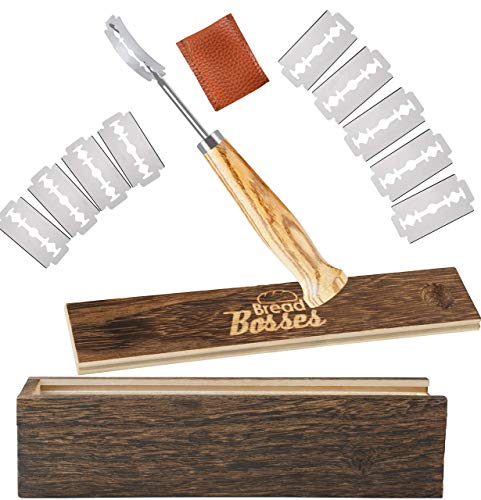
Bread Bosses supplies both halves and is the only listing on this page to do so: ten blades, a wooden storage box, and a blade cover included. A cover protects the edge and a box protects the whole tool, and the listing is explicit that the box is the point: safer than having the lame floating around in a drawer if you forget it is in there.
A Case for the Spares Is Not a Cover
What the Orblue Case Holds
Orblue publishes a snap-shut plastic case and a pouch, and reads at first like the best protected tool here. The bullet says what the case is for: keeping all 12 blades protected, clean and together. That is the spare blades, not the one in the tool, and nothing in the five bullets says the mounted blade is covered, retracted or stowed.
It is not a worse listing for that. It publishes twelve forged stainless steel blades, more than anyone else here, a smooth Kingly Wood handle, and the only washing instruction on this page, dishwasher safe. For a drawer it is simply the one tool of these five that goes in with its edge out unless you take the blade off first.
One Maker Names the Drawer
Bread Bosses is the only one of these five that argues about drawers at all, and it does it in the bullet listing the box: a storage box makes it safer compared to having it floating around in a drawer if you happen to forget it is in there. That sentence is why this page exists. No other pick raises the scenario, though the Ruansion lame elsewhere in this pool makes the same case for its ABS casing.
The same listing makes a second argument nobody else makes. It states that it does not have the three rings at the end of the handle its competitors use, because flour dries and sticks inside the rings. That is a cleaning claim on a page where only one of the five publishes a cleaning instruction at all, and it is about a part rather than a surface.
What the Figures Will and Will Not Tell You
Four Size Fields and One Length
The size fields on these five are not lengths. JACYAO’S reads 1.5 inches, Aacehlh 1.7 inches and Saint Germain 3.9 inches, on tools whose dimension fields run to 7.5 inches, so those figures are describing something else that no bullet identifies. Bread Bosses is the exception, reading 10 inches, which is at least the right order for a lame.
Its dimension fields then read 2.0 by 9.0 by 2.5 inches, so the size field and the depth field disagree by an inch. Both are plausible for a wooden handled lame and neither is confirmed by a bullet. We have used the fields, because the 2.5 inch figure is the one a drawer has to clear and the size field offers nothing to set beside it.
Wood Named and Wood Not Named
All five of these have wooden handles and the precision varies sharply. JACYAO’S names American black walnut and pairs it with 304 stainless steel for the retractable mechanism. Orblue names Kingly Wood. Saint Germain says hand crafted wood with a stainless steel stick, Bread Bosses says good quality wood, and Aacehlh says wood.
That matters for a drawer because wood and water do not mix and only one of these five publishes a washing instruction. Orblue states dishwasher safe on a tool with a wooden handle, which is an unusual claim, and the other four publish nothing, so a wet lame going back into a drawer is a question none of them answers.
Which One Fits Your Kitchen
You want the box and the cover. Bread Bosses. Ten blades, a wooden storage box and a separate blade cover, published at 2.0 by 9.0 by 2.5 inches, and the only one of these five that names a drawer as the hazard.
You will never find a cover again. JACYAO’S. The blade retracts into the tool after scoring, held by a screw while extended, in American black walnut and 304 stainless at 1.9 by 2.5 by 0.47 inches.
You want both, inside and out. Aacehlh. The razor stores inside the lame when not in use and a PU leather case holds the whole tool, with ten blades, at a weight field of 0.13 lb.
You want the blade guaranteed. Saint Germain. A hand crafted wood handle with a protective leather cover, ten standard razor blades, and a lifetime warranty on replacements, at 0.06 lb.
You want the most blades and a dishwasher. Orblue. Twelve forged stainless blades in a snap-shut case with a pouch, a Kingly Wood handle, dishwasher safe. The mounted blade is not covered.
What We Could Not Verify
These are the specifications we went looking for in all five listings and did not find.
- Any dimension for a case, a cover or a retracted blade, from any of the five.
- Whether the Orblue mounted blade is covered at all, since its case is stated to hold the spares.
- What the size fields of 1.5, 1.7 and 3.9 inches are measuring on tools whose other figures run to 7.5 inches.
- Why the Bread Bosses size field says 10 inches when its depth field says 9.0.
- A washing instruction from four of the five, all of which have wooden handles.
- Any dimension at all for the Aacehlh lame, which publishes only a 1.7 inch size field.