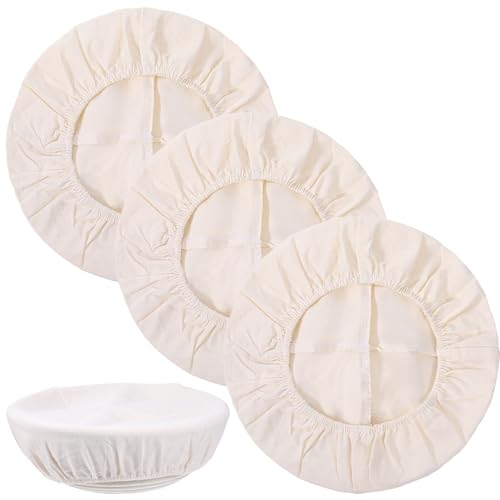
How the Five Compare on the Numbers
Nothing is live on this pool yet, so this page sets the terms. A proofing cover has no footprint of its own in any useful sense: it is a disc of fabric that folds to nothing. What it does have is a published diameter span, and in a kitchen short of storage that span is the specification, because one cover that fits three bowls is two fewer objects to own.
All five of these publish a span and they do not line up. One reaches down to 5 inches and the rest start at 7 or 8. One covers nearly the same range with two objects where the others use three. Two of the five go further and publish the individual bowl sizes, which is the difference between a span and an answer.
What the table cannot tell you is how far a stretched cover actually seals. Every span here is an elasticity claim, and a cover at the top of its range is pulled tight with very little skirt left to grip the rim, which is exactly when a cover slides off a bowl of rising dough overnight. None of these five says how much of its range is comfortable and how much is the limit, and a reader buying at the top of a span is buying the limit.
Where the Spans Separate
The Only Set That Covers a Jar
wegreeco publishes 5 to 12 inches across its three covers, and that 5 inch figure is the one nothing else on this page offers. KIBAGA and Perenllareta both begin at 7 inches, fufeisi and Xelsluthe at 8. A sourdough starter jar, a small cereal bowl or a jam jar lives below all of them, and in a kitchen that will only own one set of covers that gap is the decision.
It is also the lightest purchase here at a 0.13 lb weight field for three covers, with a lining the maker calls highly leak-free and container materials named explicitly: smooth rimmed stainless steel, glass, plastic and ceramic. Against all that it publishes no washing instruction of any kind and names no fabric beyond the word fabric, which on a product that will spend its life covered in dough is the weakest documentation on this page.
Two Objects Rather Than Three
fufeisi is the other end of the same argument. It covers 8 to 13 inches with two covers rather than three, which for a kitchen with one drawer is a real advantage: one fewer thing to find, fold and lose, for almost the same reach at the top of the range. Published as 12 inch covers in 100 percent cotton coated with food-grade beeswax.
What it gives up is the bottom. Nothing below 8 inches is covered, so the same jar that wegreeco handles is uncovered here. Its care instruction is the most restrictive on the page and the most specific: hand wash in cold water with mild soap, air dry, and avoid high temperatures and direct sunlight to maintain performance. Beeswax is the reason, and the listing is the only one that admits a maintenance condition at all.
A Span, or an Answer
Nine Sizes Instead of a Range
Perenllareta is the only listing of the five that publishes individual bowl sizes: Small for 7, 8 and 9 inch bowls, Medium for 9, 10 and 11, Large for 11, 12 and 13. Nine figures across three covers. A reader with a 10 inch mixing bowl gets an unambiguous answer, where every other listing here gives a span and leaves the overlaps to guesswork.
Its other distinctive feature is the liner, a waterproof PUL layer stated to lock moisture in while still letting the dough breathe slightly, with a clean release surface so dough does not tear even when it rises to the top of the cover. It also publishes the fullest washing routine on this page: wipe clean with a damp cloth, machine washable in cold water, and dishwasher safe, which only this pick claims.
A Cover That Publishes Its Own Diameter
Xelsluthe covers 8 to 11 inches, the least reach of these five, and is the only pick that publishes a figure for a single cover alongside it: 10.23 inches. It is also the only listing on this page that makes a storage claim at all, stating that the covers fold neatly for space-efficient storage, which on a compact kitchen page is the specification the other four leave out entirely.
Its carton supports that claim better than any sentence could. Published at 10.24 by 10.24 by 0.04 inches, it is essentially its own stated cover diameter lying flat, which is what three folded cotton discs should measure. The listing’s weakness is a bullet that breaks off mid sentence, offering both durability and then nothing, so whatever the second benefit was never arrives.
Breathable, Sealed, or Both at Once
Three Theories of What a Cover Is For
This pool has not settled its central question and these five listings prove it. fufeisi and Xelsluthe both sell breathability and both name plastic as the problem, fufeisi crediting beeswax-coated cotton with keeping dough from drying out, hardening or getting damp, and Xelsluthe describing airflow as the point rather than a side effect.
wegreeco argues the opposite, selling a highly leak-free lining to keep moisture in. Perenllareta tries to have both, with a waterproof PUL liner that it says still allows the dough to breathe slightly, which is a hedge rather than a specification. KIBAGA, the only pick that names its full blend of viscose, linen, cotton and polyester, says nothing about airflow in any direction.
The One Washing Figure
KIBAGA is the only listing among these five to put a number on washing: machine washable at 86 F. That matters more than it sounds, because a cover that comes out of a hot wash shrunk is a cover whose published span is no longer true, and the span is the entire specification on this page.
Four of the five publish a method of some kind and only KIBAGA publishes a temperature. Perenllareta and fufeisi both recommend cold water without a figure, Xelsluthe says machine washable and air dry, and wegreeco publishes nothing. Several other listings in this pool are plastic shower caps rather than fabric covers, and one of those publishes a thickness in microns, which is more material detail than any fabric pick here offers.
Which One Fits Your Kitchen
You proof in a jar as well as a bowl. wegreeco, the only set here reaching down to 5 inches, spanning 5 to 12 across three covers at a 0.13 lb weight field. Accept that no washing method is published.
You want to match covers to the bowls you own. Perenllareta. Nine individual sizes from 7 to 13 inches, a waterproof PUL liner, and the only dishwasher claim on this page.
The covers will be washed often. KIBAGA, the only pick with a washing temperature at 86 F, spanning 7 to 13 inches across three, with the full fabric blend named.
One drawer, and bowls no smaller than eight inches. fufeisi. Two beeswax cotton covers spanning 8 to 13 inches, so there is one fewer thing to store. Hand wash only, away from heat and sunlight.
Folding flat matters more than reach. Xelsluthe, at 8 to 11 inches with a 10.23 inch cover figure, the only storage claim here, and a carton barely thicker than the fabric itself.
What We Could Not Verify
These are the specifications we went looking for in all five listings and did not find.
- Any washing method from wegreeco, which publishes a span and a lining and no instruction.
- Whether the KIBAGA blend breathes. It names four fibers and never addresses airflow.
- An individual cover diameter from wegreeco, KIBAGA or fufeisi, which is three of these five sets.
- A washing temperature from four of the five. Only KIBAGA publishes one.
- How much of any published span is a comfortable fit rather than the limit of the elastic.
- What the Xelsluthe material bullet was going to say. It offers both durability and then stops.