Lush Food & Drink

Buying Guide ·Knives

Best Butcher Blocks for Carving and Everyday Prep

The deciding specification is the wood itself, and one of these five listings never names its species at all.

By the Lush Editorial Team·Researched & Compared

  • Researched & ComparedSpecs pulled from the manufacturer listing
  • Like-for-LikeSame measures across every model
  • No Paid PlacementsNobody pays to appear here

I compared named wood species, grain direction, published sizes, thickness figures and weights, juice drainage and stability features across five butcher blocks, using each maker's own listing text.

Our shortlist

Five products, one set of published numbers.
  1. 30 x 20 Extra Large Bamboo Cutting Board for Kitchen
    Best for covering a hob or a sink

    30 x 20 Extra Large Bamboo Cutting Board for Kitchen

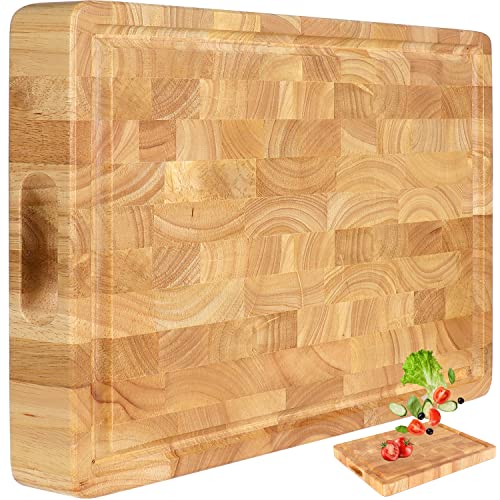
    Thirty by 20 inches of FSC certified bamboo an inch thick, with grooves around the board, a well with a spout for pouring off liquid, and built in handle holes.

    • HIWARE
    • 30"L x 20"W
    • 13.4 lb
  2. American Walnut Wood Cutting Board
    Best for sliding produce into a pot

    American Walnut Wood Cutting Board

    American black walnut, end grain, 1.7 inches thick, with a notch and a plate for sliding chopped food off, seasoned and pre-oiled with an oil bottle included.

    • BABILONIA
    • 15.7"L x 10.2"W
    • 6.79 lb
  3. End Grain Cutting Board
    Best for prepping and holding at once

    End Grain Cutting Board

    End grain at 17 by 13 inches and 1.5 inches thick, with a carved juice groove on one face and built in compartments on the other, plus handles cut into the sides.

    • FANICHI
    • 17"L x 13"W
    • 6 lb
  4. Nomsters 24 x 18 in Teak Cutting Board
    Best for carving a brisket

    Nomsters 24 x 18 in Teak Cutting Board

    Teak at 24 by 18 inches with a deep perimeter groove and an enlarged center drainage area, four corner feet for stability and airflow, and hand grips.

    • Nomsters
    • 24"L x 18"W
    • 11.46 lb
  5. Ironwood Gourmet
    Best for a block that stays on the counter

    Ironwood Gourmet

    End grain acacia in a 14 inch square 1.25 inches thick, designed by a restaurateur in North Carolina and made in Thailand from sustainably harvested wood.

    • Ironwood Gourmet
    • 14"L x 14"W
    • 4 lb

Side by side

Blank means the maker does not publish it.
ModelBrandSize (capacity)WeightBest for
30 x 20 Extra Large Bamboo Cutting Board for Kitchen HIWARE 30"L x 20"W 13.4 lb Best for covering a hob or a sink
American Walnut Wood Cutting Board BABILONIA 15.7"L x 10.2"W 6.79 lb Best for sliding produce into a pot
End Grain Cutting Board FANICHI 17"L x 13"W 6 lb Best for prepping and holding at once
Nomsters 24 x 18 in Teak Cutting Board Nomsters 24"L x 18"W 11.46 lb Best for carving a brisket
Ironwood Gourmet Ironwood Gourmet 14"L x 14"W 4 lb Best for a block that stays on the counter

Each pick in detail

What the listing says for it, and against it.
1 Best for covering a hob or a sink

30 x 20 Extra Large Bamboo Cutting Board for Kitchen

Thirty by 20 inches of FSC certified bamboo an inch thick, with grooves around the board, a well with a spout for pouring off liquid, and built in handle holes.

  • For it
  • Thirty by 20 inches, the largest surface on this page by a wide margin
  • The only drainage system here with a well and a spout as well as grooves
  • FSC certified bamboo, the only certification cited by any of the five
  • Built in handle holes, and it arrives pre-oiled and ready to use
  • Against it
  • One inch of published thickness, the lowest figure here, on the largest board
  • The heaviest of the five at 13.4 lb
  • Never states whether it is end grain, edge grain or face grain
2 Best for sliding produce into a pot

American Walnut Wood Cutting Board

American black walnut, end grain, 1.7 inches thick, with a notch and a plate for sliding chopped food off, seasoned and pre-oiled with an oil bottle included.

  • For it
  • 1.7 inches of published thickness, the largest figure on this page
  • Names its wood precisely, American black walnut grown in America
  • A notch and a plate for sliding chopped produce straight into a pot
  • Arrives seasoned and pre-oiled with an oil bottle, and carries a 2 year warranty
  • Against it
  • No juice groove at all, so it is a chopping block rather than a carving board
  • 15.7 by 10.2 inches is the smallest usable surface of the five
  • Only a hidden handle on the reverse, with no grips and nothing about feet
3 Best for prepping and holding at once

End Grain Cutting Board

End grain at 17 by 13 inches and 1.5 inches thick, with a carved juice groove on one face and built in compartments on the other, plus handles cut into the sides.

  • For it
  • Two working faces, a carved juice groove on one and compartments on the other
  • Handles cut into the inner sides, unusual on a board of this size
  • 1.5 inches of published thickness, second only to the walnut block here
  • At 6 lb it is light enough to lift and turn with one hand
  • Against it
  • Never names its wood species anywhere in the listing
  • No care instructions of any kind published
  • No feet, and nothing published about oiling or seasoning
4 Best for carving a brisket

Nomsters 24 x 18 in Teak Cutting Board

Teak at 24 by 18 inches with a deep perimeter groove and an enlarged center drainage area, four corner feet for stability and airflow, and hand grips.

  • For it
  • A deep perimeter groove with an enlarged center drain, built for carving meat
  • The only board here with feet, four of them at the corners
  • The only listing that addresses bending, warping and cracking directly
  • Teak, named, with its natural oils cited for moisture resistance
  • Against it
  • Publishes 1.26 inches while its own text says a 1.25 inch profile
  • No care instructions published, on a wood board that needs oiling
  • Does not arrive oiled, or does not say so
5 Best for a block that stays on the counter

Ironwood Gourmet

End grain acacia in a 14 inch square 1.25 inches thick, designed by a restaurateur in North Carolina and made in Thailand from sustainably harvested wood.

  • For it
  • The lightest of the five at 4 lb, and easy to move and store
  • End grain acacia, named, with the grain contrast described
  • The clearest care instructions here: hand wash, towel dry, oil periodically
  • A 14 inch square, so it works in either orientation on a small counter
  • Against it
  • No juice groove, so carving a joint means juice on the counter
  • The smallest surface area on this page after the walnut block
  • No handles, no grips and no feet published

Our verdict

HIWARE is 30 by 20 inches of FSC bamboo, the largest surface here, at 13.4 lb. BABILONIA publishes 1.7 inches of thickness in American black walnut, the largest thickness figure on this page. Nomsters is teak with a deep groove, a center drain and the only corner feet. Ironwood Gourmet is end grain acacia and the lightest at 4 lb. FANICHI never names its wood.

“A board that never names its wood is not a spec.”

Lush Editorial Team

What separates these five

Wood Walnut, teak, acacia and FSC bamboo are all named. FANICHI never names its species at all.
Size and thickness HIWARE 30 by 20 at 1 in, Nomsters 24 by 18 at 1.26, FANICHI 17 by 13 at 1.5, BABILONIA 15.7 by 10.2 at 1.7, Ironwood 14 by 14 at 1.25.
Weight HIWARE 13.4 lb, Nomsters 11.46, BABILONIA 6.79, FANICHI 6, Ironwood Gourmet 4.
Juice A well and a spout, a deep groove with a center drain, a single carved groove, and two boards with none.
Staying put Only Nomsters publishes feet. The other four publish nothing at all.

How we chose

Priorities, not a computed score. The inputs are published specifications, so we rank by what matters most and say how much.

  1. 30% The wood, actually namedHardness, oil content and how a surface ages all follow the species, and one listing here never says.
  2. 25% Thickness against surface areaHIWARE publishes 1 inch of thickness across 30 by 20 inches, which is where bowing comes from.
  3. 20% Juice drainageCarving a joint is the job that separates these boards, and two of the five have no groove at all.
  4. 15% Handling and stabilityAt 11 or 13 pounds a board needs grips, and only one of the five has feet.
  5. 10% Care and sourcingOnly two listings say how to look after the board, and only one cites a certification.

How the Five Compare on the Numbers

This is a rare category where the published figures can be trusted. All five size fields agree with the sizes each maker states in its own words, so 30 by 20 inches means 30 by 20 inches. That makes the comparison unusually clean: what separates these boards is the wood, the published thickness, and how each one handles the juice that comes off a joint of meat.

One board was left off. The sixth listing in this pool is a 24 by 18 inch bamboo board an inch thick, and its published weight sits two orders of magnitude below the 11.46 lb Nomsters publishes for a teak board of the same footprint. It was also the only one of the six with non slip rubber feet and a stated five layer construction. When the one figure a page could build on is that wrong, the rest is not safe to use.

Specification HIWARE BABILONIA FANICHI Nomsters Ironwood Gourmet
Wood named FSC certified bamboo American black walnut not published Teak Acacia
Grain stated not published End grain End grain End grain End grain
Size published 30 by 20 in 15.7 by 10.2 in 17 by 13 in 24 by 18 in 14 by 14 in
Published thickness 1 in 1.7 in 1.5 in 1.26 in 1.25 in
Published weight 13.4 lb 6.79 lb 6 lb 11.46 lb 4 lb
Juice drainage Grooves around the board and a well with a spout not published A carved groove on the front face A deep perimeter groove with an enlarged center drain not published
Reverse side not published A notch and a plate for sliding food off Built in compartments not published not published
Handles Built in handle holes A hidden handle on the reverse Inner side handles Hand grips not published
Feet not published not published not published Four corner feet not published
Arrives oiled Stated pre-oiled Seasoned and pre-oiled, oil bottle included not published not published not published
Sourcing claim FSC certified Sustainable, grown in America Responsibly sourced not published Sustainably harvested
Care instructions Stated easy to maintain Mild soap, hand wash, no dishwasher not published not published Hand wash, towel dry, oil periodically
Warranty stated not published 2 year with money back not published not published not published
Where it is made not published Walnut grown in America, brand from Italy not published not published Designed in North Carolina, made in Thailand

What the table cannot tell you is how any of these boards was glued, which is what decides whether an end grain board opens up along a seam after a year of washing. Nobody names an adhesive or a food safe glue standard. Nor does any listing state a maximum soak time or say what happens if a board is left wet, which is the single most common way a wooden board is ruined.

What the Wood Actually Is

Four species named, one not

BABILONIA names American black walnut and says it is grown in America. Nomsters names teak and points to its natural oils for moisture resistance. Ironwood Gourmet names acacia and describes the light to dark contrast in the grain. HIWARE names FSC certified bamboo. Four listings out of five tell you what you are cutting on.

FANICHI does not. Its listing says premium end grain wood, 100 percent natural wood, and responsibly sourced natural wood, and never names a species anywhere. On a board where hardness, oil content and how the surface ages all depend on the species, that is the one specification a buyer cannot do without, and it is missing on the only board here with compartments cut into its reverse.

Bamboo is not the same purchase

HIWARE is bamboo, which is a grass rather than a hardwood, and it behaves differently in every way that matters. It is harder than walnut, which is good for the board and worse for your knife edge, and it is more prone to splitting along its laminations than a solid hardwood is. Its own listing leans on FSC certification and size rather than on any wood property.

What bamboo buys you is area for the weight. HIWARE is 30 by 20 inches, easily the largest surface on this page, at a published 13.4 lb. Nomsters in teak is 24 by 18 inches at 11.46 lb, so the teak board is carrying nearly as much weight over a noticeably smaller surface. If you want a board that covers a hob or spans a sink, bamboo is how you get there.

Thickness Against Surface Area

The large boards are the thin ones

The two largest boards here are also among the thinnest. HIWARE is 30 by 20 inches and 1 inch thick, the lowest thickness figure on the page, and Nomsters is 24 by 18 inches at a published 1.26 inches, described in its own text as a 1.25 inch profile. Both are wide enough for a whole turkey or a full brisket, and both are thin for their span.

Thickness on a long board is about resisting bowing rather than about durability. Nomsters is the only one of the five that addresses it, stating that its thicker profile helps reduce bending, warping and cracking over time, and adding four corner feet so air reaches the underside. HIWARE says nothing about warping at all, on the largest board here at its lowest thickness.

The small boards are the thick ones

BABILONIA publishes 1.7 inches, the largest thickness figure on this page, on a board 15.7 by 10.2 inches. FANICHI publishes 1.5 inches at 17 by 13 inches. Ironwood Gourmet publishes 1.25 inches on a 14 inch square. These are blocks rather than boards: you chop on them rather than carry food about on them.

Weight follows. Ironwood Gourmet is the lightest of the five at 4 lb, FANICHI is 6 lb and BABILONIA 6.79 lb, so all three are liftable with one hand, which the two large boards are not. For a small counter, a thick block that does not move while you work beats a large board you have to clear space for.

Grooves, Compartments and Staying Put

Four different answers to juice

Nomsters is built for carving. It has a deep perimeter groove with an enlarged center drainage area, and its listing is specific that this is for capturing juices from meat. HIWARE goes further in engineering terms, with grooves around the board plus a separate well and a spout so you can pour the collected liquid off rather than tip the board.

FANICHI carves a single groove into one face and leaves the other face flat with compartments in it, which is a genuinely different idea: prep on the back, carve on the front. BABILONIA and Ironwood Gourmet publish no groove at all. BABILONIA instead has a notch and a plate that let you slide chopped produce straight into a pot, which suits vegetables rather than meat.

Handles, feet and friction

Four of the five publish somewhere to hold. HIWARE has built in handle holes, FANICHI has handles cut into the inner sides, and Nomsters has hand grips. On boards of 11.46 and 13.4 lb that is not a luxury. BABILONIA names a hidden handle on its reversible face, which it presents as part of a serving tray rather than a carry point. Ironwood Gourmet publishes none at all, which is more defensible at 4 lb.

Only Nomsters addresses the board moving, with four corner feet that also lift it clear of the counter so the underside dries. The board that was left off this page was the only other one with any anti slip feature, and its published weight ruled it out. On the other four, a damp cloth underneath is the answer nobody wants to print.

Which One Fits Your Kitchen

A small kitchen that needs the counter back. HIWARE. Thirty by 20 inches of FSC certified bamboo an inch thick, with grooves around the board, a well and a spout, and built in handle holes, sold to cover a hob or span a sink. At 13.4 lb it is the heaviest of the five.

Chopping vegetables straight into a pot. BABILONIA. American black walnut, end grain, 1.7 inches thick, which is the largest thickness figure here, with a notch and a plate for sliding produce off, seasoned and pre-oiled with an oil bottle and a 2 year warranty.

Prepping and holding in one place. FANICHI. End grain at 17 by 13 inches and 1.5 inches thick, with a carved juice groove on one face and built in compartments on the other, plus handles cut into the sides. It never names its wood species.

Carving a brisket or a turkey. Nomsters. Teak at 24 by 18 inches with a deep perimeter groove and an enlarged center drainage area, four corner feet for stability and airflow, hand grips, and the only listing that addresses warping directly.

A block that lives on the counter. Ironwood Gourmet. End grain acacia, a 14 inch square 1.25 inches thick and the lightest here at 4 lb, designed by a restaurateur in North Carolina, with care instructions that say hand wash, towel dry and oil periodically.

What We Could Not Verify

Six things a buyer would reasonably ask that these five listings never answer.

  • What wood the FANICHI board is made from, which it never names.
  • Whether any board uses a food safe glue, and to what standard.
  • Whether HIWARE’s bamboo board is end grain, edge grain or face grain.
  • Groove capacity in any unit, on the three boards that have one.
  • Whether four of the five do anything at all to stop the board sliding.
  • How often any maker expects the board to be re-oiled, beyond periodically.

Frequently asked questions

What does butcher block actually mean here?+

Properly it means end grain construction, where the wood is stood on end so the knife cuts into the fibers rather than across them. Four of these five state end grain: BABILONIA, FANICHI, Nomsters and Ironwood Gourmet. HIWARE never says, describing its board only as FSC certified bamboo with additional thickness. If end grain is what you are paying for, that omission matters on the largest board here.

Which of these is best for carving a roast?+

Nomsters, on the published features. It has a deep perimeter groove with an enlarged center drainage area, which its listing ties specifically to capturing juices from meat, plus hand grips and four corner feet so a loaded board stays put. HIWARE is the alternative if quantity matters more, with grooves around the board and a well with a spout so you can pour the liquid off rather than tip 13.4 lb of bamboo.

Is bamboo a good surface for knives?+

It is harder than most hardwoods, which cuts both ways. A bamboo board resists scoring better and dulls an edge faster, and it is laminated rather than solid so it can split along a glue line. HIWARE sells its board on size and FSC certification rather than on any claim about knives. The other four are wood rather than laminated bamboo: walnut, teak, acacia, and the FANICHI board that never names its species.

How thick does a butcher block need to be?+

Thickness matters most on a long board, because that is what stops it bowing. BABILONIA publishes 1.7 inches, the largest figure here, on a board 15.7 by 10.2 inches. HIWARE publishes 1 inch on a board 30 by 20. Nomsters is the only listing that connects the two, saying its thicker profile helps reduce bending, warping and cracking, and adding feet so the underside can dry.

Do any of these arrive ready to use?+

Two say so. BABILONIA arrives seasoned and pre-oiled and includes a bottle of organic oil, and HIWARE states that it arrives pre-oiled and is ready for immediate use. FANICHI states nothing about oil at all, and Nomsters cites only the natural oils in teak rather than oiling the board. Ironwood Gourmet does not claim to arrive oiled but gives the clearest care instructions of the five: hand wash with warm soapy water, towel dry promptly, and oil periodically.

Why was one board left off this page?+

Because its published weight cannot be the board's own. The sixth listing in this pool is a 24 by 18 inch bamboo board an inch thick, and the weight in its listing sits about two orders of magnitude below the 11.46 lb Nomsters publishes for a teak board of the same 24 by 18 inch footprint. It was also the only board in the pool with non slip rubber feet, which is a genuine loss to this comparison.

Specifications come from the manufacturers' own published listings. Lush Food & Drink may earn a commission if you buy through a link on this page, at no extra cost to you. How we research.