How the Five Compare on the Numbers
Sixteen listings sit on the fact sheet for this pool and almost every one of them sells the same two sentences: a 12 inch plate and hidden ball bearings for smooth rotation. Smooth rotation is easy to publish. What separates these stands in a kitchen is the opposite property, which is how well the base refuses to move while the plate is turning, and how heavy the whole thing is to move on purpose.
Four of these five publish a grip of some kind, in silicone or rubber. One publishes none. One of the five goes further and says the plate itself can be held fixed while you letter a cake, which is the only brake described anywhere on this page. Between the heaviest and the lightest of these stands there is more than seven pounds.
What the table cannot tell you is how much cake any of these will carry, because not one of the five publishes a bearing load or a plate thickness. It also cannot settle the diameters: two of these listings each publish two different figures, and in both cases the title and the fields disagree by more than rounding would explain.
What Keeps the Stand From Moving
Grip in Three Places
RFAQK publishes the most complete answer. Its first two bullets name a non-skid rubberized bottom for stability on countertops, rubber feet, and a non-slip surface on the plate itself, so both the stand against the counter and the cake against the plate are addressed. Everything else about that listing is ordinary, and this one detail is not.
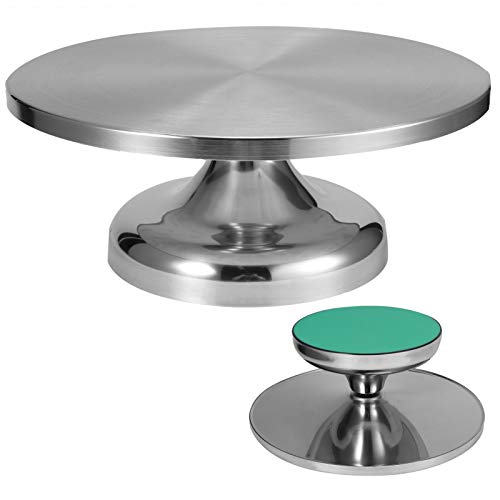
Ateco takes the single point approach and states it precisely: the base has a non-slip silicone cap to eliminate unwanted sliding on countertops, under an aluminum base and turntable on stainless steel ball bearings. At 4.8 lb it is heavy enough to help itself, which on a counter is the quiet half of staying put.
Mass Where There Is No Grip
TOTITOM and ZHUOJIA both publish a silicone layer underneath and then rely mostly on being heavy. TOTITOM publishes 7.78 lb of 304 stainless with a silicone anti-slip pad, and ZHUOJIA 7.71 lb with a non-slipping silicone bottom and a bearing it says turns both ways without noise. Neither is going to slide anywhere.
That mass is a fair trade for some kitchens and the wrong one for others. Nearly eight pounds of steel stays where it is put and takes two hands to carry to a sink, and neither listing publishes a handle, a lip or an undercut to lift by. For a kitchen where lifting is the constraint rather than sliding, that is the specification that matters.
The Light Plate and the Marked Plate
0.57 Pounds, and Nothing Holding It Down
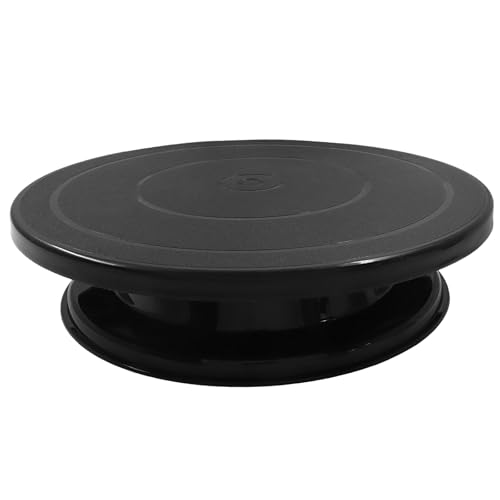
Bonsicoky publishes the opposite profile: an 11 in plastic plate at 0.57 lb, carried in one hand, wiped or rinsed clean with no submersion warning. For anyone who finds a heavy stand hard to move between a cupboard and a counter, that figure is the most useful one on this page.
What the listing does not publish is any floor grip. There is no pad, no feet and no silicone anywhere in its bullets, and it still claims the cake stays firmly in place while the plate spins. On a light plate that claim rests on the bearing and the surface alone, and the listing offers nothing to check it against.
Circles Etched at Seven, Eight and Nine Inches
The same listing has the one feature here that makes a real difference to reach. Its plate carries etched concentric circles at 7, 8 and 9 in, published as a way to center cake layers precisely for even frosting. Centering a layer by eye means leaning over the cake from several angles, and a marked plate replaces that with a glance from one position.
No other pick on this page publishes a guiding mark of any kind. For a kitchen where bending and reaching are limited, the combination of 0.57 lb and etched circles is worth more than a heavier stand’s grip, provided the counter is dry and level.
Figures That Contradict Themselves
Two Diameters, Twice
TOTITOM publishes 12 in in its title and its bullets, and 11.8 in in its size field. ZHUOJIA publishes 11.8 in and 30 cm in its title, and 13.58 in in both dimension fields. In both cases the difference is too large to be rounding, and in both cases the maker’s own sentence is the figure this page uses.
Ateco does the same thing with height. Its third bullet states that the turntable measures 12 inches in diameter and stands 4 inches high, while its dimension field reads 5.0 in. A cake decorator plans a working height around that figure, so the difference is not academic, and again the bullet is the figure to trust.
A Weight That Cannot Be Right
RFAQK publishes 1.0 lb for a 12 in aluminum alloy stand measuring 7 by 12 by 5 in. The Ateco stand on this page publishes 4.8 lb for an aluminum base and turntable of the same 12 in diameter. A plate and base of the same metal and size cannot weigh a fifth of the Ateco, so the figure is quoted here and nothing on this page is ranked by it.
That matters more on this page than it would elsewhere, because weight is doing two jobs at once: it is what keeps a stand still and it is what makes a stand hard to lift. With the RFAQK figure set aside, the honest spread across these five runs from 0.57 lb of plastic to 7.78 lb of stainless steel.
Which One Fits Your Kitchen
A hand that needs to rest on the plate. TOTITOM, 304 stainless with a silicone pad, turning both ways and stated to be held in place for lettering, at 7.78 lb. It never says how the plate is fixed.
A counter that gets slippery. RFAQK, aluminum alloy at 12 in with a rubberized bottom, rubber feet and a non-slip plate surface. Treat its 1.0 lb as unreliable beside comparable stands at nearly five pounds.
A stand you wipe rather than wash. Ateco, aluminum on stainless ball bearings at 4.8 lb with a silicone cap on the base. Its own bullet says 4 in high where its field says 5.0 in, and it must not be submerged.
Heavy cakes and a fixed spot. ZHUOJIA, food grade 304 stainless with a silicone bottom and a silent two way bearing, at 7.71 lb. Its title says 11.8 in and both of its dimension fields say 13.58 in, a gap of 1.78 inches.
Lifting, carrying and centering. Bonsicoky, an 11 in plastic plate at 0.57 lb with etched circles at 7, 8 and 9 in. No pad, no feet and no silicone are published, so the counter has to do that work.
What We Could Not Verify
Each of the following is a question these five listings do not answer.
- How the TOTITOM plate is fixed in place, since the listing states that it can be and not how.
- What holds the Bonsicoky stand to a counter, given that no pad, feet or silicone appear in its bullets.
- What the RFAQK stand actually weighs, since 1.0 lb cannot describe the same metal and size as its neighbors.
- Any bearing load or plate thickness, so the weight of cake each stand will take is unpublished on all five.
- Which diameter is correct on the two listings that publish two each.
- How RFAQK should be cleaned, the one listing here with no washing line of any kind.