How the Five Compare on the Numbers
Seven live pages already rank this pool: by the published heat range, by published width and depth, by cavity count and cavity size, by the size of the piece that comes out, by what each maker tells you to do with the mold afterwards, by the release instruction, and by the published thickness of the mold. Thickness, footprint, cavities and heat are all taken.
A deep drawer is bought for stacking, and a chocolate mold can only be stacked loaded if something covers it. Three of these five publish a lid and two do not, and of the three with lids only one publishes what the lid measures. That one also puts the lid’s figure in the field where the mold’s should be.
What the table cannot tell you is how tall two loaded lidded trays are together, because only one listing publishes a lid dimension and none publishes a stacked figure. The nearest thing is the Szxc carton at 5.0 by 7.0 by 1.1 inches, which holds two trays and two lids, and the maker never says that is what the figure describes.
Which Three Can Be Stacked Loaded
Two Makers Say It Outright
AIERSA states the purpose of its lids plainly: each mold comes with a lid to lock in the flavor and keep the contents fresh for longer, and you can stack them in the freezer while you work. Two 32 cavity trays arrive with a pipette, so a single purchase gives two stackable loaded trays, which is exactly what a deep drawer and a freezer shelf are for.
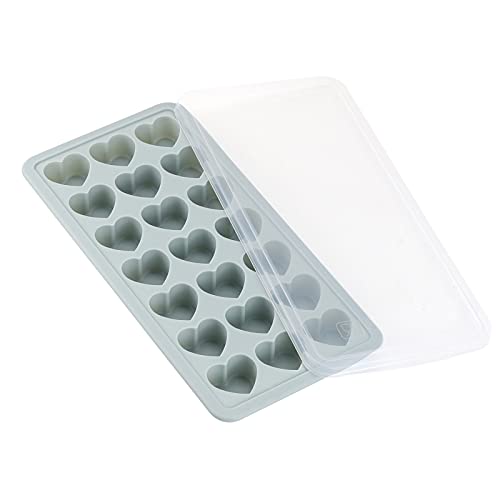
BTYMS makes the same claim about the tray rather than the lid: stackable and do not take up a lot of space, with a lid that is easy to attach and stops spillage in the freezer. It also adds a caution the others do not, that a silicone tray is not rigid like plastic, and suggests using the lid as a base to transfer a filled tray.
What the Lid Is Made Of
Szxc is the only listing here that names the lid material and the only one that limits it: two hard PP plastic lids on two silicone trays, with the bullet stating that the plastic lids are not heat resistant while the trays work from -40 to 464 degrees. A hard lid is the better stacking surface and the worse oven companion, and this is the one listing that says so.
AIERSA publishes a lid and never says what it is made from. BTYMS names food grade silicone and PP for the set without assigning either to the lid. For a drawer the distinction matters less than it does in an oven, but a soft lid under the weight of a second loaded tray is not the same object as a hard one.
One Listing Publishes the Lid in the Mold’s Fields
The AIERSA Figures
AIERSA’s last bullet gives two sizes: a mold at 7.48 by 4.01 by 0.7 inches, and then a lid size beginning 7.63 inches. Its dimension fields read 4.21 by 7.63 by 0.78 inches, so the figure in the depth slot is the lid rather than the mold. That is useful rather than broken, because it is the only lid dimension anywhere in this pool.
It also means the drawer figure is readable here and nowhere else: a 0.7 inch mold under a lid whose own thickness is not given, in a field set whose largest number belongs to the lid. We have used the mold figures from the sentence and reported the 7.63 as what the listing says it is.
Two More Pairs That Disagree
Vrthske publishes 10.63 by 6.69 by 0.59 inches in a bullet headed dimensions, and its fields read 6.0 by 10.0 by 0.5 inches. Those are the same mold measured twice with a tenth of an inch between the thickness figures, which is small and still worth knowing when the question is how many sheets fit in a stack.
SAINT NIEVE is the pair that agrees. It publishes approximately 30 by 20 by 2.6 cm and its fields read 7.88 by 11.82 by 1.0 inches, which is the same object in two unit systems. It is also the only listing here whose selling point is the thickness itself: thicker and deeper than regular chocolate molds, for a 3 cavity bar.
The Two Without Lids
A Mold Sold on Being Deeper
SAINT NIEVE is the one purchase here that wants the drawer depth for the mold rather than for a stack. Three large cavities, a holographic optical texture that the maker says reflects color under light, and a nano-textured surface. At a weight field of 0.73 lb it is the heaviest of these five, which is what a thick silicone slab weighs.
No lid is published, so a filled tray travels open and cannot be stacked under anything. For chocolate that is less of a problem than for ice, because a set bar is not a liquid, but it does mean the mold occupies its own full depth in the drawer whether it is loaded or not and nothing goes on top of it.
A Flat Sheet of Eight Bars
Vrthske is the opposite proposition and the one this page would not recommend buying a deep drawer for. Eight rectangular bar cavities in a sheet published at 0.59 inches, at a weight field of 0.1 lb, which is the lightest of these five. A sheet that thin slides anywhere and gains nothing from depth.
It earns its place as the control. The flexible silicone construction is stated to allow demolding without breaking the bars, the mold is dishwasher safe, and the overall size is published twice over. If the drawer is deep the sheet simply lies at the bottom of it, and nothing in the listing suggests a second one could be stacked on a loaded first.
Which One Fits Your Kitchen
You want two loaded trays, stacked. AIERSA. Two 32 cavity trays each with a lid, stated to stack in the freezer, with a mold published at 7.48 by 4.01 by 0.7 inches and the only lid dimension in this pool.
You want a hard lid to stack on. Szxc. Two silicone trays at 7 by 5 by 1.1 inches with two hard PP lids, and the only listing here stating that the lids are not heat resistant.
You want the maker to promise it stacks. BTYMS. A 21 cavity tray with an attachable lid, stated stackable, published at 10.47 by 5.1 by 1.2 inches, with the lid also usable as a base when carrying it filled.
You want a thick bar, not a stack. SAINT NIEVE. Three deep cavities in a mold published at approximately 30 by 20 by 2.6 cm, with a holographic surface texture. No lid is included.
You want eight bars and no bulk. Vrthske. A flat sheet published at 10.63 by 6.69 by 0.59 inches and 0.1 lb, dishwasher safe, with nothing to stack on it.
What We Could Not Verify
These are the specifications we went looking for in all five listings and did not find.
- A stacked height for two loaded lidded trays, which none of the three lidded listings publishes.
- A lid thickness from any of the three that include one.
- What the AIERSA lid is made of, which the listing never names.
- Any mold dimension in words from BTYMS, whose only figures are its fields.
- Whether the BTYMS lid is the silicone or the PP named for the set.
- Why the Vrthske thickness reads 0.59 inches in a bullet and 0.5 in the field.