How the Five Compare on the Numbers
Every pick on this page arrives as a set. Each listing has one size field, one dimension triple and one weight field, and each has three or six different objects to describe with them. That is a structural problem rather than a careless one, and the interesting question is which makers noticed it and what they did about it.
One of the five solved it properly, by publishing a labeled figure for each named bowl. One sidestepped it, by shipping six bowls of one size. The other three published a single figure for a mixed purchase, and on two of those three the figure can be shown to be wrong using nothing but the other picks on this page.
What the table cannot tell you is which bowl of a set you would actually use for chocolate. A small bowl over a pan is the usual answer, which makes the smallest vessel in each purchase the one that matters, and that is precisely the object these listings describe least. Four of the five publish their largest capacity somewhere prominent and leave the small end to a bullet.
The One Listing That Names the Bowl
Three Objects, Nine Figures, Every One Labeled
Calphalon publishes a bullet headed Top Diameter by Bottom Diameter by Height, then three lines beneath it: Small at 7.1 by 5.3 by 3.3 inches, Medium at 8.5 by 5.9 by 3.9 inches, and Large at 9.8 by 7.1 by 4.5 inches. Every number on that listing therefore belongs to a named object and runs in a named direction, which nothing else on this page does once.
The capacities line up behind them at 2 quarts, 3.4 quarts and 5.2 quarts, so a volume can be matched to a diameter and a height without inference. For daily use that is the whole point: the bowl you reach for is the one that suits the job and the shelf, and this is the only pick where both halves of that decision can be checked before buying.
What Is Still Missing From It
Three things. Its dimension fields all read zero, which is a placeholder rather than a measurement and would mislead anybody reading the fields instead of the bullets. No weight appears in a field or a sentence, so there is no figure for how heavy a steel bowl of 5.2 quarts is. And the size entry repeats the product name rather than giving a size.
The fourth gap is the one its own storage claim creates. The bullets say the bowls nest neatly for compact storage and never say what the nested stack measures, which is the figure a cupboard actually needs. Flared rims are named for drip free pouring and non slip bases for steady mixing, both of which are claims without figures attached.
A Labeled Triple Attached to Nothing
Figures That Match None of the Bowls
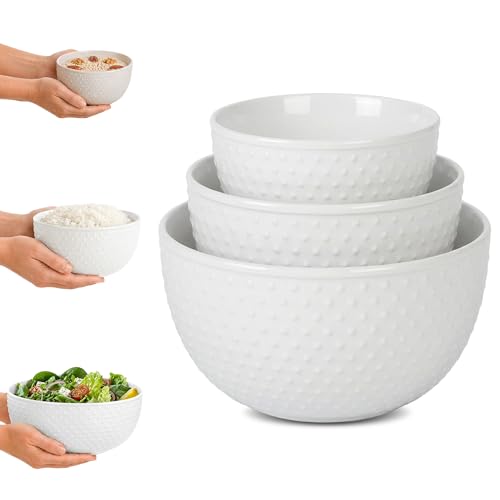
Gibson describes its three bowls better than most listings on this keyword: a 6.75-inch bowl at 46oz, an 8-inch bowl at 74oz, and a 9.75-inch bowl at 147oz. Then the size entry gives 5.25 inch H by 9.6 inch L by 9.6 inch W, labeled by direction, and the dimension fields agree with it exactly at 9.6 by 9.6 by 5.25 inches.
The trouble is that 9.6 is not 6.75, not 8 and not 9.75. The labeled triple describes an object the listing never names. The nested stack is the obvious candidate, since the bowls are stated to nest for storage, but nothing on the listing says so and this page will not assert it. Its 7.84 lb weight field covers all three bowls together.
Three Cups and One Unlabeled Triple
TUZAZO has the same structural problem in a smaller object. The title gives 3Pcs at 125ml, 250ml and 500ml, the size entry restates the volumes as 1/2cup, 1cup and 2cup, and the dimension fields read 3.2 by 4.7 by 5.7 inches. All three numbers in that triple differ from each other, so it is not one round cup measured across and down.
Nothing on the listing says whether the triple is the largest cup or the three nested together, and no weight is published to help settle it. Everything else about working with chocolate is covered well: set chocolate is stated to pop out of the flexible silicone, the cups take warm soapy water or a dishwasher, they are stated fully microwave safe, and the wall carries scales in ounces, milliliters and cups.
When a Carton and a Weight Rule a Figure Out
Six Capacities in the Title, Five in the Bullet
Umite Chef cannot agree with itself about what is in the box. The title describes a 6 piece set and names six capacities, the smallest a 1QT bowl and the largest a 7 quart bowl. The bullet that describes the set then names only five of them, and drops the 1QT bowl entirely.
Two more figures fail a check that needs nothing outside these five picks. The dimension fields were filed as a carton at 8.4 by 8.4 by 4.9 inches, and a 7 quart bowl cannot sit inside an 8.4 inch square: Gibson on this page publishes a 9.75-inch bowl holding 147oz, which is well under 7 quarts, so the Umite Chef bowl has to be wider still. And 1.0 lb cannot cover six heavy gauge steel bowls and six lids.
Six Identical Bowls and a Letter That Implies More
Goalfly removes the ambiguity rather than resolving it. Its 6PCS set is one size in three colors, gray, white and green, so a mouth diameter of 4.1 inch, a lower bowl bottom of 1.7 inch, a height of 2.7 inch and a capacity of 0.27 QT describe every bowl in the purchase. That is clarity bought with uniformity, and it costs flexibility: six bowls of one size cover one job.
Two details still repay attention. The size entry reads M with the triple 4.1 by 4.1 by 2.7 inch, and the letter implies sizes that appear nowhere on the listing. And the field triple repeats 4.1 twice while the bullet gives three different figures, so the 1.7 inch base exists only in the sentence. The silicone is rated to 392 F, given as 200 C, and the weight field reads 0.6 lb for all six.
Which One Fits Your Kitchen
Buying on published figures alone. Calphalon. Three named bowls, three labeled triples from 7.1 by 5.3 by 3.3 inches up to 9.8 by 7.1 by 4.5 inches, and capacities of 2, 3.4 and 5.2 quarts. Nothing else here is this legible.
Melting small quantities most days. Goalfly. Six silicone bowls of 0.27 QT each, 4.1 inch across and 2.7 inch tall, rated to 392 F and stackable. One size for every bowl, which is the point and the limit.
Matching a bowl to a recipe. Gibson. A 6.75-inch bowl at 46oz, an 8-inch at 74oz and a 9.75-inch at 147oz is the clearest volume ladder on this page. Treat its 9.6 inch triple as unexplained.
Chocolate that has to come out cleanly. TUZAZO. Three cups at 125ml, 250ml and 500ml, stated to release set chocolate, microwave safe and dishwasher safe. You will not learn which cup its one triple describes.
A wide capacity range above all. Umite Chef, with care. It claims bowls from 1QT to 7 quarts with lids and non slip bases, and its own carton figure and weight field cannot both be describing that set.
What We Could Not Verify
Everything above comes from each maker’s own listing. These are the questions those listings leave open, and this page does not answer them by inference.
- Which Gibson object the labeled 5.25 by 9.6 by 9.6 inch triple describes, since it matches none of its three bowls.
- Which TUZAZO cup the 3.2 by 4.7 by 5.7 inch triple belongs to, or whether it covers the three of them nested.
- Whether the Umite Chef purchase holds six bowls or five, which its title and its own bullet answer differently.
- Any height for the Gibson bowls, which publishes three diameters and three capacities and no clearance at all.
- What the Calphalon set measures nested, which is the figure its own storage claim implies and never supplies.
- What the Umite Chef set actually weighs, since the published 1.0 lb cannot cover six steel bowls and six lids.