How the Five Compare on the Numbers
A citrus press is a cone, a sieve, a funnel and a lever in a frame, and almost all of its cleaning happens to the pieces rather than to the press. So the question that separates these five is not how much juice comes out. It is which pieces the maker states come off, what it calls them, and what it says each one is for once it is in your hand.
Four of the five name at least one removable part. One ships a part whose only job is to lock another one. One publishes a rule about what its removable handle must not be used for. One gives its strainer and its funnel two different verbs. And exactly one publishes a measurement for a piece rather than for the whole object.
What the table cannot tell you is where a lost funnel comes from. None of these five sells a replacement strainer, cone, funnel or handle, and the one press that ships a part purely to keep a lever up never publishes anything about that part beyond its color and its material. Two of the five publish a figure that contradicts another figure in the same listing, so the ranking here rests on named parts.
The Press That Ships a Part to Lock It
ROVSUN Supplies a Safety Hat
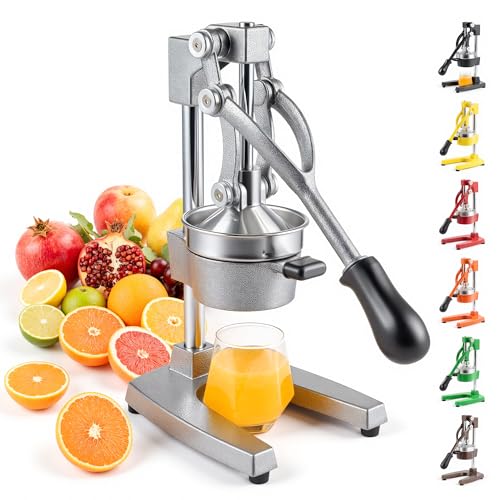
ROVSUN opens its listing with the part rather than the press. Its first bullet states that only ROVSUN sends a safety hat, that the black plastic hat is used to lock the handle in that position, and that it prevents the handle coming down accidentally. On a cast iron lever press the falling lever is the one real hazard, and this is the only listing here that answers it with hardware.
The rest is a conventional cast iron press described in parts: a long light handle with a rubber grip, an easily removed strainer cone and funnel for cleaning, and a 304 stainless steel strainer over cast iron. It publishes 7.09 by 8.66 by 14.57 in and 13.45 lb, the heaviest figure here, and it gives no measurement for the hat, the cone or the funnel.
CO-Z Gives Two Parts Two Different Verbs
CO-Z is the most careful listing here about how its pieces behave. Its cleaning bullet states that the stainless steel strainer captures pulp and seeds but detaches for no-hassle emptying and washing after each session, and that the funnel likewise slots off and keeps everything easy to handle in any sink or dishwasher. Detaches and slots off are different motions, and the listing distinguishes them.
It also makes the broadest material claim on the page, stating that every part of the press that touches your drink is food-grade 304 stainless steel, alongside 2300 psi of pressure resistance and a base that suctions to the counter. Its own bullet states 15 pounds of reinforced cast iron while its weight field reads 13.23 lb, and both cannot be the press.
A Handle That Must Not Be Squeezed
ChefVille Detaches the Handle and Swaps the Head
ChefVille is the only listing on this page that publishes a limit on one of its own parts. Its grip bullet states that the juicer is squeezed using anti-slip side grooves, that the detachable handle makes carrying and pouring easy, and then in a note: always squeeze using the side grips only, because the handle is designed for carrying and pouring and not for squeezing.
It is also the only pick with two interchangeable heads, stating a 12-tooth precision head for lemons and limes and a 3-claw large head for oranges and larger fruit. Underneath them is a 16.9 oz cup with ml markings, a V-shaped spout, a flip-top body and a silicone base, in food-grade PP stated BPA free. It publishes 0.99 lb and no diameter for either head.
Lechin Supplies Two Cones and a Gasket
Lechin reaches two cones by a different route. Its performance bullet states two ways of using the juicer, two cones sharp enough for complete juicing with many holes to prevent juice blocking, a lid that holds the fruit firmly and keeps hands clean, and a juice container with a spout and a non-slip gasket. That is four named components in one sentence.
It is the only pick naming a lid at all, and the only one naming a gasket. Its material bullet states PP described as resistant to 120 C, dishwasher safe and resistant to acid and alkali. It publishes 3.74 by 4.09 by 5.91 in and 0.57 lb, no figure for any of its parts, and a warning against squeezing hard fruits with low juice yield.
The Press That Measures Its Own Parts
Etinslant Publishes a Cone and a Sieve
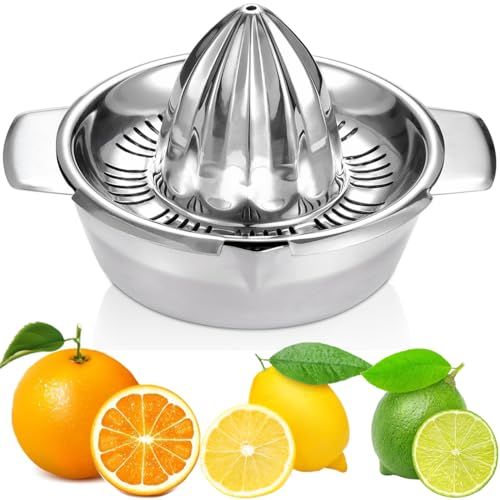
Etinslant is the only pick here that measures a piece rather than a press. Its dimensions bullet publishes the height of the pressing cone at 2.75 inch and the diameter of the sieve at 5.43 inch, which between them describe the two surfaces a fruit actually touches. Nothing else on this page publishes either figure, and on a page about parts that is the most useful line available.
It also explains its sieve rather than naming it, stating slits rather than round holes and giving the reason: round holes jam the juice. The cone carries an 11-tooth reamer in 304 stainless steel, the container has two-sided handles and two spouts, and it publishes 0.22 lb, the lightest figure here. What it never states is that any part comes off.
Where a Component Figure Became the Product
There is a catch in those Etinslant figures worth naming. Its dimension fields read 5.43 by 4.92 by 2.36 in, and the 5.43 in is exactly the sieve diameter its own bullet publishes. So the width field is not the press at all: it is one component, filed as the whole object, which is the commonest way a listing misleads a reader working from fields alone.
The CO-Z contradiction is the other shape of the same problem. Its bullet states 15 pounds of reinforced cast iron and its field reads 13.23 lb, and the gap sits inside one listing. Neither figure is unreasonable for a cast iron press, which is what makes the pair useless: there is no way to tell which one was measured and which one was rounded for a bullet.
Which One Fits Your Kitchen
You want to be told how a part may be used. ChefVille detaches its handle for carrying and pouring and states plainly that squeezing goes through the side grips, with a 12-tooth and a 3-claw head over a 16.9 oz cup at 0.99 lb.
You want the lever locked when you walk away. ROVSUN ships a black plastic safety hat to hold the handle up, over an easily removed strainer cone and funnel in 304 stainless. It publishes 13.45 lb and 7.09 by 8.66 by 14.57 in.
You want every juice contact part in steel. CO-Z states its strainer detaches and its funnel slots off, with 304 stainless on everything the drink touches, 2300 psi and a suction base. Its stated 15 pounds argues with its 13.23 lb field.
You want the cone and the sieve measured. Etinslant publishes a 2.75 inch cone and a 5.43 inch sieve with an 11-tooth reamer in 304 stainless, two spouts and 0.22 lb. It never states that a part comes off.
You want a lid and a gasket named. Lechin supplies two cones for two squeezing options, a lid that grips the fruit and a container with a spout and a non-slip gasket, in PP stated to 120 C at 0.57 lb.
What We Could Not Verify
Six things a reader buying for access to parts would want, and no listing among these five supplies.
- A replacement strainer, cone, funnel or handle sold separately by any of the five.
- A replacement safety hat from ROVSUN, where the hat is supplied free and never specified.
- A diameter for either ChefVille head or either Lechin cone, where only tooth and claw counts are given.
- A figure for the ROVSUN or CO-Z strainer cone, since both state it comes out and neither measures it.
- Whether the CO-Z press weighs the 15 pounds it states or the 13.23 lb its own field publishes.
- Whether the Etinslant cone and sieve can be separated from its bowl, which the listing never says.