How the Five Compare on the Numbers
Sixteen citrus presses sit on the fact sheet for this topic and they fall into two groups that barely belong on the same page. Six are presses meant to stand on a counter, five of them cast iron or alloy and one of them powered. Ten are hand tools, most of them under a pound, that go in a drawer. This page carries three of the small ones and two of the large.
The split matters because it decides what the press is for. A lever press is bought to get through a bag of oranges. A hand squeezer is bought because one lemon needs juicing while something else is cooking. The published figures that separate them are folded thickness, bowl diameter and weight, and most of the listings here publish only one of the three.
What the table cannot tell you is how hard any of these is to squeeze. A lever press multiplies your effort by the ratio of its handle, and not one listing on this fact sheet publishes that ratio or any force figure. One press states 2300 psi of pressure its body withstands, which is a strength rating rather than a measure of what the lever gives you. Long handle and minimal effort are doing the work a number would do better.
Three Tools That Live in a Drawer
The One That Folds to an Inch
Bagrox is the most precisely specified small squeezer in this pool and the only one that folds. Its first bullet is a specification list rather than a sales line: overall length 7.28 inches, folded thickness 1 inch, juicer head height 2.75 inches, each figure given in centimeters as well. It folds completely flat, and its listing names the reason, which is that a drawer has no room for a bulky hump.
It is food grade stainless steel, stated not to react with the fruit, and its cleaning instruction is the simplest here: rinse it under water and hang it to dry, no special maintenance. It never mentions a dishwasher, which for solid stainless is an odd omission. It publishes no bowl diameter either, so which fruit sizes it actually takes is not addressed anywhere on the listing.
A Reamer That Catches and Pours
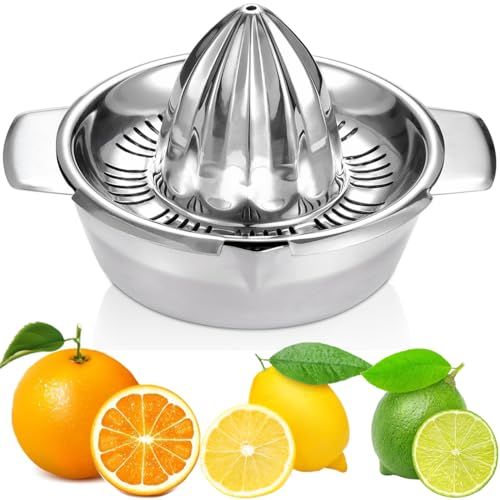
Etinslant solves a different everyday problem: where the juice goes. It is a 304 stainless reamer with an 11 tooth cone sitting over a 10oz bowl with two pour spouts and handles on both sides, so you juice into the bowl and pour rather than holding a glass underneath. Its cone is published at 2.75 inches high and its sieve at 5.43 inches across.
It also explains its own design, which almost nothing in this pool does. The sieve uses slits rather than round holes, and the listing says round holes jam the juice. It states 304 stainless as 18/8, dishwasher safe, with a twelve month warranty. At 0.22 lb it is the lightest published weight of these five, which means the bowl needs a hand on it while the cone is being twisted.
Gears, and What They Are Measured Against
A Squeezer With a Mechanism
Chef’n is the only hand press here with anything mechanical in it: a patented dual gear mechanism, stated to deliver up to 20 percent more juice than standard citrus squeezers with less hand strain. It is nylon and stainless steel rather than coated aluminum, 10.25 inches long, 0.99 lb, and top rack dishwasher safe.
The honest part of the listing is its scope. It says directly that it is designed for lemons, key limes and similar fruits, which is a limit rather than a feature and worth more than a vague claim of versatility. The unsatisfying part is the 20 percent: a standard citrus squeezer is not a defined thing, so the figure has nothing behind it. Nylon gears are also the wearing part, and no life is stated.
Where the Yield Claims Fall Apart
Only one of these five publishes a number about output and it cannot be checked. Chef’n has its 20 percent, measured against a standard citrus squeezer that is not a defined object. One cast iron listing on this sheet states that its body withstands 2300 psi, which is about the iron rather than the juice. Sopito and ROVSUN simply say the output is higher than standard juicers.
None names a fruit, a quantity or a comparison product, so these are not comparable figures. What can be compared is what the press physically does with the pulp and seeds, and there the listings are more useful: a built-in cone, a detachable 304 strainer, a slit sieve. Those are mechanisms you can see rather than percentages you cannot.
Two Lever Presses, Two Practical Ideas
The Only Press That Names a Fruit Size
Sopito does the single most useful thing in this category. It publishes a 4.3 inch wide bowl and then tells you what that means, stating that most oranges are 2.6 to 3.5 inches in diameter so the bowl fits nearly all commercial oranges. Two cast iron presses in this pool publish a wider bowl and neither says what fits in one.
It is also the lightest lever press here at 6.83 lb, built as a stainless frame with a heavy aluminum alloy body rather than cast iron, which the listing frames as balancing durability against portability. The cleaning instruction is properly split: every part that touches fruit is dishwasher safe stainless, the body gets a rinse or a wipe, and a brush is included. At 16.5 inches tall it is still a counter object.
A Handle That Cannot Fall
ROVSUN leads with something no other listing in this pool mentions: a plastic safety hat that locks the handle in the raised position so it cannot come down accidentally. On a 13.45 lb cast iron press with a long lever, that is the difference between a tool and a hazard in a kitchen where other people reach past it, and the three other cast iron presses on this sheet never raise the subject.
It is otherwise a conventional cast iron press with a 304 stainless strainer, a rubber grip and a stated three step operation: halve the fruit, put the cut side down, press the handle. It states that it does not rub the rind, so no bitterness reaches the juice. It publishes no bowl diameter, and nothing in the listing says whether the painted cast iron body may be washed.
Which One Fits Your Kitchen
A drawer with nothing spare in it. Bagrox, a stainless squeezer that folds flat to a published 1 inch, 7.28 inches long with a 2.75 inch head, rinsed and hung to dry. Every figure is also given in centimeters.
Juicing straight into a glass without holding one. Etinslant, a 304 stainless reamer with an 11 tooth cone over a 10oz bowl with two pour spouts, a slit sieve that it says will not jam, and a twelve month warranty at 0.22 lb.
Lemons, often, with sore hands. Chef’n, a dual gear press in nylon and stainless at 10.25 inches and 0.99 lb, stated to give up to 20 percent more juice with less strain, top rack dishwasher safe, and honest that it is for small citrus only.
Oranges by the bag, without cast iron on the counter. Sopito, a 4.3 inch bowl matched in the listing to oranges of 2.6 to 3.5 inches, on an alloy body at 6.83 lb, with the fruit-facing parts dishwasher safe and a brush supplied.
A press other people will walk past. ROVSUN, 13.45 lb of cast iron with a 304 stainless strainer and a plastic hat that locks the handle raised, with the operation published in three steps.
What We Could Not Verify
Every figure above comes from the maker’s own listing text. These are the things we went looking for and could not source in any of them.
- Three of these five publish no bowl diameter, so which fruit they accept is unknown in advance.
- Every yield claim in this pool is measured against an unnamed standard, with no method given.
- No listing publishes the force its lever multiplies, only that the handle is long.
- Bagrox publishes no dishwasher instruction on a squeezer that is otherwise fully specified.
- No cast iron press here says whether its painted body may be washed rather than wiped.
- No listing states how many fruit can be pressed before the strainer needs emptying.