How the Five Compare on the Numbers
Seven listings sit on the fact sheet and two are left off. Subminimal publishes a retractable needle mechanism and an aluminum base and never names a metal for the needles themselves, which on a page about steel leaves nothing to place. Nessus publishes ten food grade stainless steel needles at 0.35 mm in an aluminum alloy handle, which is the same arrangement MEION publishes, so it would add a sixth column and no sixth answer.
What decides this page is which part of the tool the word stainless is attached to. On four of the five below it is the needles and only the needles, with the body given as aluminum, walnut or hard plastic. On one of them the steel is the base that meets the coffee. Two listings name more than one material for the same handle, and one of those names three.
The table cannot settle what any of these handles is made of, because two of the five listings answer that question more than once and in different words. It also cannot tell you how much steel is in a needle set, since no maker publishes a needle length, and it cannot compare mass: Apexstone publishes 0.99 lb and the other four publish no weight at all, which on a tool held in the hand is a strange thing for four listings to leave out.
Which Part Is Actually Steel
One Steel Base, Four Sets of Steel Needles
Apexstone is the only pick here where the steel is the working surface. Its listing calls the base solid 304 stainless steel with an anti slip aluminum handle, adjusted for height by a screw mechanism with no shims or tools, sized for 58 mm portafilters and standard 18 g baskets. The steel is the part that flattens the coffee, and it is the part a buyer is paying for.
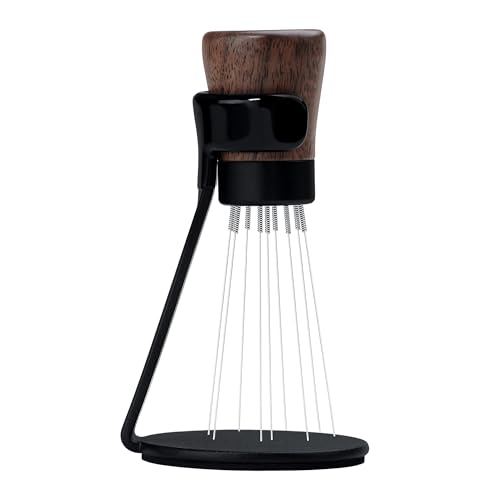
On the other four the steel is thin wire. Normcore publishes nine prongs at 0.23 mm, MEION seven needles at 0.35 mm, AIEVE ten at 0.4 mm and Zolunu five at 0.4 mm. In each case the maker names the needles as stainless and the thing you hold as something else. That is not a fault, but it means a shopper searching for a steel tool is mostly buying aluminum, walnut or plastic with steel in it.
Grade 304, Named Four Times Out of Five
Apexstone, Normcore, MEION and AIEVE all publish the grade as 304. Zolunu publishes only high quality stainless steel, corrosion and rust resistant, with no grade attached. Four named grades out of five is unusually good for a pool this size, and it is the one material claim on this page that is consistent across the listings that make it.
What none of them publishes is a grade for anything else. Normcore’s aluminum is described as anodized and CNC machined, MEION’s as aluminum with a non slip pattern, AIEVE’s plastic as food grade and BPA free. None of that is a specification in the way 304 is, so the only comparable material figure on the page belongs to the part with the least metal in it.
Listings That Name Two Handles, or Three
Normcore Publishes Three Handle Materials
Normcore’s title says American Walnut Wood Handle. Its second bullet says the sturdy handle is made from anodized aluminum CNC while the spring wires are 304 stainless steel. Its third bullet says the tool features a machined anodized 304 stainless steel stirrer handle. Those are three different answers to one question, inside one listing, and nothing on the listing chooses between them.
This page did not choose either. The handle row above records all three because that is what the maker published, and the needle figures, nine prongs at 0.23 mm with 16 extra supplied, are quoted because they are the only claims on the listing that nothing else contradicts. A buyer who cares whether the grip is wood or metal has to ask the seller, which is an odd place to be left by a listing this detailed.
MEION Names Aluminum and Wood in One Sentence
MEION’s title says aluminum alloy handle with stand. Its cleaning bullet says the sturdy handle and stand are made of aluminum, and then, in the same bullet, that the wooden handle and base cannot be cleaned with water and easily accumulate dust. Two materials, one bullet, and the practical instruction attached to the one the rest of the listing does not claim.
The safe reading is that the warning has been copied from another product, and the safe purchase decision is to treat the cleaning line as unreliable rather than the handle. What is not in doubt is the needle set: seven food grade 304 stainless steel needles at 0.35 mm, seven replacements, a storage tube, and the ability to run three to seven needles at a time.
What the Body Material Changes in Use
Walnut, Plastic and the Water Question
Zolunu is walnut wood for both handle and stand, with the two integrated so the tool carries as one piece. Its listing says to rinse it with water and leave it to dry, which is a straightforward instruction to give about wood. AIEVE is the opposite choice, food grade hard plastic throughout with a 304 stainless needle, matte black, and it publishes no cleaning instruction at all.
Between them sits MEION, whose listing warns that wood must not be washed while its title says the handle is aluminum. Apexstone publishes the most complete cleaning answer of the five, saying it can be rinsed or brushed and taken apart for a thorough clean. On a tool that goes into wet coffee grounds several times a day, that is worth as much as the grade of the steel.
The Pick That Is Not a Stirrer
Apexstone belongs on a steel page and does not belong on a needle page. It is a leveler: a wide flat base lowered onto the grounds and turned, sized to a 58 mm portafilter, adjusted by screw for the depth of an 18 g basket. It has no needles, so four rows of the table above read not applicable for it rather than not published.
It is included because it answers the question this page asks better than anything else in the pool: it is the one tool here whose steel does the work. If what you want is a tool that breaks up clumps before tamping, it is the wrong purchase, and one of the four needle tools is the right one. The listings make that distinction clearly, which is more than they manage about their own handles.
Which One Fits Your Kitchen
A 58 mm machine and a palm. Apexstone, whose solid 304 stainless steel base is the part that meets the coffee. Height adjusts by screw for an 18 g basket, and it publishes 2.5 by 2.5 by 1.45 in and 0.99 lb, which nothing else here does.
The finest needles published. Normcore, at 0.23 mm across nine prongs with 16 spares in the box. Accept that the listing names its handle as walnut, as anodized aluminum and as anodized 304 steel, and that only the needle figures are unambiguous.
Changing how many needles you run. MEION, seven 304 stainless needles at 0.35 mm with seven replacements and a storage tube, and the only pick that publishes a way to run three, four, five, six or seven of them.
A wooden tool that lives on the counter. Zolunu, walnut handle and integrated walnut stand, five needles at 0.4 mm. It is the only pick with no grade published for its steel and no spare needles.
Sticking the tool to the machine. AIEVE, ten 304 stainless needles at 0.4 mm in a food grade hard plastic body, with a magnet and an adhesive mount so it can sit on the side of an espresso machine rather than on the counter.
What We Could Not Verify
Every figure above comes from the maker’s own listing text. These are the things we went looking for and could not source in any of the seven.
- Not one listing publishes a needle length, so how far into the puck any of these needles reaches cannot be compared.
- Four of the five publish no weight at all, which leaves Apexstone’s 0.99 lb standing alone with nothing to be read against.
- Normcore’s handle is named as walnut, as anodized aluminum and as anodized 304 stainless steel on the same listing, and nothing there resolves it.
- MEION’s cleaning bullet warns about a wooden handle the rest of its listing says is aluminum, so which instruction applies is unknown.
- Zolunu publishes no grade for its steel, and AIEVE publishes no cleaning instruction of any kind.
- Only Apexstone publishes a portafilter figure, so whether the four needle tools suit a 58 mm basket or a smaller one is nowhere stated.