How the Five Compare on the Numbers
Capacity is the figure a buyer reaches for first, and these five publish it in three different units. Breville states 16 cups, Ninja 9 cups and Cuisinart 11 cups. Waring states 2.5 quarts. Tiwvjzbr states 15 liters. No listing converts its figure into any other unit, so the only honest comparison is between the three that happen to use cups.
Weight is published on three of the five. Breville is 30.6 pounds, Cuisinart 16.92 pounds and Waring 12.4 pounds, making the Breville the heaviest of the three that publish a weight and the Waring the lightest of them. Ninja and Tiwvjzbr publish no weight at all, which matters because both are machines a kitchen porter would have to lift onto a shelf.
What the table cannot tell you is duty cycle, which is the thing that actually separates a commercial machine from a domestic one. None of the five states how long it may run before the motor needs to rest, and none states a bowl material thickness or a bearing type. Nor does any of them publish a noise figure, which decides whether a machine can run during service.
Three Units of Capacity and No Common Figure
Cups, Quarts and Liters in One Search Result
A cup, in dry kitchen terms, is a quarter of a quart, so Waring’s 2.5 quart bowl sits in the same region as Breville’s 16 cups by arithmetic. But neither maker publishes that conversion, and a bowl rating is not a working volume in any case. Nobody fills a processor bowl to the brim with liquid. Treating the printed figure as a yield is the most common mistake on this page.
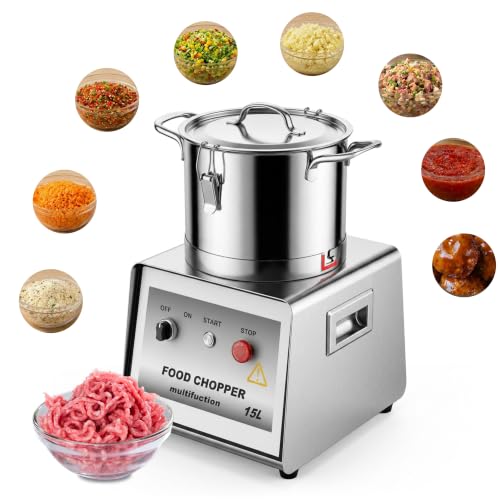
Tiwvjzbr’s 15 liters is a different order of thing again. The listing speaks of processing a full bucket at a time, which is how bowl choppers are sold into butchery and catering, not how a benchtop processor is sold into a home. If your prep is measured in buckets rather than in batches, that figure is the one on this page that speaks to you, and nothing else here comes near it.
What a Bowl Rating Leaves Out
None of the five publishes a maximum liquid level, which is the number that governs soups, purees and emulsions. Waring is the only listing that addresses liquid at all, and it does so with a seal rather than a figure: the LiquiLock system, which it says prevents spills and maximizes liquid processing capacity. That is a capability claim without a volume attached, so it cannot be compared against anything.
Nor does any listing say how much of the bowl the blade actually sweeps. On a tall narrow bowl, ingredients climb the wall and stay there. Breville’s dimension fields describe a body 17.7 inches high on an 11.3 by 9.2 inch base, and Ninja’s describe a body 16.02 inches high on a smaller footprint, but neither maker states a bowl height, only a machine height.
Which of These Publishes a Duty Rating
Horsepower, Watts and Peak Watts Are Not One Scale
Waring is the only one of the five to rate its motor in horsepower, at 3/4, and the only one to attach the word commercial to that rating. Tiwvjzbr publishes 1400 W and converts it itself, stating 1.9 hp. Breville publishes 1450 W and calls the motor a heavy duty induction unit with direct drive. Three different conventions, and only one of the three names a continuous rating.
Ninja’s figure is 1000 peak watts, and peak is the word that matters. A peak rating describes what the motor draws at the instant of highest load, not what it will sustain. Cuisinart publishes no motor figure at all in the text supplied, which on a page about commercial use is a significant absence rather than a small one. Its listing sells design and a brand history instead.
The Machine That Calls Itself a Meat Grinder
Tiwvjzbr’s own bullets are internally inconsistent in a way worth knowing about before you order. The title sells a vegetable cutter with an S-shaped blade. Three separate bullets then refer to the product as a meat grinder: that all parts of the meat grinder are removable, that the meat grinder must be fully installed before starting, and what to do if the meat grinder does not start.
A bowl cutter with an S-blade and a grinder with a worm and plate are different machines that do different things to meat. The blade description is consistent across the listing, so the likeliest reading is boilerplate carried over from another product. That still leaves you buying from a listing whose own copy has not been read, and the figures on it deserve the same suspicion.
Feeding, Sealing and Getting It Clean
Only One Listing Publishes a Chute Figure
Breville is alone in publishing chute measurements. Its listing describes a three way chute with openings from 1.7 inches up to 5.5 inches, the argument being that a wide opening removes a pre-cutting step for things like tomatoes and potatoes. Ninja says its chute is large and gives no figure. Waring, Cuisinart and Tiwvjzbr publish nothing about the opening at all, which is a real gap on a volume machine.
The chute figure also tells you something about the slicing work. Breville pairs its chute with an adjustable slicer offering 24 thickness settings, which is the only variable slicing on this page. The other four publish fixed discs: a reversible slice and shred disc on Ninja, slicing and shredding discs on Cuisinart, a whipping disc on Waring, and a single blade on Tiwvjzbr.
Seals, Lids and Washing Up
Cuisinart is the only listing that states dishwasher safe outright, and on a machine that is used daily that is worth more than most spec lines. Tiwvjzbr says its parts are removable and can be washed directly with water, then dried, which is a hand wash instruction rather than a dishwasher claim. Breville and Ninja publish no cleaning statement in the text supplied at all.
Waring’s contribution is a flat lid, which it frames as a storage advantage: the flat cover lets the unit sit under a standard counter and stack away. Its fields give a 13 inch front to back figure against an 11 inch height, the lowest height figure among the five, and the listing calls the design low profile and space saving. That is the only listing here that addresses cabinet clearance.
Which One Fits Your Kitchen
The busy prep bench. Breville states 16 cups, a 1450 W induction motor, a chute from 1.7 to 5.5 inches and 24 slicing settings, which is the most published detail on this page. At 30.6 pounds it is also the heaviest of the three that give a weight, so it wants a permanent home on the counter.
The wet mix station. Waring is the only pick with a sealed lid system aimed at liquid, and the only one rating its motor at 3/4 horsepower and calling it commercial. Its 2.5 quart bowl is the smallest published capacity here, so it suits sauces and dressings rather than bulk vegetable work.
Bulk chopping by the bucket. Tiwvjzbr publishes 15 liters, 1400 W and a claimed full bucket of vegetables in 10 seconds. Its dimension fields, 23.03 by 19.09 by 13.78 inches, describe a machine that needs a table of its own, and it publishes no weight, so plan the lift blind.
The daily domestic workhorse. Cuisinart states 11 cups, dishwasher safe parts and slicing and shredding discs at 16.92 pounds. It publishes no wattage, no horsepower and no chute figure, so buy it on the cleaning claim and the bowl size rather than on any promise about duty.
Dough more than prep. Ninja publishes a dough blade, four preset programs and 1000 peak watts on a 9 cup bowl, with dimension fields of 7.87 by 8.07 by 16.02 inches. It is the narrowest published set of specifications after Cuisinart, and it publishes no weight, so shelf planning is guesswork.
What We Could Not Verify
These six things decide whether a processor survives commercial use, and not one of the five listings states them.
- Duty cycle. No listing says how long its motor may run continuously, or how long it must rest, which is the difference between a commercial machine and a domestic one under a commercial search term.
- Weight on two of the five. Ninja and Tiwvjzbr publish none, and the Tiwvjzbr is the largest machine here by its own dimension fields, so its lift weight is the figure most worth knowing.
- Any certification. None of the five names a commercial kitchen listing or a sanitation standard, so the word commercial in these listings carries no external backing.
- Bowl material and thickness. Only capacity is published. No listing states what the bowl is made from beyond Waring calling its own unbreakable and clear view.
- Noise. No listing publishes a figure, and a machine that cannot run during service is a machine that only works before opening.
- Whether the Tiwvjzbr is a cutter or a grinder. Its own bullets say both, three times over, and no figure in the listing settles which description was written for this product.