How the Five Compare on the Numbers
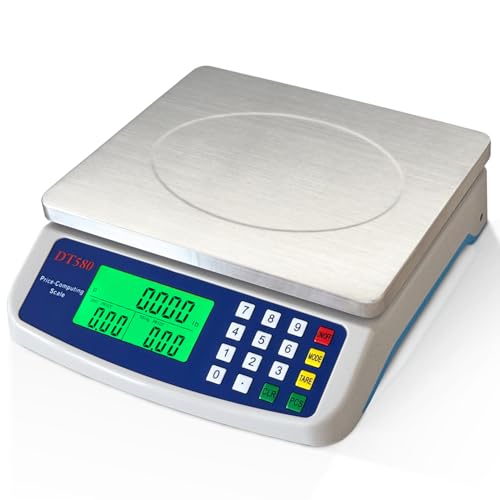
Six scales were in this pool and one is not here. LNXDMWMS publishes an 88 pound capacity and six unit conversions and then publishes no weight, no width, no depth and no height at all, and its size field reads Silver-40kg. It is the same 40 kilogram class as MOCCO with less documentation behind it, so there was nothing to compare it on.
What separates the five that remain is the number at the top of every listing: maximum capacity. Atogou states 110 pounds, MOCCO states 88, BROMECH states 66, Taylor states 11, and My Weigh states 8000 grams and never converts it. Four of those are pound figures and one is not, which is the first thing to notice about buying a scale this way.
What the table cannot tell you is whether a 1 gram increment means the same thing on a 110 pound scale as on a 66 pound one. Atogou and MOCCO both claim 1 gram steps at the top of their ranges, and neither publishes a linearity figure, a repeatability figure, or any standard the sensor was checked against. BROMECH pairs its increment with an accuracy sentence, which is not a specification either.
Capacity Published in Four Different Ways
Eleven Pounds Against One Hundred and Ten
The span across these five is the biggest difference on this page. Taylor tops out at 11 pounds, which is a portioning scale, and Atogou tops out at 110 pounds, which is a receiving scale. Nothing about the two is comparable except the word scale on the box. A kitchen weighing flour into a bowl and a kitchen weighing a box of chicken off a delivery are two different jobs.
BROMECH at 66 pounds and MOCCO at 88 pounds sit between them, and both publish their figure in kilograms first, 30 and 40 respectively. That ordering is a hint about who wrote the listing rather than about the hardware, but it does mean the pound figure in the title is a conversion the maker performed and not the number the sensor was specified in.
The One That Only Speaks Grams
My Weigh publishes 8000 grams and stops. The bullet lists four further weighing modes, pounds, pounds and ounces, ounces and kilograms, so the display will show a pound figure, but the capacity itself is never written in pounds anywhere on the listing. Lining it up against Atogou’s 110 pounds means doing arithmetic the maker declined to do, and this page does not do arithmetic for makers.
That matters more than it sounds. Capacity is the one number a commercial buyer filters on, and a listing that publishes it in a unit nobody filters in effectively hides it. The same listing is the only one of the five that publishes a percentage weighing function, which is the feature a bread baker actually opens the page for, and it is buried in the same bullet.
What the Size Fields Actually Describe
Atogou Disagrees With Itself
Atogou’s own bullet states a size of 8.7 by 9.5 by 2.6 inches, and its size field repeats that exactly. Its dimension fields say 9.4 by 8.6 by 2.5 inches. Those are not the same scale unless two of the figures have swapped places, which is what usually happens when a listing is loaded twice. The maker’s own sentence is the one this page uses.
The discarded field is the 9.4 inch figure and the 8.6 that goes with it. Neither appears in a single bullet, neither is labeled, and the listing gives no drawing that would settle which edge is which. Where a page below quotes an Atogou measurement, it is quoting the bullet, because a bullet is written by somebody who looked at the product.
Two Listings Publish No Size at All
MOCCO publishes no width, no depth and no height, and its size field contains the string 40kg, which is a capacity in a slot meant for a dimension. Nothing in its five bullets gives a measurement of the housing either. You can learn that it has a large full view display and a stainless platform, and you cannot learn whether it fits the gap beside a sink.
BROMECH publishes nothing in the dimension fields but does publish a size of 7.9 by 5.7 by 1.1 inches in the size field, in inches and again in millimeters. That is the figure used here, and it is the reason BROMECH reads as the flat one of the five: a 1.1 inch profile is a different object from a scale with a 2.5 inch body, whatever the capacity says.
Wet Work, Power and Who Each One Is Built For
A Washdown Scale Is Not a Kitchen Scale
BROMECH is the only pick that addresses water directly. It states a super sealed platform, two drain holes to keep the sensor dry, corrosion resistant stainless steel and an IP rating, and it names meat shops, delis and produce markets as the setting. That is a claim about being hosed down, not about being wiped, and no other listing here makes it.
My Weigh comes at the same problem from the other side with a hinged gunk shield, which is a cover over the join between platform and body rather than a seal. Atogou, MOCCO and Taylor say only that the platform is easy to clean. Taylor at least states that its platform lifts off and has a raised marine edge to keep spills on the metal.
Batteries, Cords and What Comes in the Box
Three of the five publish something about the power supply that will annoy somebody. Atogou ships two AA cells and a USB cable and states plainly that the AC adapter is not included and must be bought separately. Taylor includes the AC adapter but not the two AAA cells. MOCCO and BROMECH both state that an adapter is included, and BROMECH adds a rechargeable battery.
BROMECH is also the only one to publish a runtime, 180 hours of continuous use, and the only one to mention adjustable feet and a leveling bead. My Weigh publishes nothing about power at all across its five bullets, which for a scale intended to sit on a bench all day is the single largest hole in the documentation on this page.
Which One Fits Your Kitchen
The receiving door. Atogou states 110 pounds with 1 gram increments, price computing and counting, on a 304 food grade stainless platform. Buy the AC adapter at the same time, because the listing states it is not in the box.
The deli counter. MOCCO states 88 pounds, five unit conversions including milliliters, price computing and a PCS counting mode, with the adapter included. It publishes no dimensions at all, so measure your own gap first.
The wet bench. BROMECH states 66 pounds with a 1 gram increment, a sealed platform, two drain holes, 180 hours of runtime and a 7.9 by 5.7 by 1.1 inch body. Its published weight of 0.44 pounds is not credible.
The bread bench. My Weigh is the only pick with percentage weighing and a hinged gunk shield, at 8000 grams with four further modes. It never states that capacity in pounds and never mentions its power supply.
The prep station. Taylor states 11 pounds in 0.1 ounce steps, with tare and hold, a recalibratable design and a lift off 5.4 inch square platform with a marine edge. It is a portioning scale, not a receiving scale.
What We Could Not Verify
Everything above is from the listings. These are the things looked for there and not found.
- No listing publishes a repeatability or linearity figure, so a claimed 1 gram increment at 110 pounds cannot be checked against one at 66.
- No maker names a certification, a trade approval, or any standard the sensor was tested to, which is what the word commercial normally implies.
- BROMECH’s published weight of 0.44 pounds cannot be right for a sealed stainless scale, so no weight ranking is offered on this page.
- MOCCO publishes no dimensions of any kind, and its size field holds a capacity instead, so its footprint is unknown.
- My Weigh publishes nothing about batteries, adapters or runtime, and no capacity figure outside grams.
- No listing states a warranty period, a spare platform, or whether a replacement adapter can be bought.