How the Five Compare on the Numbers
Eight live pages already rank this pool: by published oven temperature, by tiers per footprint, by the gap between tiers, by packed thickness and weight, by leg height against rack count, by whether there is plating on the wire, by what there is to grip, and by how many jobs the rack will do unplugged. Temperature, tiers, legs and plating are all taken.
A pantry is organized by pairing things, and a cooling rack pairs with a sheet pan. Four of these five name the pan they are built for and three give a figure for it, and the three figures do not agree: two say a half sheet is 13 by 18 inches and one says the standard is 13 by 19. One names a jelly roll sheet instead and one names no figure at all.
What the table cannot tell you is which of the two half sheet figures is right, because the three listings that publish one do not cite anything and no standard is named by any of them. What it does tell you is that the rack figures are all smaller than the pan figures, which is the relationship you want, and that one maker asks you to check your own pan rather than trusting its number.
What a Half Sheet Pan Measures
Two Makers Say 13 by 18
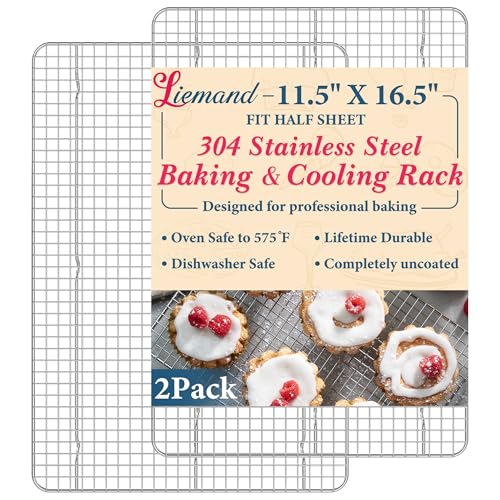
Ultra Cuisine states its rack is designed to perfectly fit a large 13 by 18 inch half sheet baking pan or cookie sheet, and publishes the rack itself at 11.5 by 16.5 inches. LIEMAND’s larger listing gives the same pan figure, 13 by 18 inches, for a rack it publishes at 11.5 by 16.5 by 1.0 inches. Two brands, one pan figure, the same rack size.
That agreement is the most useful thing on this page, because it means the pairing can be checked twice. Both racks sit about an inch and a half inside the pan on each axis, which is the clearance a rack needs to drop in without jamming. Neither maker explains how it arrived at the pan figure, and neither cites a standard by name.
One Says 13 by 19
Norpro publishes a different number for the same object: sized so the legs fit directly inside a standard 13 by 19 inch half-sheet pan. Its own rack is published at 18 by 12.5 by 1 inches, which is larger than either of the other two and consistent with the larger pan it names. The internal logic holds and the external figure does not match its siblings.
One of the two figures is wrong about what a standard half sheet is and this pool gives no way to tell which. For a pantry the consequence is practical rather than academic: a rack built for 13 by 19 inches sitting in a 13 by 18 inch pan will not drop to the bottom, and no listing here publishes a tolerance.
Naming a Pan Without a Figure
A Jelly Roll Sheet and Most Standard Pans
LIEMAND’s smaller listing names a different pan entirely, stating that its 10 by 15 inch rack fits perfectly into a standard jelly roll sheet pan and is also suitable for stand-alone use. A jelly roll sheet is a smaller format than a half sheet, so this is the right rack for a different pan rather than a worse rack for the same one.
OXO publishes the vaguest version and the shortest: tray legs are optimized to fit most standard half sheet pans, with no figure for the pan and no figure for the rack in its bullets. Its size field reads 20.3 by 11.5 inches and its dimension fields 11.0 by 20.0 by 1.5, which is longer than any pan named on this page.
The One Instruction That Helps
LIEMAND’s larger listing does the thing no other maker here does: after giving the pan figure it tells you to check your pan’s interior dimensions. On a page where two brands disagree about what a half sheet measures, that single clause is worth more than either number, because the interior is what the rack has to clear and the exterior is what gets advertised.
It is also the listing that publishes the most about the underside, with nine support feet stated to elevate food above the countertop or the pan. Nine feet across a rack of that size is a lot of contact, and on a 304 stainless rack with no plating or coating there is nothing on those feet to wear off onto a pan.
What Happens Under the Rack
Feet Counted and Feet Not Counted
Three of these five count the feet. LIEMAND’s larger rack publishes nine support feet, its smaller one four integrated support feet, and Norpro publishes 1 inch raised feet without a count. OXO publishes tray legs with neither a count nor a height, and Ultra Cuisine publishes nothing about feet at all across its five bullets.
The count matters more inside a pan than on a counter. Four feet in a sheet pan put the whole load on four points of a thin sheet, and nine spread it. Neither LIEMAND listing says so, and no listing in this group publishes a load figure, so the comparison stops at the count itself.
One Published Grid Figure
Norpro is the only listing here to put a number on the wire: a tight 0.5 inch crosswire mesh, stated to stop small cookies and fragile pastries falling through. That is the figure that decides what the rack can actually hold, and it is published once in a pool of sixteen. LIEMAND’s larger listing says narrow wire spacing and gives no figure.
Norpro also publishes the highest oven rating here at 600 F, given also as 315 C, against 575 F from the three stainless racks and nothing at all from OXO. On a ceramic coated rack the absence is notable, because a coating is the part a temperature limit usually protects.
Which One Fits Your Kitchen
You want the maker to tell you to measure. LIEMAND’s larger rack. Published at 11.5 by 16.5 by 1.0 inches for a 13 by 18 inch half sheet, in 304 stainless with no plating, nine support feet, 575 F.
You want to know what falls through. Norpro. A tight 0.5 inch crosswire mesh on a rack of 18 by 12.5 by 1 inches, rated to 600 F, sized for what it calls a standard 13 by 19 inch half sheet.
You want two racks and a named pan. Ultra Cuisine. Two 304 stainless racks at 11.5 by 16.5 inches for a 13 by 18 inch half sheet, 575 F, dishwasher safe, at 1.08 lb for the pair.
Your pan is a jelly roll sheet. LIEMAND’s smaller rack. Two racks at 10 by 15 inches with four integrated support feet, stated to fit a standard jelly roll sheet pan, rated to 575 F.
You want food to release without oil. OXO. A ceramic coated non-stick rack with reinforced edges, published at 20.3 by 11.5 inches. Its pan claim is most standard half sheet pans, with no figure.
What We Could Not Verify
These are the specifications we went looking for in all five listings and did not find.
- Which half sheet figure is correct, 13 by 18 inches or 13 by 19, since neither listing cites a standard.
- Any pan figure from OXO, which names most standard half sheet pans, or from the smaller LIEMAND rack.
- A grid or wire spacing figure from four of the five, with only Norpro publishing 0.5 inches.
- An oven rating from OXO, the only coated rack on this page.
- A load figure from any of the five, which is what a foot count would need to mean anything.
- A washing instruction from Norpro, and a weight for the OXO rack.