How the Five Compare on the Numbers
A crepe pan spends its life being lifted, tilted and swirled, so weight is the specification that decides whether making lunch for four is pleasant or tiring. It is also, in this pool, the specification most likely to be published twice with two different answers. Two listings from one brand manage exactly that, and the mistake runs in both directions.
The other figure worth having is the handle, because in all five cases it and not the pan sets the oven limit. Bakelite handles stop at 302 degrees Fahrenheit. Stainless handles reach 480 and 500. That is a spread of nearly 200 degrees decided by the part you hold, and it is the reason three of these pans can finish a filled crepe in an oven and two cannot.
What the table cannot tell you is how thick the base is on any of these. Three listings describe a thickened or widened bottom and none publishes a figure, so the reason one 10 inch pan weighs 1.76 pounds and one 12 inch pan weighs 2.2 cannot be traced. Nor does any listing state how long a Bakelite handle survives at 302 degrees.
Two Pans, Two Swapped Weights
The Ten Inch Says 2.2 and Weighs 1.76
Innerwell’s 10 inch pan publishes 1.76 pounds in its weight field. Its final substantive bullet states that the pan is lightweight enough to move freely, at only 2.2 pounds. Those two figures differ by nearly half a pound on an object you hold at arm’s length, and nothing else in the listing addresses the gap.
Everything else about the pan is specified carefully. It is triply, with a food grade 304 stainless inner layer, a 430 stainless outer layer and a thermal aluminum alloy core. The handle is hollow stainless attached by welding rather than rivets. The surface is dual honeycomb laser etched, stated free of PFOA, and the pan is dishwasher safe and oven safe to 480 degrees Fahrenheit.
The Twelve Inch Says 1.98 and Weighs 2.2
The same brand’s 12 inch pan publishes 2.2 pounds and states, in the same position in the same bullet, only 1.98. So the smaller pan’s bullet quotes the larger pan’s field, and the larger pan’s bullet quotes a figure lower than either. A 12 inch version of an identical triply build cannot weigh less than the 10 inch one, which is what makes the reading obvious.
The two listings share more than a mistake. Their second and third dimension fields are identical at 8.6 and 1.2 inches, which is plausible for a shared handle and rim, and a bullet in each one describes the pan as 11 inches while the titles say 10 and 12. Both are sound pans described by a listing assembled from a template.
The Handle Sets the Oven Limit
Bakelite Stops at 302
SENSARTE and ESLITE LIFE both use Bakelite and both cap the oven at a stated 302 degrees Fahrenheit. That is not a criticism of either pan: a Bakelite handle is genuinely cool in the hand on a hob, which is where a crepe pan spends its time, and both listings say so. It does mean neither pan finishes a filled savory crepe under a grill.
SENSARTE pairs it with the only weight figure on this page that is confirmed twice, 2.5 pounds in the field and 2.5 in a bullet, plus a wooden spreader, a Swiss granite coating stated free of intentionally added PFOA and a half inch side tied to easier flipping. ESLITE LIFE pairs it with a low profile rim, a wooden spreader and 2 pounds.
Steel Reaches 480 and 500
Cuisinart publishes the highest figure on this page, 500 degrees Fahrenheit, and it is the only listing that explains the mechanism: a V flange on the stainless stick handle stated to dissipate heat away from the handle and keep it concentrated in the pan. The interior is ceramic, stated free of PFAS, over a hard anodized exterior, and the warranty is stated as lifetime.
Innerwell’s two pans reach 480 with a hollow stainless handle attached by welding, and add a dishwasher clearance that the Cuisinart does not: Cuisinart recommends hand washing. Both Innerwell pans also put a hole in the handle for hanging, which neither Bakelite pick offers, so the steel handled pans win on storage as well as on heat.
Diameters the Fields Do Not Support
A 12 Inch Pan With a 10 Inch Field
SENSARTE’s title says 12 inch, and a bullet states a large 12 inch diameter that makes crepes to suit the biggest appetites. Its published width field reads 10 inches. On a pan whose selling point is the surface area, that is a two inch disagreement between the maker’s sentence and the maker’s field, and only the sentence explains itself.
This page uses the 12 inch figure and reports the field, which is the same treatment the Innerwell weights get. The rest of the SENSARTE listing holds together: a half inch side, a cast aluminum core on a magnetic stainless base for induction, no rivets to trap batter, and a wooden spreader supplied with the pan.
Two Diameters, One Set of Figures
ESLITE LIFE’s 11 inch pan publishes 11 by 7.3 by 0.4 inches and 2 pounds. The same brand’s smaller pan, which this page left out, publishes the same 7.3 by 0.4 inch second and third figures and the same 2 pounds, with only the first figure changed to match its own narrower diameter. An identical weight on a visibly smaller pan is not credible on any construction.
The 11 inch is the pick here because it is the family sized one and because its own bullet ties the diameter to accommodating family portions. What the pair shows is that a field weight in this category is often a category figure rather than a measurement, which is the whole reason a maker repeating the weight in a sentence is worth something.
Which One Fits Your Kitchen
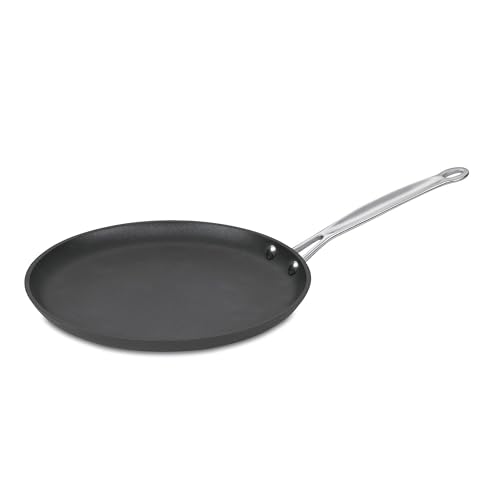
The cook finishing crepes in the oven. Cuisinart states 500 degrees Fahrenheit with a stainless stick handle and a V flange to move heat away from it, a ceramic interior stated PFAS free and a hard anodized exterior. Published at 1.76 pounds, hand wash recommended, lifetime warranty, and no spreader.
The cook who wants it in the dishwasher. Innerwell’s 10 inch triply pan states 480 degrees Fahrenheit, a dishwasher clearance and a welded hollow stainless handle with a hanging hole, plus a 1 inch raised edge. It publishes 1.76 pounds and states 2.2 in a bullet, so treat the weight as approximate.
The family lunch that needs a bigger pan. Innerwell’s 12 inch version has the same triply build, the same welded handle, the same 480 degrees and the same dishwasher clearance on a wider surface. It publishes 2.2 pounds and states 1.98, and one of its own bullets calls it 11 inches.
The cook who wants a spreader and a real weight. SENSARTE states 2.5 pounds twice, supplies a wooden spreader, uses a Swiss granite coating free of intentionally added PFOA and states a half inch side for flipping. Its Bakelite handle caps the oven at 302 degrees, and its width field reads 10 against a stated 12 inch pan.
The cook flipping thin and delicate. ESLITE LIFE’s 11 inch pan pairs a low profile rim and a flat surface with a wooden spreader, a granite coating free of PTFE, PFOA, lead and cadmium, and a magnetized base for all cooktops. Fields of 11 by 7.3 by 0.4 inches at 2 pounds, and 302 degrees in an oven.
What We Could Not Verify
Everything above comes from the makers’ own listings. These are the things a family cook needs and the published data does not supply.
- Innerwell’s two pans state weights in their bullets that do not match their own fields, and each is closer to the other pan’s figure.
- Both Innerwell listings call the same pan 11 inches in one bullet while their titles say 10 and 12.
- SENSARTE states a 12 inch diameter and publishes a width field of 10 inches, and nothing reconciles them.
- ESLITE LIFE’s 11 inch pan and the same brand’s smaller pan publish identical weights and identical second and third fields.
- No listing here publishes a base thickness, so the weight differences between these five cannot be traced to construction.
- No listing states how long a Bakelite handle tolerates 302 degrees, or what happens above it.