How the Five Compare on the Numbers
The other live pages on this pool rank by where the rack sits, by the counter it gives up, by the narrow side against the height, by how fast a busy kitchen clears and by how many parts one purchase brings. None of them asks the question a family asks after a roast, which is how much of the meal this thing will actually take before the counter has to be used as well.
Four of these five will answer that in writing and one will not. The four do not answer it the same way either: two publish fixed numbers, one publishes ranges, one counts only dishes and says how they are held, and the fifth replaces the whole idea with a weight in pounds and a lid.
What the table cannot tell you is what any of those plate counts means. No listing in this pool publishes the diameter of plate its slots are cut for, and a slot that takes twelve side plates may take eight dinner plates. One rack in the wider pool comes closest and still does not answer it: Urackify publishes a height for its plate support and warns that dishes shorter than that may not be fully supported and could slip, which is the same problem seen from the other side. It is not a pick here because it publishes no weight at all.
What Each Maker Will Count
Fixed Numbers Against Ranges
JASIWAY publishes the only fully itemized count on this page as three fixed numbers: 12 dishes, 10 bowls, 4 cups and silverware, in dedicated slots stated to keep plates upright and prevent stacking. Being specific like that is useful and it is also a promise, because a fixed number carries no room for the plate that is wider than the one the maker had in mind.
Godboat refuses the promise and publishes ranges instead: 10 to 12 plates, 8 to 10 bowls, 4 to 8 cups and one cutting board. On a page about capacity that looks weaker and is probably more truthful, because the width of a cup decides whether four or eight of them stand in the same rail. Plan on the lower number and the rack cannot disappoint you.
Eleven Plates, Seven Dishes, and None
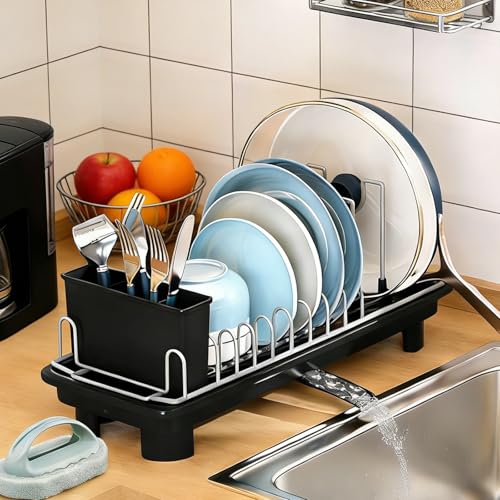
SNTD counts differently again. It publishes 11 plates, 4 cups and 30 silverwares plus room for small cookware, and skips bowls entirely. The cutlery number is the one nobody else gives, and it is backed by a caddy with 4 compartments and knife slots, plus a cup holder in 4mm thick wire with a 3.74 inch usable depth stated to reduce tipping.
Fanbsy publishes the lowest count here and the most precise description of it: 7 dishes, vertically. Ageanbri publishes no count of plates, bowls or cups anywhere in its listing. For a prep station those two sit at opposite ends of the same problem, one telling you exactly how little it takes and one telling you nothing at all.
Load Instead of Count
Seventy Pounds on a Rack That Sits in the Sink
JASIWAY publishes the highest load figure here, stating thickened tube pipes and high load bearing up to 70lb. That is the highest of the three load claims on this page, and it belongs to the rack with the lightest published weight, 1.6 pounds, which sits down inside the basin rather than on the counter beside it.
The sink position is the trade. Water drips straight into the basin, air circulates on all sides, and the counter stays dry, which is the argument its listing makes. It also means the sink is occupied while the dishes dry, and a family meal prep station is usually a kitchen where the sink is wanted back. The silicone handle sleeves are stated to lock position without sliding or scratching.
Two Tiers and a Load Rating
Ageanbri answers capacity the other way. It publishes up to 44.09 lbs of load across double shelves at 14.96 by 9.84 by 17.72 inches, in PP and PET formed by injection molding, and it counts nothing. The figure and the two tiers together say the same thing a plate count would, which is that a lot of washed tableware can be put here at once.
It adds something none of the other four has: a dust cover with cupboard doors stated to open for ventilation, so a load can be left covered on the counter between meals instead of standing in the open. Ageanbri publishes 5.07 pounds, the heaviest of these five, and it is the only pick on the page that goes upward rather than along.
Where the Published Figures Disagree
Three Listings That Argue With Their Own Fields
JASIWAY’s sentence gives 15.5 by 11 by 4.8 inches while its fields read 15.47 by 10.39 by 4.69. Two of those are rounding and one is not: a depth of 10.39 against a stated 11 is more than half an inch of difference on the measurement that decides whether the rack clears a faucet. This page follows the sentence, as the maker wrote it.
Fanbsy is starker. Its own bullet gives 14.96 by 11.02 by 5.35 inches with 38, 28 and 13.6 centimeters printed beside them, and it repeats the 5.35 for the expanded setting. Its height field reads 4.33. One of those is a different object, and since the maker states the figure twice in two unit systems, the field is what this page discarded.
What a Count Cannot Tell a Family
SNTD publishes only two of the three dimensions in its own words, 12.6 inches wide by 16.5 long, and no overall height at all, while its fields read 22.6 by 12.5 by 8.6. The 22.6 has no support anywhere in the listing. What it does publish instead is unusually practical: feet that raise the rack 2.55 inches specifically to clear a raised sink edge.
The same brand also lists a larger expandable rack, and that listing names daily use after family meals and gatherings in its bullets and then publishes no count of anything at all. That is the pattern across this pool: the listings that talk most about families are the ones least willing to say how many plates fit. The two picks that do commit to a figure, 12 dishes and 11 plates, spend their bullets on slots and compartments instead.
Which One Fits Your Kitchen
Wanting a number for every category. JASIWAY, with 12 dishes, 10 bowls, 4 cups and silverware counted separately, a stated 70lb load and bars that extend from 15.5 to 23.2 inches. It occupies the sink while it works, and publishes 1.6 pounds.
Buying on the lower end of an honest range. Godboat, at 10 to 12 plates, 8 to 10 bowls, 4 to 8 cups and one cutting board, on a counter rack published at 16.5 by 11.8 by 5.1 inches with its tray and cutlery holder measured separately.
Drowning in forks rather than plates. SNTD, the only listing here that counts cutlery, at 30 silverwares beside 11 plates and 4 cups, with a 4 compartment removable caddy, knife slots and feet that raise the rack 2.55 inches.
Keeping the counter clear and the sink in play. Fanbsy, 7 dishes held vertically, in or over a sink between 15 and 22.9 inches long, with arms from 14.96 to 22.64 inches and every figure given in inches and centimeters.
Leaving a load covered between meals. Ageanbri, two tiers at 14.96 by 9.84 by 17.72 inches rated to 44.09 lbs, with a dust cover and doors that open for ventilation. It counts no plates, and it is PP and PET rather than steel.
What We Could Not Verify
Every item below was looked for across all five listings and is not published:
- The diameter of plate any of these slots is cut for, which is what a plate count depends on.
- Whether JASIWAY’s 70lb, Ageanbri’s 44.09 lbs and Godboat’s 30 lbs cover the rack, the tray or the whole loaded assembly.
- How many of the counted plates still fit once a cutting board or a pan is standing in the rack.
- Any bowl count from SNTD, Fanbsy or Ageanbri, and any cup count from Fanbsy or Ageanbri.
- An overall height from SNTD in its own words, where its field reads 8.6 inches with nothing supporting it.
- How much the cutlery holders hold, on the four listings that name one and count nothing.