How the Five Compare on the Numbers
Sixteen listings sit on the fact sheet and most are not on this page. One pitcher publishes dimension fields too small for the volume its title claims. Another names four different sizes in a single bullet and quotes a weight in its handle claim that belongs to a size it does not sell. A third publishes a capacity, no dimensions, and bullets that break off mid sentence. None of the three can be ranked on a page about stated size.
What decides a family kitchen is how much one vessel holds and how much of it is marked. Norpro publishes 9 cups, given also as 2.2 Liters and 72 oz. EISCO publishes 5000ml. Restaurantware publishes 2 quarts. Amazing Abby publishes four separate cups from 1 cup to 8 cups. Yiyiring publishes 128oz of capacity and a scale that reads to 8 ounces.
Two of these capacities argue with themselves. Restaurantware writes that the jug measures up to 2 quarts, giving that as 4 cups in one bullet and as 8 cups in another, and 2 quarts is 8 cups. Yiyiring writes that the container holds 128oz and then that it measures accurately up to 8 ounces, which describes a storage bottle with a small scale rather than a measuring jug. The EISCO weight of 0.2 lb for a 5000ml polypropylene jug is not a figure anything here is ranked on.
How Much One Vessel Actually Holds
Nine Cups, Five Liters, or Two Quarts
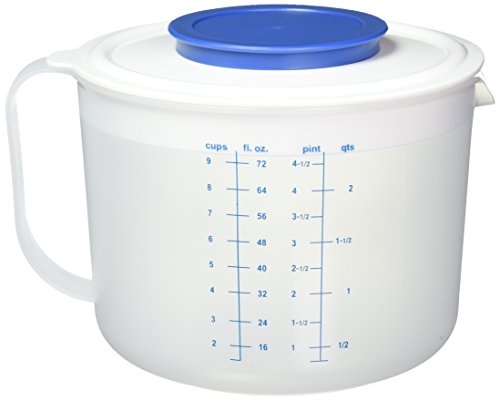
Norpro publishes the most completely stated capacity here. It gives 9 cups, then repeats it as 2.2 Liters and again as 72 oz, and the jug carries scales in cups, pints, fluid ounces, Liters and milliliters. For a batch of pancake batter measured from a recipe in whichever units it happens to use, that is one vessel doing the conversion rather than the cook.
EISCO is larger again at 5000ml, restated as 5 Liter and as 169.1 Ounces, with raised graduations every 250ml. It is a laboratory jug that the listing offers to households as an afterthought, and the graduation interval is the giveaway: 250ml steps are coarse for a cake and perfectly normal for a beaker. Restaurantware publishes 2 quarts and a fine embossed scale.
Four Small Cups Instead of One Large One
Amazing Abby answers the same question differently. Rather than one jug it supplies four, at 1 cup, 2 cups, 4 cups and 8 cups, each embossed in imperial and metric, and states that they are unbreakable, stackable and dishwasher safe. The published 1.3 lb covers all four together, and the dimension fields describe the carton rather than any one cup, so they were moved out.
In a family kitchen that is a real alternative to a big jug. Four vessels means four things to wash and four things to store, and it also means the 1 cup of milk and the 8 cups of stock never share a scale. The largest of the four, 8 cups, is roughly the same capacity as the whole Norpro jug.
Where the Capacity Claims Break Down
Two Quarts, Four Cups, Eight Cups
The Restaurantware listing states in one bullet that the jug measures up to 2 quarts, written as 4 cups, and in another that it is a 2 quart measuring cup, written as 8 cups. Two quarts is 8 cups, so one of those two parentheses is wrong and the listing gives no way to tell which figure the mold was built to.
The rest of that listing is careful. The graduations are embossed rather than printed, both metric and imperial appear on the same vessel, and the dishwasher claim is unqualified. The published dimensions, 7.75 by 6 by 7.5 in, are also repeated in the size field, so the shape is well documented. It is only the capacity, the one number a measuring jug exists for, that appears twice in two forms.
A Hundred and Twenty Eight Ounces, Marked to Eight
Yiyiring publishes a capacity of 128oz and then states that the container enables accurate measure up to 8 ounces without needing a distinct measuring cup. Those two sentences describe different objects. The first is a large storage bottle, the second a small dosing scale, and the product is sold as measuring containers with lids in a pack the listing says contains one.
Its dimensions are the best corroborated in the pool, with the fields at 13.19 by 7.28 by 5.31 in and the maker’s own sentence giving 13.1 by 7.2 by 5.2 inches, or 33.3 by 18.2 by 13.3 cm. HDPE is named, which none of the others use. What is not published is whether the scale continues past 8 ounces at all, which for a family batch is the question.
What Happens to the Jug After the Batter
One Lid, and It Is the Reason to Choose It
Norpro is the only pick with a lid that does anything. The listing describes a two piece splatter guard lid with a center cap that pops out, so a hand mixer beater or an immersion blender goes in through the hole while the lid stays on. In a family kitchen that is the difference between whipping cream in the jug and washing the wall behind it.
Yiyiring states that lids are included and never describes them. The other three publish no lid at all. Amazing Abby offers stacking instead, which solves storage rather than splatter, and EISCO offers a tapered spout and a handle, which is a laboratory pouring arrangement and says nothing about what happens while the mixer is running.
Heat, Washing, and What the Plastic Is
EISCO publishes the only temperature figure in the pool, stating tolerance up to 135 C and naming autoclave, microwave and dishwasher use, along with resistance to strong acids, alcohols and bases. That is a laboratory specification and it is also the most useful heat statement a cook could be given, because it covers hot stock and a dishwasher cycle without ambiguity.
The others are vaguer. Norpro names food grade BPA free plastic and top rack dishwasher safe. Amazing Abby names food grade polycarbonate and dishwasher safe. Restaurantware says sturdy plastic and dishwasher safe without naming the polymer. Yiyiring names HDPE and then makes no washing statement at all, which is the one combination that leaves both questions open.
Which One Fits Your Kitchen
Batter whipped in the jug it is poured from. Norpro, 9 cups given also as 2.2 Liters and 72 oz, with a two piece splatter guard lid whose center pops out for beaters, scales in five units, and 6 by 8.5 by 7 in published in words.
Stock, brine, and anything measured in liters. EISCO, 5000ml with raised graduations every 250ml in polypropylene, stated to 135 C and safe in an autoclave, a microwave and a dishwasher. Ignore its published weight, which cannot be right.
A well made jug with one number in dispute. Restaurantware, 2 quarts with embossed metric and imperial graduations, dishwasher safe, published at 7.75 by 6 by 7.5 in. Read the capacity bullets before buying, because they disagree with each other.
Four sizes rather than one big one. Amazing Abby, 1, 2, 4 and 8 cup vessels in food grade polycarbonate, embossed in both unit systems, stated unbreakable, stackable and dishwasher safe, published together at 1.3 lb.
Storing a batch rather than measuring one. Yiyiring, 128oz of HDPE with lids and the best corroborated dimensions here, 13.1 by 7.2 by 5.2 inches. Its own listing only claims accuracy to 8 ounces, so treat it as a container first.
What We Could Not Verify
Every figure above comes from the maker’s own listing text. These are the things we went looking for and could not source in any of them.
- Restaurantware gives its 2 quart capacity as 4 cups in one bullet and as 8 cups in another, and nothing in the listing resolves which is the molded scale.
- Yiyiring publishes 128oz of capacity and states accuracy only to 8 ounces, and never says whether the scale continues above that.
- Only EISCO publishes a graduation interval, so how finely the other four are divided cannot be compared on any figure.
- EISCO publishes 0.2 lb for a 5000ml polypropylene jug, which is not credible, and the listing offers no other weight.
- Amazing Abby publishes one weight for four vessels, so what any single cup weighs is not available.
- Only EISCO states a temperature, so whether the other four can take boiling stock is unanswered in every one of their listings.