How the Five Compare on the Numbers
A first baking kit is a counting problem before it is a quality problem. One purchase might be three nested jugs, or two buckets with lids and scoops, or a single tool that mixes and pours. The listings in this pool publish that count plainly and publish almost nothing else, so the piece list is where a starter kit is actually decided.
Across the sixteen listings the counts run from one vessel to four. KitchenAid and Amazing Abby both publish three jugs at 1, 2 and 4 cups. Amazing Abby also sells a four piece adding an 8 cup. Varfukaz publishes two 2 quart containers with two lids and two scoops. AMZ Empire publishes exactly three pieces. Norpro publishes one.
What the table cannot show is which count is right for a first kit, because the counts measure different things. Three jugs at 1, 2 and 4 cups is one job done three ways. Two 2 quart buckets with lids is a different job entirely, and a batter dispenser is a third. Only two of these five publish a dimension for the vessel itself.
Counting What Arrives
Three Jugs, Two Different Sets
KitchenAid and Amazing Abby publish the same three capacities and almost nothing else in common. KitchenAid publishes 1 cup, 2 cup and 4 cup jugs in BPA free plastic, with an integrated pouring spout and a non-slip handle on each, markings in cups, fluid ounces and milliliters, and jugs that nest for storage. It publishes no dimension for any of the three.
Amazing Abby publishes the same trio as 1 cup at 8 oz and 250 ml, 2 cups at 16 oz and 500 ml, and 4 cups at 32 oz and 1000 ml, in food-grade polycarbonate, with both imperial and metric measurements embossed and highlighted rather than printed. It publishes no spout and no handle. The same three capacities, and a different object.
One Object That Replaces Two
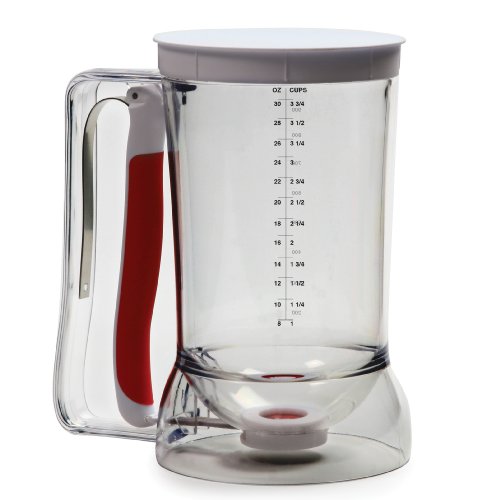
Norpro goes the other way and publishes a single piece: a batter dispenser holding 4 cups, published as 1 L, with measurements on the side in ounces, cups and milliliters. You pull a soft grip handle to dispense and release it to stop. The listing states the point of it directly, mix and dispense your batter with one tool, no wasted batter and less mess.
AMZ Empire is unusually literal about what arrives: set of 1 container, 1 lid and 1 cup. The container is 2 quarts of polypropylene, NSF listed, made in the USA, dishwasher and freezer safe, and rated between minus 40 and 160 degrees Fahrenheit. AMZ Empire publishes 0.44 pounds for the three pieces, the lightest of these five, and is the only pick here that publishes a temperature range.
What the Sets Do Not Publish
Capacities Without Dimensions
Three of the five publish no dimension for the vessel itself, only for the carton it ships in. KitchenAid publishes 8.63 by 5.06 by 5.0 inches for the box of three. Amazing Abby publishes 4.7 by 6.6 by 6.0 inches for the box of three. Varfukaz publishes 7.36 by 8.07 by 4.33 inches for the pair. None of those is a jug.
That matters more than it sounds. A 4 cup jug and a 2 quart bucket are different heights and different mouths, and the drawer or the shelf they have to live in is a fixed gap. On three of these five the only way to find out is to buy it. The capacities are published to the milliliter and the object is not measured at all.
The One Listing Whose Fields Match Its Own Words
AMZ Empire is the exception and it is worth pointing at. Its bullet publishes a height of 4 3/16 inches and a top diameter of 7 3/16 inches. Its dimension fields read 7.18 by 7.18 by 4.18 inches. Those are the same figures written two ways, which is rare enough in this pool that it counts as a specification in itself.
Norpro is the counter-example. Its own bullet publishes 7.25 by 6.5 by 6.5 inches while its dimension fields read 4.5 by 7.0 by 7.5 inches, and the two do not overlap on a single number. This page uses the sentence, because a maker writing out its own measurement in a feature bullet is a better source than a field nobody signs.
Jugs, Buckets and the Difference
A Measuring Jug Is Not a Proofing Container
Two of these five are not jugs and the listings say so. Varfukaz publishes a dough proofing container with a lid, designed to create an airtight environment for sourdough, pizza dough and bread to rise, with red measurement markings you read through the wall without opening it. It publishes a measuring scoop with each of the two containers.
Ziliny publishes the single-container version of the same thing, 2 quarts of polycarbonate with a lid and a red scale, graduated so you can see how much is left without opening it. AMZ Empire publishes a 2 quart container, a lid and a cup. For a baker who proofs in the vessel and measures in it too, that is one purchase instead of two.
What a First Kit Actually Needs
Eleven of the sixteen listings on this fact sheet are one vessel, with or without a lid, and five bring more than one container. Two of the singles are worth knowing about anyway. One is a polycarbonate pitcher with laser etched markings and a published temperature range, and the other a stainless steel cup whose graduation steps are printed in its own listing. Neither is a kit, and neither was picked here.
For a first kit the honest answer is that a count is not a quality. Three jugs at 1, 2 and 4 cups covers most recipes and stores as one object. One 2 quart bucket with a lid covers proofing and storage, and publishes markings rather than a stated interval. A batter dispenser does one job better than a jug and every other job worse.
Which One Fits Your Kitchen
You want three sizes and a spout. KitchenAid publishes 1 cup, 2 cup and 4 cup jugs with an integrated pouring spout and a non-slip handle on each, markings in cups, fluid ounces and milliliters, and three jugs that nest together for storage.
You want markings that cannot wear off. Amazing Abby publishes the same three capacities in polycarbonate with imperial and metric measurements embossed and highlighted rather than printed, stackable and dishwasher safe, at 0.72 pounds for the set of three.
You proof dough as often as you measure. Varfukaz publishes two 2 quart containers with airtight lids, red markings readable through the wall and a measuring scoop with each. It publishes no size for one container and no material.
You want the fewest pieces that still cover both jobs. AMZ Empire publishes one container, one lid and one cup at 2 quarts, in NSF listed polypropylene, dishwasher and freezer safe, rated between minus 40 and 160 degrees Fahrenheit.
You make pancakes and waffles more than bread. Norpro publishes a single 4 cup dispenser with a soft grip trigger, measurements in ounces, cups and milliliters, and its own size as 7.25 by 6.5 by 6.5 inches.
What We Could Not Verify
Every figure above is a manufacturer’s own published number or sentence. These are the things we went looking for across all sixteen listings and did not find.
- A dimension for one vessel from KitchenAid, Amazing Abby or Varfukaz. All three publish only the carton the purchase ships in.
- A weight for one jug rather than for the whole purchase, from any of the five picks.
- A material for Varfukaz or for Norpro. Neither names what its vessel is made of.
- A graduation interval for any of the five picks, so how finely each scale is divided is unstated.
- A dishwasher or temperature statement from Varfukaz and Norpro, the two picks that publish neither.
- Any statement from KitchenAid about whether its markings are printed, embossed or molded into the plastic.