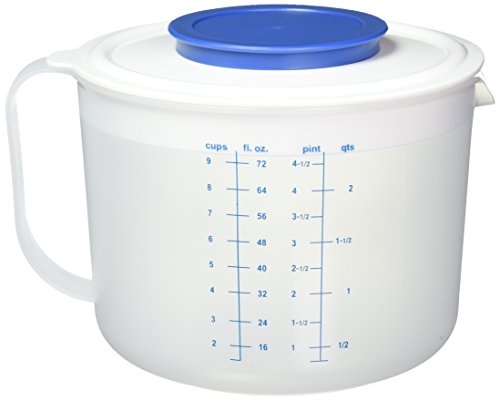
Norpro Mixing Jug with Measures
A two piece splatter lid whose center cap pops out for a hand mixer or immersion blender.
- One Size
- 0.55 lb
The deciding specification is how the scale is applied to the jug, because a printed line that fades makes the capacity meaningless.
By the Lush Editorial Team·Researched & Compared
I compared the published capacities, weights, dimensions and marking methods of five plastic measuring jugs and sets against each maker's own listing text.
A two piece splatter lid whose center cap pops out for a hand mixer or immersion blender.

The only pick to name its marking process, a laser etch the maker calls wear resistant.

Embossed metric and imperial graduations, and the lightest of the five at 0.26 pounds.

Marked at 128 ounces and supplied with a lid, for dough that goes straight into the refrigerator.

Four stacking polycarbonate cups at 1, 2, 4 and 8 cups rather than a single jug.
| Model | Brand | Size (Capacity) | Weight | Best For |
|---|---|---|---|---|
| Norpro Mixing Jug with Measures | Norpro | One Size | 0.55 lb | Best for mixing in the jug |
| NaNaPaly 64oz Measuring Pitcher with Permanent Laser... | NaNaPaly | 64 Ounces | 0.5 lb | Best for markings that will not fade |
| Restaurantware Plastic Measuring Cup - Chef 101 Meas... | Restaurantware | 7.75" × 6" × 7.5" | 0.26 lb | Best for dual unit recipes |
| Yiyiring 1 Pcs Measuring Containers with Lids | Yiyiring | about 128 oz in capacity | 0.65 lb | Best for batches you need to cover |
| Amazing Abby - Melissa - Plastic Measuring Cups (4-P... | Amazing Abby | 4-Piece Set (1/2/4/8-Cup) | 1.3 lb | Best as a set of graded cups |
A two piece splatter lid whose center cap pops out for a hand mixer or immersion blender.
The only pick to name its marking process, a laser etch the maker calls wear resistant.
Embossed metric and imperial graduations, and the lightest of the five at 0.26 pounds.
Marked at 128 ounces and supplied with a lid, for dough that goes straight into the refrigerator.
Four stacking polycarbonate cups at 1, 2, 4 and 8 cups rather than a single jug.
The Norpro Mixing Jug is the pick for mixing in the vessel: 9 cups with a two piece splatter lid whose center pops out for a hand mixer. The NaNaPaly 64oz pitcher is the only one naming its marking process, a laser etch. The Restaurantware Chef 101 is the lightest at 0.26 pounds with embossed dual unit graduations. The Yiyiring is marked at 128 ounces with a lid. The Amazing Abby set is four stacking cups instead of one jug.
“Read how the scale is applied before you read the capacity.”
Lush Food & Drink
Most bread formulas are written in grams, and none of these five publishes a weight scale. All five mark volume only, in cups, ounces, milliliters or a combination. That means a jug from this page handles water, milk and oil well and handles flour poorly, because flour packs to different densities. If your recipes are weight based, a jug measures your liquids and a scale measures your flour.
Because those two figures cannot both describe the same object, and the dimension fields are the ones that do not fit. A box of 4 by 4 by 6 inches does not enclose 64 ounces of liquid. The maker's description repeats the 64 ounce capacity, the 2000 milliliter equivalent and the 8 cup marking, and also lists 32, 120 and 160 ounce versions, so the dimension fields most likely belong to another size in that range.
Only the Norpro publishes a design for it. Its lid is a two piece splatter guard whose center cap pops out so beaters or an immersion blender can pass through while the guard stays on. The other four publish nothing about mixer use. A tall jug with no lid can still take a hand mixer, but the maker makes no claim about splatter, wall strength or whether the markings survive contact with a beater.
It depends on which measurement you take most often. The Amazing Abby set gives 1, 2, 4 and 8 cup vessels that stack into one cupboard slot, so a small measure is never read off the bottom of a large jug, where the error is worst. A single jug wins when you want to measure, mix and pour without moving the batter, which is what the Norpro lid is built for.
It means the numbers and lines are formed into the plastic during molding rather than printed onto the surface afterward. The Restaurantware and the Amazing Abby set both state embossed graduations, and Amazing Abby adds that its embossing is highlighted, which suggests a colored pass over the raised shapes. The raised shape cannot wash away. A highlight applied over it can wear, and neither maker states how it is applied.
The Yiyiring states 128 ounces, well above the Norpro at 9 cups, the NaNaPaly at 64 ounces and the Restaurantware at 2 quarts. The capacity appears twice in its listing, which is why it is used here. The same listing also says the container measures up to 8 ounces, and that line contradicts the capacity. Treat the 128 ounces as the vessel size and the 8 ounce claim as an error.
Specifications come from the manufacturers' own published listings. Lush Food & Drink may earn a commission if you buy through a link on this page, at no extra cost to you. How we research.
Capacity is the first split. The Yiyiring bottle is marked at 128 ounces, the Norpro holds 9 cups, which its own listing converts to 2.2 liters and 72 ounces, the NaNaPaly is a 64 ounce pitcher, and the Restaurantware is described as 2 quarts. The Amazing Abby is not one vessel at all but four cups of 1, 2, 4 and 8 cup capacity, so its 1.3 pound figure covers the whole set.
Weight separates them less than the listings suggest. The Restaurantware is the lightest of the five at 0.26 pounds, the NaNaPaly is 0.5 pounds and the Norpro 0.55 pounds. Only the Norpro and the Restaurantware publish a length, width and height that agree with the measurements repeated in their own descriptions. The NaNaPaly and Yiyiring disagree with themselves, and the Amazing Abby publishes no dimensions at all.
| Specification | Restaurantware Chef 101 | Norpro Mixing Jug | NaNaPaly 64oz Pitcher | Yiyiring Measuring Bottle | Amazing Abby Melissa |
|---|---|---|---|---|---|
| Published capacity | 2 quarts | 9 cups (2.2 liters, 72 oz) | 64 oz (2000 ml, 8 cups) | 128 oz | 1, 2, 4 and 8 cups |
| Pieces in the box | 1 | 1 | 1 | 1 | 4 |
| Weight | 0.26 lb | 0.55 lb | 0.5 lb | 0.65 lb | 1.3 lb, all four cups |
| Dimension fields | 7.75 by 6 by 7.5 in | 6 by 8.5 by 7 in | 4 by 4 by 6 in (see note) | 7.28 by 13.19 by 5.31 in | not published |
| Dimensions in the maker’s own words | 7.75 by 6 by 7.5 in | 6 by 8.5 by 7 in | not published | 13.1 by 7.2 by 5.2 in | not published |
| Material | Plastic, type not stated | BPA free food grade plastic | Food grade polycarbonate | HDPE | Food grade polycarbonate |
| How the scale is applied | Embossed graduations | Graduated scales, method not stated | Laser etched, described as fade proof | Marked in ounces, method not stated | Embossed and highlighted |
| Units on the scale | Metric and imperial | Cups, pints, fluid ounces, liters, milliliters | Ounces, cups, milliliters | Ounces | Imperial and metric |
| Lid | not published | Two piece splatter guard with pop out insert | not published | Yes, lid included | not published |
| Dishwasher safe | Yes | Top rack | not published | not published | Yes |
| Stated temperature range | not published | not published | Minus 4 to 248 F | not published | not published |
What the table cannot show you is how a scale reads when the jug is full of batter. A graduation that sits on the outside of a translucent wall is read through whatever is inside it, and none of these makers state the line spacing on the scale, so there is no way to tell from the published data whether a jug is marked every quarter cup or every two cups. Fill lines for dough specifically are not published by any of the five.
The Restaurantware and the Amazing Abby set both use embossed graduations, which means the numbers are formed in the plastic rather than printed on it. Restaurantware says the embossing eliminates guesswork; Amazing Abby says both imperial and metric measurements are embossed and highlighted, which implies a second colored pass over the molded shapes. An embossed line cannot wash off, but a highlight over it can.
The Norpro states graduated measurement scales in cups, pints, fluid ounces, liters and milliliters without saying how those scales are applied. That is a real gap on a jug intended for mixing, because a hand mixer and an immersion blender both work inside the vessel. Neither the listing nor its feature text says whether the markings are molded, printed or a decal, so durability under a beater cannot be judged from what is published.
The NaNaPaly is the only one of the five to name its marking process. Its listing calls the scale permanently laser etched and describes it as wear resistant and fade proof, with a dual sided design carrying ounces, cups and milliliters. For anyone who has scrubbed a printed jug until the 2 cup line vanished, that is the most specific durability claim on this page, though it is the maker’s claim and not a measured result.
The Yiyiring sits at the other end. Its text promises clear measurement markings that help ensure accurate reading at all times but never says whether they are printed, molded or etched, and never states the interval. Its material, HDPE, is opaque compared with the polycarbonate and polypropylene used by the others, which matters because a scale you read from the outside depends on seeing the contents behind it.
The NaNaPaly’s dimension fields give 4 by 4 by 6 inches. Its own description says the pitcher holds 64 ounces, and lists 32 ounce, 64 ounce, 120 ounce and 160 ounce versions in the same family. A box measuring 4 by 4 by 6 inches does not enclose 64 ounces of liquid, so the dimension fields cannot be describing the jug the page is selling. This guide uses the maker’s own words instead.
That means the 64 ounce capacity, the 2000 milliliter equivalent and the 8 cup marking are treated as real, while the length, width and height are set aside as belonging to some other size in the range or to a packing carton. The table above carries the figures with a note rather than hiding them, because a buyer who checks the listing will see the same numbers and deserves to know why they are not used here.
The Yiyiring publishes both, and they turn out to be the same object twice. Its dimension fields read 7.28 by 13.19 by 5.31 inches, and its feature text states that the 128 ounce bottle equates to roughly 33.3 by 18.2 by 13.3 centimeters, or 13.1 by 7.2 by 5.2 inches. Each figure matches to within a tenth of an inch, and only the order of the axes differs. It is also the largest stated capacity of the five by a wide margin.
The same listing then says the container enables accurate measure up to 8 ounces, which contradicts the 128 ounce capacity in the line above it. One of those two numbers describes something other than this product, most likely a smaller item in the same range. Because the capacity figure is repeated twice and the 8 ounce figure once, the capacity is used here and the 8 ounce claim is flagged rather than relied on.
The Norpro is the only one of the five with a published lid designed to be used while mixing. It is a two piece splatter guard whose center cap pops out so hand mixer beaters or an immersion blender can go in while the lid stays on. For pancake batter and cake mix, that turns a measuring jug into the bowl, and its 9 cup capacity leaves headroom above a batch that is being beaten.
The Yiyiring also ships with a lid, but the listing frames it as storage rather than splatter control: a bottle you fill, close and keep. Restaurantware, NaNaPaly and Amazing Abby publish no lid at all. If you want to mix in the vessel and then refrigerate the batter in the same vessel, only two of these five say anything about covering it.
Norpro publishes a contoured pour spout and an integrated ergonomic handle. NaNaPaly describes a handle it calls 7 shaped, and claims a secure grip with as much as 160 ounces of liquid in the largest pitcher in its range, which is a statement about a different size than the one picked here. Restaurantware describes a clear body for checking liquid level but does not state a spout or handle shape.
Storage works differently for the Amazing Abby, which is four cups that stack inside each other and go in the dishwasher. That is the whole argument for choosing a set over a jug: a 1 cup vessel for a starter feed and an 8 cup vessel for a double batch of batter take one cupboard slot together. The trade is that no single piece of it has published dimensions.
The baker who mixes batter in the jug. The Norpro is the only pick with a splatter lid whose center pops out for a hand mixer or immersion blender, and it publishes cups, pints, fluid ounces, liters and milliliters on one scale, so a recipe in any of those units can be followed without converting.
The cook following recipes from two countries. The Restaurantware carries embossed metric and imperial graduations and is the lightest of the five at 0.26 pounds. Its listing contradicts itself on cup count, so read the 2 quart figure and ignore the cup conversion printed beside it.
The person whose old jug lost its numbers. The NaNaPaly is the only one to name its marking process, a permanent laser etch the maker calls fade proof, and it is the only pick that publishes a temperature range, from minus 4 to 248 F.
The batch cook who needs volume and a lid. The Yiyiring is marked at 128 ounces and comes with a lid, so mixed dough or batter can be closed and moved. Accept that its dimensions live only in its description and that its measuring range is stated inconsistently.
The baker who wants graded sizes. The Amazing Abby is four polycarbonate cups at 1, 2, 4 and 8 cups that stack for storage. It is not a jug, and a page about jugs should say so, but it answers the same question when a recipe needs a small measure and a large one in the same session.
These are the things a buyer would reasonably want and no maker on this page states: