How the Five Compare on the Numbers
A scoop given as a gift has to explain itself, because the sizing system does not. Disher numbers run backwards, so a #60 is smaller than a #20, and nothing about the tool says so. These five handle that four different ways: a set that publishes the number with its volume, a set that drops the numbers and publishes tablespoons only, a scoop with the size labeled on the handle, and two that identify themselves by handle color.
The volumes published are 1, 2 and 3 tablespoons on one set, 1, 2 and 3 tablespoons again with milliliters and ounces beside them on another, 4 tablespoons on a single scoop, 3.25 oz on another and 1.35 oz on the last. Weights run from 0.08 lb to 1.14 lb, and the lowest of those is not a figure to believe.
What the table cannot settle is the Saebye weight. It publishes 0.08 lb for a #24 stainless steel scoop with a trigger mechanism, where a comparable single scoop here publishes 0.26 lb and 0.29 lb. The volume figures in that listing are unusually complete, at 1.35 oz with 40 ml and 2.7 tablespoon, so this page uses those and leaves the weight alone.
Four Ways to Say What Size It Is
The Number, the Volume and the Ounces
JUNADAEL J publishes the sizing system in full for every scoop in its set: the small is a #60 holding 1 tablespoon or 0.5 oz, the medium a #40 holding 2 tablespoons or 1 oz, and the large a #20 holding 3 tablespoons or 1.5 oz. Three scoops, three numbers, two units each. For a gift that is the version that teaches the recipient how dishers work rather than assuming it.
LifHap publishes the same three volumes and none of the numbers: small at 1 tablespoon, 15 ml and 0.5 oz, medium at 2 tablespoons, 30 ml and 1 oz, large at 3 tablespoons, 45 ml and 1.5 oz. It is the more legible set to a beginner and the less useful one for following a recipe written in disher numbers, which is most professional baking writing.
Stamped on the Handle, or Painted On
King Arthur takes the approach a gift benefits from most: the size is clearly labeled on the handle for quick identification. It is a single 4 tablespoon scoop, published at 8.23 by 3.4 by 1.55 inches and 0.29 lb, in 18/8 stainless steel with BPA free and PFAS free plastic, and it is the only pick here that publishes a full size in the maker’s own words.
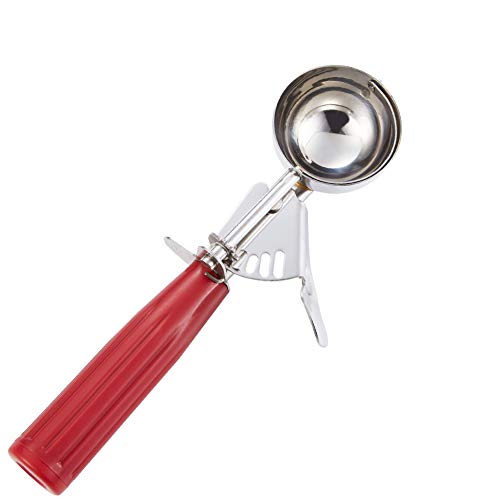
Restaurantware and Saebye both use color instead. Restaurantware publishes a #12 at 3.25 oz with a green handle, stating that the color allows quick visual identification within color coded systems. Saebye publishes a #24 at 1.35 oz with a red handle. Color works in a kitchen that already knows the code and says nothing to a recipient opening a box.
What a Set Actually Gives
Three Scoops or One
Two of the five are sets of three and three are single scoops. JUNADAEL J publishes 1.14 lb for its three and LifHap 0.73 lb for its three, both in stainless steel with sprung trigger handles. Against that, the single scoops publish 0.29, 0.26 and 0.08 lb, and each covers one size only.
For a bread making gift the set is the safer choice and the single scoop is the more considered one. A #12 at 3.25 oz portions rolls and burger buns, a 4 tablespoon scoop portions scones and jumbo cookies, and a #24 at 1.35 oz portions dinner rolls. None of those three listings says which dough it suits, and two of them are described as ice cream scoops in their own titles.
What Nobody Publishes
Not one of these five publishes a bowl diameter. That is the figure that decides how wide a portion sits on a tray, and on this page the volume is all there is. A reader can work from what the makers do print, 1, 2 and 3 tablespoons on the sets, 4 tablespoons on King Arthur, 3.25 oz and 1.35 oz on the other two singles, but a volume does not say whether the ball leaves the bowl tall and narrow or shallow and wide.
Nobody here publishes the size of the baked result either. For dough that matters more than it does for ice cream, because a roll spreads and a cookie spreads further, and a volume alone does not tell you how many fit on a sheet. King Arthur comes nearest by naming what its 4 tablespoon scoop is for, jumbo cookies, scones, muffins and cupcakes, which is a use rather than a measurement.
What Happens After the Gift
Every One Says Dishwasher
All five publish a dishwasher statement, which is unusual, and two qualify it. JUNADAEL J states dishwasher safe and hand washing both. Saebye states dishwasher safe and asks you to avoid harsh detergents, rinsing the bowl with clean water. King Arthur, LifHap and Restaurantware state dishwasher safe and stop there.
Only King Arthur names the plastic in the handle, as BPA free and PFAS free, which is the part a dishwasher actually tests on a sprung scoop. Three of the five name 18/8 stainless steel for the bowl and one says only high quality stainless, and no listing publishes anything about the spring inside the mechanism.
The Trigger, Four Ways Described
Each listing describes the release differently and none of them measures it. Saebye publishes a cog and ratchet release system. King Arthur publishes a spring loaded handle with a scraper. JUNADAEL J publishes a spring trigger system with a soft non-slip grip. LifHap publishes a spring and a smooth gear mechanism. Restaurantware publishes an ergonomic thumb trigger.
All five are the same mechanism dressed in different words, and for stiff bread dough rather than cookie dough the spring is what fails first. No listing here publishes a cycle count, a warranty or a replacement part, so the wording is the whole of the evidence about a component that will be squeezed a few hundred times a year.
Which One Fits Your Kitchen
Learning the numbering as you go. JUNADAEL J, three 18/8 stainless scoops published as #60 at 1 tablespoon or 0.5 oz, #40 at 2 tablespoons or 1 oz and #20, with soft non-slip rubber grips and a spring trigger release, published at 1.14 lb for the set and stated dishwasher safe.
Volumes without the jargon. LifHap, three stainless steel scoops published at 1 tablespoon with 15 ml and 0.5 oz, 2 tablespoons with 30 ml and 1 oz, and 3 tablespoons with 45 ml and 1.5 oz, with an effort saving spring and a smooth gear mechanism, at 0.73 lb for the three.
A size you can read on the tool. King Arthur, a single 4 tablespoon scoop with the size clearly labeled on the handle, published at 8.23 by 3.4 by 1.55 inches and 0.29 lb in 18/8 stainless steel with BPA free and PFAS free plastic, spring loaded with a scraper.
Portioning rolls by the ounce. Restaurantware, a #12 portion scoop published at 3.25 oz with a green handle for quick visual identification in a color coded system, published at 3.35 by 8.6 by 1.5 inches and 0.26 lb, and stated dishwasher friendly.
Dinner rolls and a red handle. Saebye, a #24 scoop published at 1.35 oz with 40 ml and 2.7 tablespoon given alongside it, in 18/8 stainless steel with a cog and ratchet release, identified by a red handle, dishwasher safe with harsh detergents to be avoided.
What We Could Not Verify
Every figure above is quoted from the listing that published it. These are the things a gift set raises and no listing here answers.
- Not one of the five publishes a bowl diameter, though six other listings in this pool publish one.
- No listing on this page says what size the baked portion becomes.
- Three of the five publish a disher number and two publish none at all.
- Saebye publishes 0.08 lb for a stainless steel scoop with a trigger mechanism.
- No listing publishes a warranty, a cycle count or a spare spring for the release.
- None of the five says which dough or batter its size is meant for.