How the Five Compare on the Numbers
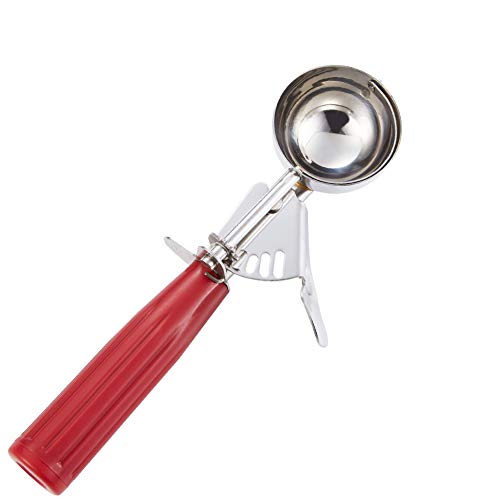
A trigger scoop is not one object. It is a bowl, a sprung wiper, a pivot and a handle, and the pivot is where dough dries and a dishwasher cycle is either enough or it is not. So a dishwasher page has to read the wording rather than count the claims: four of these five say something about a machine, and no two of the four say the same thing.
Spring Chef says dishwasher safe and then explains why the scoop should survive, arguing that its bowl is a single metal piece rather than two welded together, because a seam lets dough get trapped. Saebye says dishwasher safe and attaches two conditions. King Arthur says it twice and names the plastic. Restaurantware says dishwasher-friendly, which is not the same phrase. Solula says nothing at all.
What the table cannot tell you is whether any of these went through a machine before the copy was written. Four listings assert a dishwasher and none publishes a cycle, a temperature or a detergent type, except Saebye, which publishes the opposite: avoid harsh detergents. On a tool with a spring inside it, that single caution is the most specific thing anybody here says about a dishwasher.
The Two That Explain Themselves
Spring Chef Argues About the Seam
Spring Chef is the only listing on this page that connects washing to construction. It states dishwasher safe in passing and then spends a whole bullet on the bowl: Grade 304 18/8 stainless steel with a single metal piece construction, against others that have a weak scoop head made of two pieces welded together which can let dough get trapped. Trapped dough is the actual failure a dishwasher is meant to prevent.
It also publishes the only mechanical clearing aid described as such, a wiper that cleanly removes sticky dough with just a swipe, and it is the only pick that publishes a result rather than a portion: a #20 at 2.93 tablespoons that yields a 3.5 inch cookie. Handles are soft and ergonomic, and it publishes 0.35 lb on dimension fields of 2.48 by 8.46 by 0.1 inches.
Saebye Publishes the Conditions Nobody Else Does
Saebye states hand wash and dishwasher is safe, and then adds two sentences that no other listing here matches: avoid harsh detergents, and simply rinse the bowl of the scoop with clean water. That is a caution and a routine, and on a sprung tool with a pivot it is more useful than a bare permission, because it tells you what the maker is actually worried about.
The bowl is 18/8 stainless described as stain-resistant and unable to pit, rust or corrode, the release is a cog-and-ratchet system needing only a gentle press, and the capacity is published three ways, 1.35 oz, 40 ml and 2.7 tablespoons, as a #24. The figure to distrust is the weight: 0.08 lb on a scoop whose fields run to 9.49 inches cannot be the tool.
Saying It Twice, and Saying It Differently
King Arthur Names the Part a Dishwasher Attacks
King Arthur publishes dishwasher safe in two separate bullets, once in the materials line and once under care instructions, and the materials line is the one that matters: 18/8 stainless steel and BPA-free, PFAS-free plastic. Naming the plastic is the point, because on a trigger scoop the plastic is the part a hot cycle degrades and the steel is not.
It is also the most completely measured pick here, publishing 8.23 by 3.4 by 1.55 inches in its own words. The dimension fields repeat 8.23 inches and 3.4 inches but give 0.1 inches for the third figure, which cannot be a scoop, so this page uses the maker’s own 1.55 inches and discards the field. The size is clearly labeled on the handle for identification and the design is stated to be compact for storage. The release is a spring-loaded handle with a scraper, the capacity is 4 rounded tablespoons with no disher number given, and it publishes 0.29 lb.
Restaurantware Says Friendly, Not Safe
Restaurantware is the one listing here that does not use the phrase dishwasher safe. Its bullet is headed dishwasher-friendly cleanup and reads that the scoop simplifies cleanup and suits busy cafés, restaurants and high-volume kitchens where saving time during sanitation is crucial. Read closely that is a claim about convenience in a commercial routine rather than a permission for a domestic machine.
It may well mean the same thing, and the rest of the listing is written for the same audience: a green handle for quick visual identification within color-coded systems, an ergonomic grip described as reducing hand fatigue during long hours of portioning. It publishes a #12 at 3.25 oz, one scoop per order, dimension fields of 3.35 by 8.6 by 1.5 inches and 0.26 lb, and no steel grade at all.
The One That Says Nothing
Solula Publishes a Bowl and No Washing Line
Solula is the only pick of the five with no washing statement anywhere on the listing, and it is not a thin listing otherwise. It publishes 18/8 premium food-grade stainless steel that will not rust or corrode, a capacity of 1 tablespoon given also as 15 ml and 0.51 fl oz, and the one figure nobody else on this page gives: a bowl diameter of 1 7/16 inches, given also as 36 mm.
So a reader gets more measurement from Solula than from any other pick and less instruction. The squeeze is described as requiring no intense effort and the grip as fitting left and right hands, which is the only ambidextrous claim here. On washing you are left with the material argument, which for bare 18/8 stainless with no plastic named is not a weak one.
What a Dishwasher Claim Is Worth on This Pool
Four assertions, one caution and one silence. The pattern across the five is that the listings which explain their construction, Spring Chef on its single-piece bowl and King Arthur on its plastic, give a reader something to reason with, while the listings that simply state the word give nothing. Saebye’s caution belongs in the first group even though it reads like a warning.
Nothing here publishes a temperature, a cycle or a rack position, and no listing mentions the spring or the pivot at all except by implication. For a tool where dough dries inside a mechanism, that is the gap the whole page runs into, and it is the same gap on all five whether they say safe, friendly or nothing.
Which One Fits Your Kitchen
The scoop you want built so dough cannot hide. Spring Chef. Grade 304 18/8 stainless with a single metal piece bowl and no welded seam, a wiper that clears sticky dough in one swipe, dishwasher safe, at 2.93 tablespoons as a #20 yielding a 3.5 inch cookie.
The reader who wants the caveats written down. Saebye. Hand wash and dishwasher safe, with two conditions attached: avoid harsh detergents and rinse the bowl with clean water, on an 18/8 bowl with a cog-and-ratchet release at 1.35 oz, given also as 40 ml.
The trigger scoop whose plastic you worry about. King Arthur. Dishwasher safe stated twice, with 18/8 stainless and BPA-free, PFAS-free plastic named together, a spring-loaded handle and scraper, and a written size of 8.23 by 3.4 by 1.55 inches at 0.29 lb.
The busy kitchen running batches of scoops. Restaurantware. A #12 at 3.25 oz with a green handle for color-coded systems and a dishwasher-friendly cleanup claim aimed at commercial sanitation rather than a home machine, at a published 0.26 lb.
The buyer who would rather have a measurement. Solula. 18/8 stainless with a published bowl diameter of 1 7/16 inches, given also as 36 mm, and 1 tablespoon, given also as 15 ml and 0.51 fl oz, with no washing statement anywhere on the listing.
What We Could Not Verify
These are the things we went looking for in the published listings and did not find:
- A washing statement of any kind from Solula.
- A cycle, a temperature or a rack position from any of the four that claim a dishwasher.
- Whether the spring or the pivot is covered by any dishwasher claim here.
- A bowl diameter for four of the five, Solula’s being the only one.
- Whether the Saebye 0.08 lb weight describes the scoop or something else.
- A steel grade for Restaurantware, which names none.