How the Five Compare on the Numbers
The five dough sheeters here split first by power source. The VEVOR is the only electric model, and it is also the only one that publishes a temperature range and a timer. The other four are manual, hand-cranked machines that the makers state need no electricity. That single difference decides more about daily use than any other figure on the sheet.
Thickness control is the second split. The Atdsetr states 0 to 27 millimeters across 55 settings. The PFUM states 0 to 25 millimeters with 56 settings and 0.5 millimeter precision, and the Npmkx the same range without a count. The VEVOR states 0 to 0.43 inches. The SZRLDZSW describes multi-level adjustment without figures, so its range cannot be compared at all.
The table does not tell you how any of these machines rolls dough. No one at Lush has used them, and the makers publish no throughput figures, no roller diameters and no dough capacity in pounds. The table also cannot resolve the PFUM, whose published width and depth are both 40.5 inches, and the maker does not say which figure is which.
Manual Models and the One Electric Press
What the hand-cranked four share
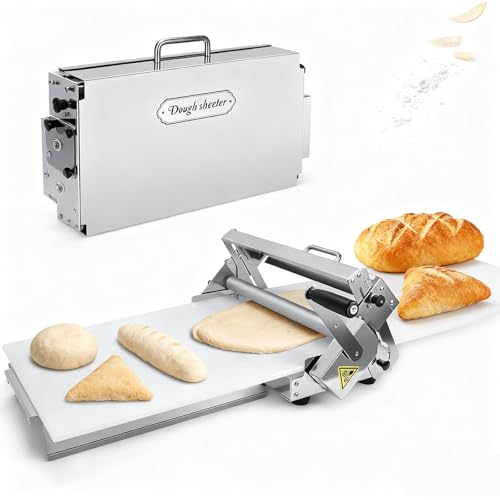
The Atdsetr, SZRLDZSW, PFUM and Npmkx are all manual. Each maker states that no electricity is needed, and each describes a hand crank or rotating handle. The PFUM and Npmkx both state a 360 degree handle, and the Npmkx adds a gear system. These are the maker’s descriptions of the mechanism, not accounts of how the machines feel in use.
All four are also described as folding. Two of them publish a folded size. The SZRLDZSW states 40.9 by 15.5 inches when folded, against dimension fields of 22.5 by 40.9 by 9.3 inches for the machine in use. The PFUM states 40.5 by 22.8 inches in use and 19.7 by 11.8 inches folded, the only pick that gives both figures in one sentence. The Atdsetr and Npmkx describe a folding structure and publish no figure for it.
What the VEVOR does differently
The VEVOR is the only electric model and the only one that presses rather than rolls. The maker states it presses dough into uniform crusts and rates it for crusts up to 18 inches. It publishes a 0 to 0.43 inch thickness range, a 32 to 464 Fahrenheit temperature range and a 0 to 999 second timer, none of which the manual models offer.
That capability comes with the largest published weight on the sheet, 112.44 pounds, against 6.0 pounds for the lightest manual model. The VEVOR is also the only one of the five not described as folding, and its published 17.72 inches of height sits against 9.3, 9.8 and 9.84 inches on the manual bodies. It is a countertop machine in name only.
Thickness Settings and What They Mean
Counts against ranges
The Atdsetr publishes 55 settings across 0 to 27 millimeters, the highest upper figure of the five, without stating the step between them. The PFUM publishes 56 settings across 0 to 25 millimeters with 0.5 millimeter precision, the only stated step on the page. The Npmkx publishes the same 0 to 25 millimeter range with no setting count, so how finely its knob moves is unstated.
The VEVOR is the odd one out because it publishes its range in inches, 0 to 0.43, which is roughly 0 to 11 millimeters. That is a narrower published range than the 0 to 25 millimeters the PFUM and Npmkx state, but the VEVOR is pressing crusts rather than rolling sheets, so the two figures are not measuring the same thing.
Where the makers stay silent
The SZRLDZSW describes multi-level thickness adjustment without publishing a range in millimeters or inches, so it cannot be placed against the others. The Npmkx publishes a range with no setting count and the Atdsetr a count with no step, so neither says how far the knob moves between two settings. Four of the five publish a range a buyer can use and one does not.
None of the five makers publish a roller diameter, a dough capacity in pounds or a throughput figure. Those are the numbers that would let a buyer compare output, and they are absent from every listing on the sheet.
Materials, Rollers and What Holds Still
What each body is made of
The Atdsetr states a high strength alloy body with a plated surface it describes as resistant to oxidation. The PFUM states a high strength alloy frame with food grade stainless steel on the dough contacting parts and an electroplated finish over the rest. The SZRLDZSW and Npmkx both state stainless steel throughout, and the VEVOR a steel body with a powder coated finish, a stainless handle and a cast aluminum press plate.
That is three different answers to the same question. Two picks are stainless steel in their own words, two are alloy frames with stainless only where dough touches, and one is coated steel. No maker publishes a gauge, a plating thickness or a weight for the rollers, so on material the name is the whole of the published evidence and nothing here can be ranked by it.
How each one stays put
Three picks address the machine moving while the handle turns. The SZRLDZSW states anti slip pads on the base. The Npmkx states that the body stays firmly fixed on the table during operation. The VEVOR states that its steel body and cast aluminum plate give greater stability with less wobbling, which is a different problem because it is powered rather than cranked by hand.
Two picks address the dough sticking instead. The SZRLDZSW states precision ground rolling pins with a non stick surface, and the Npmkx a finely polished roller, both arguing the same point: less flour used and less to clean afterwards. The Atdsetr and PFUM describe their plated finishes as easy to wipe without making any claim about dough release.
Which One Fits Your Kitchen
Buyer who moves the machine often. The SZRLDZSW is the lightest of the five at 6.0 pounds, against 15.65 pounds on the Atdsetr, and it states a folded 40.9 by 15.5 inches. It is the one to look at if the sheeter will be lifted onto a counter and put away again.
Buyer who wants no hand cranking. The VEVOR is the only electric model, rated to 18 inch crusts with a 0 to 0.43 inch thickness range and a 32 to 464 Fahrenheit temperature range. It weighs 112.44 pounds, so it needs a permanent spot.
Buyer who wants the most thickness settings. The Atdsetr lists 55 adjustable thicknesses from 0 to 27 millimeters on a folding body, the highest upper figure here. The PFUM publishes 56 settings across a stated 0 to 25 millimeter range with 0.5 millimeter precision.
Buyer who needs a stated folded size. The PFUM publishes 19.7 by 11.8 inches folded against 40.5 by 22.8 inches in use, the only pick that gives both, alongside a 0 to 25 millimeter range with 0.5 millimeter precision.
Buyer who wants a stainless steel build. The Npmkx states a stainless steel body and a 0 to 25 millimeter range, at a published 24.0 pounds. The SZRLDZSW also states stainless steel and is the lighter of the two at 6.0 pounds.
What We Could Not Verify
Several figures that would decide a purchase are not published by the makers, and we did not estimate them.
- A step between the Atdsetr’s 55 settings, which it publishes alongside a 0 to 27 millimeter range and no precision figure.
- A weight for the PFUM, the one pick here that publishes none.
- Dimension fields for the Npmkx, whose own title states 40.5 by 22.8 inches while its fields are empty.
- A folded storage size for the Atdsetr and the Npmkx, both described as folding without a figure for it.
- A thickness range for the SZRLDZSW, which describes multi-level adjustment without figures.
- Roller diameter, dough capacity in pounds and throughput for all five.