How the Five Compare on the Numbers
Sixteen listings sit on the fact sheet and eleven are off this page. Most are the same expandable wire frame under a different name, publishing a length range, a load rating and nothing about maintenance. Several publish only a carton in their dimension fields. One is a two tier pot rack built to stand out on a counter, which is a different scale of object from a shelf that sits inside a cupboard.
Cleaning a cabinet shelf is not the job the category is written about, so the useful sentences are scattered. Four things separate these five: whether the surface has holes in it, whether the maker gives a washing method or only an adjective, what the surface is made of, and how much of the unit comes apart. On all four the five picks answer differently.
What the table cannot give you is whether any of these finishes survives a degreaser. A shelf near a cooktop collects an oily film that soap and water does not lift, and not one of these sixteen listings says a word about solvents, sprays or abrasives. Every claim is either easy to clean or nothing. On the two picks made partly of plastic and bamboo that silence matters more, because those are the surfaces a strong cleaner would actually mark.
Solid Sheet, Open Frame or Holes on Purpose
The One Shelf With No Holes In It
Cidaziya makes a claim nothing else in this pool makes: the shelf can be cleaned easily because it is solid without any hole and it is flat. That is a description of geometry rather than a marketing line, and it is checkable against the photographs in a way that easy to clean is not. It also comes with the highest load figure here, 110 lb, and the maker states the shelf carried that load for thirty days without bending.
A flat sheet has one disadvantage and it is worth naming. A spill stays where it lands, so a solid shelf holds a puddle that an open frame would drop onto the shelf below. Whether that is better depends on what is underneath. In a cupboard of dry goods it is clearly better. Above a stack of plates it means the spill has to be dealt with rather than discovered later.
Holes That Are There for a Reason
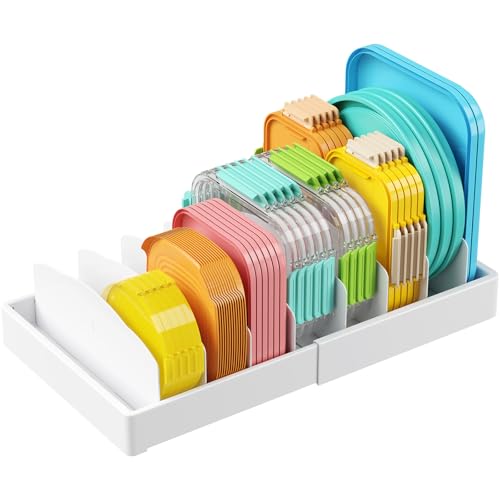
Lifewit and Magheo both put openings in the base on purpose and both explain why. Lifewit states that ventilation holes keep items dry and help secure round items in place, which on a lid organizer is two problems solved with one feature. Magheo describes a hollow layered design that accelerates air circulation, avoids water accumulation and mold, and says it is competent in humid areas.
Those are hygiene arguments rather than cleaning arguments and they point the opposite way from Cidaziya’s flat sheet. A closed cabinet with a damp container in it grows mold, and airflow is a real answer to that. The trade is the obvious one: crumbs and drips pass through. Neither listing pretends otherwise, and neither says how the layer underneath a hollow base is supposed to be reached.
What the Surface Is Made Of
Steel With Nothing On It
Tomorotec is premium stainless steel and credits the material itself, not a coating, with preventing rust. On a shelf that lives above a kettle or beside a cooktop that distinction is the whole argument, because a coating is a layer that can chip and a bare metal is not. The listing says the rack is sturdy, durable and easy to clean, and it does not say with what.
The same listing has the most useful mechanical detail on this page: the extension rack is detachable. Nothing else here can be separated into two pieces for washing. It also carries a warning that the four leg base and the two leg sliding top are not two separate shelves and must be used together, which reads like a correction the maker has had to make more than once.
Plastic, ABS and One Set With Bamboo In It
Lifewit is BPA-free food-grade plastic with a smooth surface, and it is the only listing in this pool that mentions a dishwasher, to say it is not one. Magheo is a one-piece ABS base with nine stainless steel dividers, and the reason it gives for the smooth burr-free surface is specific and unusual: it is there so the base does not scratch the nonstick coating on a pan resting against it.
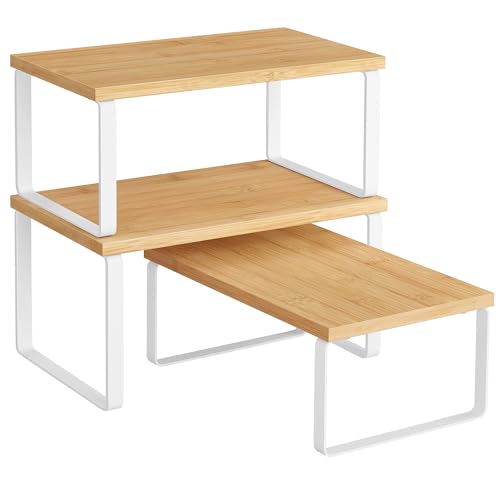
SONGMICS is the outlier and the reason it is on this page. Its title says steel and bamboo, one bullet says premium engineered wood and metal, and nothing anywhere in the listing mentions cleaning, washing or water. Engineered wood swells when it is soaked and bamboo marks. The set is three racks at 4.6, 5.4 and 6.2 in high rated to 11 lb each, which describes dry storage rather than anything that drips.
Getting It Out of the Cabinet
Screws, Sliding Tops and Folding Frames
Cleaning behind a shelf means moving it, and the five differ in how willingly they move. Magheo needs no tools, assembles in seconds and folds flat for storage, which means the whole unit can come out to a sink. Lifewit’s dividers insert and lift out. Tomorotec’s extension detaches. Cidaziya and SONGMICS both come together with screws that have to be tightened, and neither describes coming apart again.
Weight decides the rest. Lifewit is 1.39 lb, the lightest of these five, and Tomorotec 3.09. SONGMICS publishes 4.6 lb for all three racks, so each one alone is a light object. Cidaziya and Magheo publish no weight at all, which on a shelf rated to 110 lb is a real gap, because a heavy frame full of pans is not lifted out casually.
Where the Published Figures Disagree
Two listings contradict themselves in ways worth knowing. Tomorotec’s own sentence gives an overall length of 12.8 to 22.8 in, and its width field reads 24. A shelf cannot extend to less than one of its own published dimensions, so the maker’s sentence is what the table above uses. Lifewit publishes fields of 9.65 x 9.84 x 3.78 in against an expandable width it states as 10 to 17 in, which is the collapsed position recorded as though it were the product.
Magheo and SONGMICS publish no product dimensions in their fields at all, only a carton, at 7.9 x 22.4 x 6.3 in and 11.7 x 7.7 x 6.2 in. Those carton figures are real and are labeled as cartons above. On SONGMICS it leaves a genuine hole: the set publishes three heights and no length anywhere, so how much cabinet each rack claims is not in the data.
Which One Fits Your Kitchen
A shelf that wipes in one pass. Cidaziya, the only pick stating a solid surface with no hole, flat, in double layers of black powder coating. Extends 18.2 to 28.9 in at heights of 11.6, 14 or 16.3, rated to 110 lb, with no weight published.
Bare metal near a cooktop. Tomorotec, premium stainless steel with no coating to chip, a detachable extension rack and anti-slip foot covers. The maker’s sentence gives 12.8 to 22.8 in long by 9.4 wide by 5.7 high, at 3.09 lb, against a 24 in width field.
Lids, dividers and a sink. Lifewit, the one listing here with a washing instruction, cleans by hand and not in a dishwasher. Eight removable dividers, ventilation holes in the base, 9.65 x 9.84 x 3.78 in and 1.39 lb, the lightest of these five.
Pans with coatings you care about. Magheo, a one-piece ABS base stated as smooth and burr free so it does not scratch nonstick, with nine stainless steel dividers and a hollow layer against water and mold. No tools, folds flat, no weight published.
Three heights and dry goods only. SONGMICS, three racks at 4.6, 5.4 and 6.2 in in steel with bamboo, rated to 11 lb each, 4.6 lb for the set. Nothing in the listing mentions cleaning or water, and no length is published.
What We Could Not Verify
Every figure above is from the maker’s own listing. These are the things we went looking for and could not source in any of the sixteen.
- No listing says whether its finish tolerates a degreaser or an abrasive, which is what a shelf near a cooktop actually collects.
- Only Lifewit mentions a dishwasher, and only to rule it out, so four of these five publish no washing instruction of any kind.
- SONGMICS never mentions cleaning or water, on the one pick that includes engineered wood and bamboo.
- Tomorotec publishes a 24 in width field against a stated maximum extension of 22.8 in, with no explanation of the difference.
- Cidaziya and Magheo publish no weight, so neither can be compared on how easily it comes out of a cabinet.
- Magheo describes a hollow layered base and never says how the surface under that layer is meant to be reached.