How the Five Compare on the Numbers
Seven products came up on this fact sheet and two of them could not be ranked. Neither of those two publishes a weight anywhere, and one of them publishes no capacity figure either, on dimension fields that are hard to reconcile with a 3 cup body. Because they are not among the five, their figures stay off this page. That leaves five sifters that each publish a capacity, a weight and a full set of dimension fields.
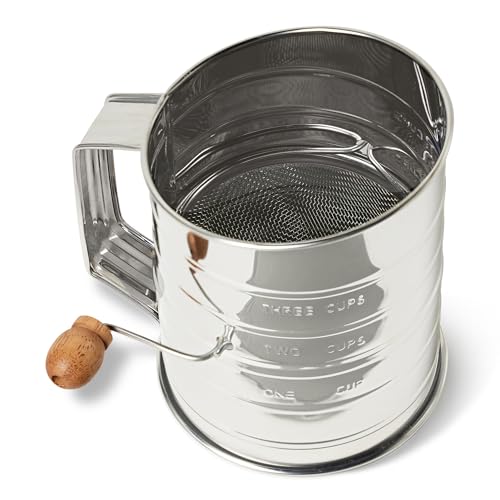
Every one of the five here holds 3 cups, which means capacity decides nothing on this page. What is left is the handle, the mesh and the sink. Four of the five turn a crank and one is squeezed. One states a single mesh layer and one states a double. One says it is dishwasher safe and one says hand wash only, and two take opposite positions on whether a sifter suits painful hands.
What the table cannot tell you is how fine the mesh actually is. Not one of these five publishes a mesh count, a wire gauge or an aperture in millimeters, and every single listing uses the words fine mesh. So the only mesh fact these five give is how many layers there are, and only two of them even say that. Everything else about the screen is a word.
Crank, Squeeze, and Two Listings That Disagree About Your Hands
The Same Argument, Argued Both Ways
Bellemain builds an entire bullet around hand pain. It says squeeze handles require hand strength and wear you out, that professionals prefer crank sifters for repeated use, and that its crank is easy for bakers with arthritis. Two of the other three crank sifters make a softer version of the same point without naming a condition, and Amazon Basics says nothing about hand strain at all.
Cook Army is the squeeze sifter and it does something unusual: it agrees. Its own listing says the grab and squeeze grip lets you sift without taxing your hand strength, and then states plainly that it is not recommended for people with osteoarthritis. A maker ruling out a group of buyers in its own bullet is rare, and it is the most useful sentence in this pool.
What Each Mechanism Costs
A crank is a two handed tool. You hold the sifter with one hand and turn with the other, so a crank sifter cannot be operated over a bowl while your other hand does something else. All four crank sifters describe turning as easy or effortless, and Bellemain adds that lightweight flours practically sift themselves.
A squeeze handle is one handed, which is the whole point of the Cook Army, and it is also the heaviest of the five at 0.6 pounds. That weight is in your fingers throughout, where a crank sifter’s mass sits in your supporting hand. The tradeoff is real and neither design wins it outright.
One Layer of Mesh or Two
Bellemain Argues for Single, Cook Army for Double
Bellemain states a single mesh and defends it: no multi-layers of mesh for ingredients to get stuck in, and cleaning that is simpler because of it. It also says lumps can be left behind to clog screens on squeeze models and that its double loop agitator captures everything. That is a coherent position, single screen plus a good agitator.
Cook Army states the opposite, a double layer sieve which it says filters more effectively than standard single mesh layers, and adds that it is easy to rinse out. Notably, Cook Army is the one sifter here with no agitator described at all, so the second screen is doing the work the wires do elsewhere.
The Three That Say Neither
Esvopa, Amazon Basics and Zemensha all say fine mesh and stop. All three describe a two wire or dual wire agitator, so they are in the Bellemain camp on the agitator question, but none states how many screens sit between the flour and the bowl. That is the single most useful mesh fact on this page and three listings out of five omit it.
No listing anywhere in the pool publishes a mesh count or an aperture, so even the two that state a layer count cannot be compared on fineness. If you sift for a specific texture, none of these five gives you a figure to buy on, only an adjective every one of them uses.
Washing Up, Steel and the Figures Behind Them
Two Say Dishwasher, One Says No
Amazon Basics and Cook Army both state dishwasher safe. Zemensha states the opposite: its highly polished body makes the inner space easier to clean by hand wash, which reads as a hand wash instruction rather than a preference. Bellemain and Esvopa say nothing either way, and both instead describe smooth interiors and simple cleanup.
That matters more on a sifter than on most tools, because flour paste sets in a mesh screen and a screen cannot be scrubbed hard without deforming it. Cook Army’s dishwasher bullet is worth reading closely though: it announces dishwasher safety in the heading and then spends its sentence on the maker’s own trials rather than on the machine.
Esvopa Names Its Steel, Nobody Else Does
Esvopa is the only listing in this pool that states a grade: 18/8 stainless, food grade. The other four say stainless steel, food grade stainless steel, or rust resistant stainless steel, all of which are true of many grades. For a tool that lives in a damp cupboard and touches nothing acidic, the practical difference is small, but it is the only checkable material fact here.
Esvopa’s own dimension fields read 4.0 by 3.0 by 4.0 inches, which do not obviously enclose 3 cups. Bellemain’s read 5.0 by 5.0 by 5.0 inches, three identical figures, which is a placeholder rather than a measurement, so nothing on this page is ranked on it. Zemensha is the one product whose two size statements agree: 14.5 by 10.5 by 14.7 centimeters in the maker’s words, which converts cleanly onto its 4.2 by 5.7 by 5.8 inch fields.
Which One Fits Your Kitchen
A baker whose hands hurt. Bellemain is the only listing here that names arthritis and says its crank suits it, with a single mesh so nothing clogs between layers and a double loop agitator to clear lumps. At 0.35 pounds it is barely heavier than the lightest sifter on this page.
Sifting with one hand over a bowl. Cook Army is the squeeze sifter, with a double layer mesh and dishwasher safety stated, and it is the only pick you can work without a second hand. Its own listing advises against it if you have osteoarthritis, which is worth taking at face value.
Anyone who wants a material fact. Esvopa names 18/8 stainless, a dual wire agitator and stamped marks readable from inside and outside. Its 4.0 by 3.0 by 4.0 inch fields are hard to square with 3 cups, so treat the capacity claim as the figure to check on arrival.
A sifter that goes in with the dishes. Amazon Basics states dishwasher safe, a two wire agitator and measurement markers on the outside, and publishes 0.4 pounds with fields of 4.4 by 5.9 by 5.6 inches. It makes no durability claim at all, which is at least not overpromising.
Cocoa, spices and nut flours as well as flour. Zemensha names nine ingredients including coconut flour, gluten free flour and cocoa, doubles as a sugar shaker and duster, and at 0.34 pounds is the lightest of the five. It asks to be hand washed, which is the tradeoff for that polished interior.
What We Could Not Verify
Every figure above comes from the makers’ own listings. These are the things we went looking for and could not source.
- Not one listing publishes a mesh count, a wire gauge or an aperture size, so fineness cannot be compared at all.
- Three of the five do not say whether the mesh is one layer or two, which is the only mesh fact available here.
- Bellemain and Esvopa say nothing about a dishwasher, and silence is not permission on a mesh screen.
- No listing states whether a crank mechanism or an agitator can be replaced or serviced when it stiffens.
- Only Esvopa names a steel grade, so on four of the five the word stainless is the whole material specification.
- No listing publishes a warranty period, and the longest claim made anywhere is that one sifter will still be in use in 20 years.