How the Five Compare on the Numbers
Nine live pages already rank this pool: by capacity, material and lid design together, by published width and depth, by the one feature that removes a daily step, by what the headline piece count counts, by published capacity, by the height of one container with its lid on, by what comes apart before washing, by what the maker gives your hands, and by which heat source is cleared. Those are all questions about a full container.
In a studio the container spends most of its life empty, in the one cupboard that also holds the pans. So the question is what the material lets it do when there is nothing in it, and on that question these five give four different answers: collapse, fold flat, stack, or interlock the lids and stack anyway.
What the table cannot tell you is how thick a collapsed silicone container actually is. Annaklin publishes a percentage and no collapsed height. Big Bee publishes a thickness and no capacity. So neither of the two space-saving options here can be checked against a specific shelf gap, and the comparison between them has to be made on different units entirely.
The Two Materials That Shrink
A Percentage and No Height
Annaklin’s save space bullet is the only place in this pool where a maker quantifies what its shape is worth: collapsible storage containers made from food grade silicone, soft and unbreakable, with a collapsible design that helps save space almost 60%. The same listing is the only one here with a temperature range, 4 degrees below zero to 428 Fahrenheit, given again in Celsius.
It is also specific about size and about history. The opening is 6.4 by 3.9 inches, the capacity 27 oz or 800 ml, and the first bullet explains that the maker enlarged the range after customers complained that the earlier 11.8 oz version was too small. Four snap buckles and a silicone seal ring secure the lid, and the air vent must be opened before heating.
A Thickness and No Capacity
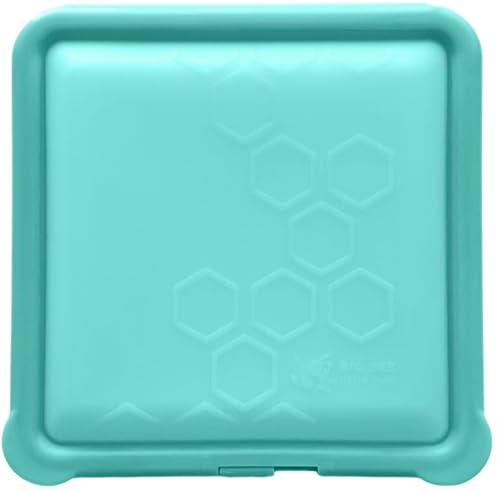
Big Bee’s SoftShell solves a different studio problem: the lid. Its clamshell design keeps the lid permanently attached, so there is no second object to match, store or lose, and the whole thing opens flat and goes into a dishwasher like a plate with no disassembly. The field figures read 7.0 by 7.0 by 0.75 inches, and no other listing here publishes a figure under two inches.
Two details raise it above the other silicone option on honesty. Only FDA-grade silicone panels touch the food, with a polypropylene frame that the maker says stays cool out of the microwave. And the sealing claim is a limit rather than a boast: leak-resistant, not leak-proof or airtight, stated in brackets in the first bullet. No capacity is published anywhere.
The Three That Only Stack
Steel That Argues Against Plastic
souso’s six stainless steel boxes with plastic lids are published at 5.4 by 4.3 by 2.2 inches each, and the listing makes its material case directly: compared to plastic food storage, stainless steel is safer, healthier and lasts longer. For a studio where the same boxes do fridge duty, lunch duty and office duty, that is the argument that matters, because steel does not stain or hold a smell.
What steel cannot do is get smaller. Six empty boxes occupy six boxes of shelf, and the only concession is that they stack. The listing also disagrees with itself on size: the size field reads 5.43 by 2.24 by 5.43 inches while the bullet gives 5.4 by 4.3 by 2.2, so the 4.3 inch width appears as 2.24 in one place and the height appears twice in the other.
Tritan, and Lids That Interlock
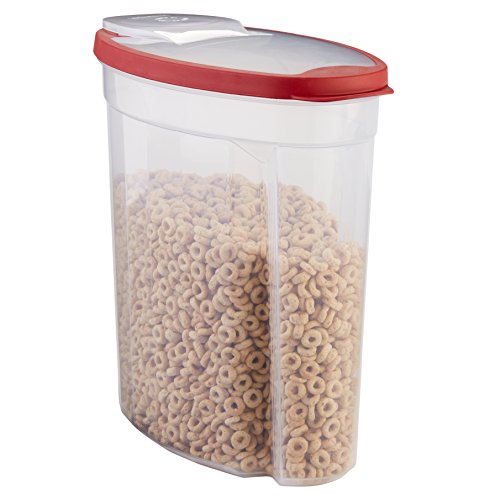
Rubbermaid names Tritan and ties it to the failure plastic normally has: stain-resistant and odor-resistant, with a crystal-clear view of the contents. Five 3.2 cup containers and five lids make ten pieces, with built-in vents so the lid stays on in a microwave and a stated 100% leak-proof seal. It stacks for a fridge or pantry and publishes no dimensions of its own.
Glad takes the storage question somewhere else entirely. Its containers are 64 ounces, given as 8 cups, in a deep rectangle the maker says holds more than a shallow container, and the organizing claim is about the lids: they nest and interlock so a set of matching lids stores as a single unit in a drawer. The boxes themselves stay the size they are.
What Gets Published and What Does Not
Three Sizes and Two Cartons
Annaklin, Big Bee and souso all publish a figure for the container. Annaklin gives an opening, Big Bee gives a field set including the folded thickness, souso gives the box. Rubbermaid and Glad publish neither: their only three figures each, 5.75 by 8.25 by 8.25 inches and 6.63 by 8.75 by 5.5 inches, describe the cartons their sets ship in.
Both of those two publish a capacity instead, which is the more useful figure for choosing how to divide a cooked meal. Glad publishes 64 ounces and 8 cups, against 27 oz from Annaklin and 3.2 cups from Rubbermaid. Between them, the pool gives you either a size or a volume on each listing and both on none.
One Temperature and Four Appliance Lists
Annaklin is the only listing here with a figure: 4 degrees below zero to 428 Fahrenheit, repeated as minus 20 to 220 Celsius, with an instruction to pull the vent valve up or remove the lid before heating. That matters for silicone, which has a wider working range than any plastic on this page.
The other four name appliances. Rubbermaid lists dishwasher, microwave and freezer with built-in vents. Glad lists microwave, top rack dishwasher, refrigerator and freezer. Big Bee lists microwave, freezer and dishwasher. souso lists none of the three, which for a steel box with a plastic lid is the gap to notice, because the lid is the part a microwave would test.
Which One Fits Your Kitchen
One cupboard for everything. Annaklin. The only listing here that quantifies collapsing, at almost 60% of its space, with a 27 oz capacity and a published range from 4 below zero to 428 Fahrenheit.
You lose lids. Big Bee’s SoftShell, with the lid permanently attached and a folded thickness of 0.75 inches. Take its own words seriously: leak-resistant, not leak-proof or airtight.
The same boxes go out with you. souso, six stainless steel boxes at a stated 5.4 by 4.3 by 2.2 inches with plastic lids. They stack and they do not shrink, and no appliance claim is published.
You want to see what is inside. Rubbermaid, five 3.2 cup Tritan containers stated stain and odor resistant, 100% leak-proof, with vents so the lid stays on in the microwave.
You cook once and eat all week. Glad, three containers of 64 ounces or 8 cups in a deep rectangle, with lids that nest and interlock so they store as one unit.
What We Could Not Verify
These are the specifications we went looking for in all five listings and did not find.
- A collapsed height for Annaklin, so its almost 60% claim cannot be checked against a shelf.
- Any capacity for Big Bee or souso, in ounces, cups or milliliters.
- Container dimensions for Rubbermaid or Glad. Both publish only the carton.
- A temperature range for four of the five, although all four name a microwave or a freezer.
- Any microwave or dishwasher statement from souso, whose lid is plastic.
- Which souso figure is right: a stated 4.3 inch width or a 2.24 inch size field.