How the Five Compare on the Numbers
Six live pages already rank this pool by capacity, by counter width, by where the leaves are held, by what comes in the box and by how many pieces arrive with the pot. Every one of them treats the glass as glass and the strainer as stainless. Read the listings closely and neither holds: these five publish three different steel grades, one ungraded stainless, and one infuser whose material is never named.
On a family prep station that matters more than it sounds. The infuser is the part that goes in the dishwasher twice a day, sits wet in a drawer and gets bent by a spoon. HIWARE publishes 18/10, PARACITY publishes 18/8, Aquach publishes 304, Hario names a stainless strainer and no grade, and Amzcku never says what its removable infuser is made of at all.
What the table cannot settle is whether any of those labels changes the tea. None of these five publishes a mesh aperture, a wire gauge or a wall thickness in figures, so the steel grade is a name and not a measurement. Hario is the only one that tells you where each part was made, and Aquach the only one that publishes an opening figure at 4.3 inches.
What the Steel Is Called
Three Grades and Two Silences
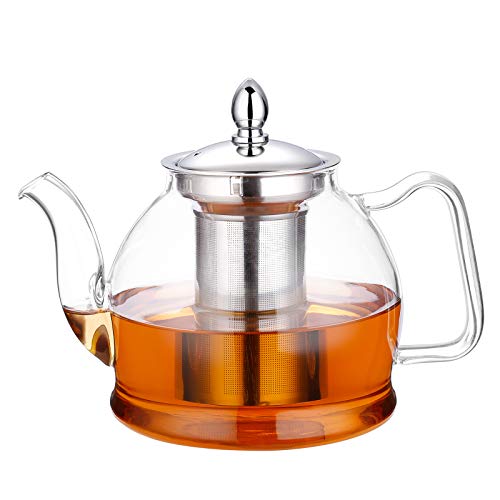
HIWARE publishes the only 18/10 mesh infuser of these five and calls it high-grade, and adds the detail that matters on a busy counter: the lid fits the tea basket both when it is inserted and when it is removed. That is the difference between decanting into cups and watching a pot over-steep while you fetch a saucer for the basket.
PARACITY publishes 18/8 and an ultra-fine strainer stated to filter most teas, and then contradicts itself inside the same bullet: the sentence opens by calling the infuser a removable glass infuser and the next sentence says the infuser is made of 18/8 stainless steel. The two sit side by side in consecutive sentences, and nothing else in the listing settles which one is the part you receive.
What Two of Them Never Say
Aquach publishes 304 stainless for its infuser and calls the material lead and phthalate-free, which is the most specific safety statement on this page. Hario stops at stainless steel and gives a country instead: the glass teapot and lid are made in Japan and the stainless strainer is made in China. That is unusual candor and it is still not a grade.
Amzcku says least of all. Its removable infuser gets a bullet of its own, stated easy to clean and suited to blooming teas, loose leaf and herbal infusions, and the bullet never says what the infuser is. Five of its six bullets end with the word Patented and not one of them names a metal. On the 50 ounce pot here, that is the gap worth knowing.
What the Glass Is Called
Four Say Borosilicate and One Does Not
Four of these five name borosilicate glass. HIWARE calls it heat resistant and hand crafted, PARACITY calls it lead-free and scratch resistant, Aquach calls it lead and phthalate-free, and Amzcku calls it high-quality. Hario never uses the word. It publishes heatproof glass in two separate bullets and adds that the glass has been treated to resist shattering, which is a process claim rather than a material one.
Only PARACITY puts a number on what the glass will take. It publishes a range of -68 to 302 F and says the pot can go directly on a gas or electric stove, in the microwave and in the dishwasher. The other four permit heat in words and publish no temperature at all, so on four of these five pots the thermal limit is whatever the maker’s prose implies.
The Thickness Nobody Measures
One listing describes its glass as thicker and gives no figure for it. HIWARE states that the borosilicate body has been optimized to be thicker and stronger for everyday use, which is a comparison with nothing named on the other side of it. PARACITY offers scratch resistance instead. Aquach offers care: avoid dry burning when empty, and stand the hot pot on a dry trivet rather than a cold surface.
That care note is the one thing a family station really needs, because a glass pot on a shared counter meets a wet worktop, a cold sink edge and a hot burner within a minute of each other. Hario approaches it from the other side with glass treated to resist shattering. Amzcku says stovetop safe and heat resistant and leaves the reader to work out the rest.
Where the Published Figures Stop Agreeing
Hario Publishes Millimeters and Nothing Matches
Hario is the only listing here that publishes a full size triple of its own, and it publishes it in millimeters: W173 by D132 by H108. The dimension fields for the same product read 5.6 by 6.4 by 4.6 inches. Convert either triple and the two do not line up, and the listing gives no clue which describes the pot and which describes something else.
This page quotes the maker’s millimeters where it needs Hario’s size and flags the inch fields as unexplained. The capacity is not in doubt: 700 ml is stated in the title and in the size field, and only PARACITY’s 18.6 ounces is smaller among these five, so on a family station this is the pot you refill rather than the pot you pour from. Its published weight is 0.67 pounds.
Aquach Publishes Two Heights
Aquach publishes 8.5 inches for its height inside a bullet about fridge shelves, and the published height field reads 8.0. The same listing publishes a 4.3 inch broad opening, which is the only opening figure on this page and the one that decides whether a hand and a cloth will reach the bottom of an 85 ounce cylinder.
Both figures are the maker’s own, and the pattern repeats across this pool: a bullet and a field disagree by a fraction and nobody explains it. This page uses 8.5 where it quotes Aquach’s height because the maker wrote it in a sentence. At 1.8 pounds Aquach is the heaviest of these five, which is what an 85 fluid ounce cylinder of borosilicate weighs empty.
Which One Fits Your Kitchen
A household pouring for four or more. Aquach publishes 85 fluid ounces, or 2500 ml, with a 304 stainless infuser, a 4.3 inch opening and a stated fit on a standard fridge shelf for overnight cold brew. It publishes 1.8 pounds.
Anyone who serves in rounds and reuses the pot. HIWARE publishes 1000 ml and the only 18/10 infuser here, and its lid fits whether the basket is in or out, so the leaves come out between rounds without a second dish.
A prep counter that runs hot and cold in the same minute. PARACITY is the only one that publishes a range, -68 to 302 F, and permits the stove, the microwave and the dishwasher. It publishes 18.6 ounces and 0.49 pounds, the lightest of these five.
Someone who wants the volume without the bulk. Amzcku publishes 50 ounces, or 1500 ml, at 1.0 pound, and a fluted vintage body with a sunflower relief. It never says what the removable infuser is made of, which is the trade you accept.
A kitchen that cares where a thing was made. Hario is the only listing that tells you: the glass pot and lid in Japan, the stainless strainer in China. It publishes 700 ml, W173 by D132 by H108 mm, and 0.67 pounds.
What We Could Not Verify
Everything above is from the five listings. These are the things they do not say.
- No listing publishes a mesh aperture or a wire gauge, so no infuser here can be compared with another on how fine it actually is.
- No listing publishes a glass wall thickness, on a page where one maker calls its glass thicker than something it never names.
- Amzcku never states what its removable infuser is made of, and Hario states stainless steel with no grade.
- PARACITY’s infuser is called glass in one sentence and 18/8 stainless steel in the next, and nothing in the listing resolves it.
- Hario publishes W173 by D132 by H108 mm while the dimension fields publish 5.6 by 6.4 by 4.6 inches, with no explanation of the difference.
- Only PARACITY publishes a temperature range, so on the other four the thermal limit is a word rather than a figure.