Rishi Tea Simple Brew Teapot for Loose Tea
Publishes 0.57 lb on a 400ml pot with a lid strainer that unscrews.
- 13.5 Fl Oz (Pack of 1)
- 0.57 lb
The deciding specification is the published empty weight, because a pot brewed from three times a day is lifted, filled and poured more often than it is admired.
By the Lush Editorial Team·Researched & Compared
I compared the published empty weights, capacities, dimensions, handles and washing instructions of sixteen glass teapot listings on the manufacturer fact sheet.
Publishes 0.57 lb on a 400ml pot with a lid strainer that unscrews.

Publishes 0.67 lb on 700ml with glass treated to resist shattering.

Publishes 0.95 lb on 1200ml, with a widened handle and a water level scale.
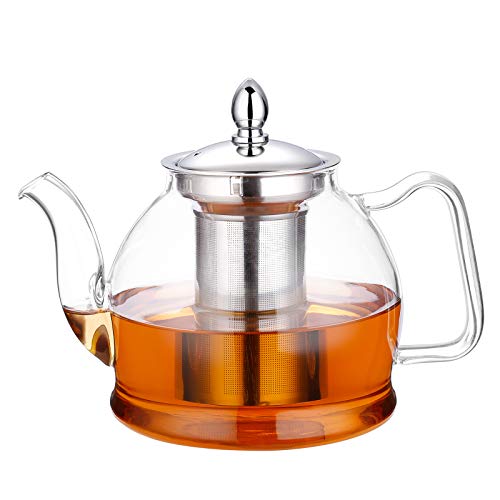
Publishes 1.21 lb on 1000ml and permits gas, electric and the microwave.

Publishes 1.34 lb on a 10 oz hand-blown kyusu with a side handle.
| Model | Brand | Size (Capacity) | Weight | Best For |
|---|---|---|---|---|
| Rishi Tea Simple Brew Teapot for Loose Tea | Rishi Tea | 13.5 Fl Oz (Pack of 1) | 0.57 lb | Best for the lightest lift |
| Hario ChaCha Kyusu "Maru" Tea Pot | HARIO | 700ml | 0.67 lb | Best mid-size pot for one or two |
| STNTUS Glass Teapot | STNTUS INNOVATIONS | 1200ml/40oz | 0.95 lb | Best tea per pound of glass |
| HIWARE 1000ml Glass Teapot with Removable Infuser | HIWARE | 33 oz | 1.21 lb | Best for reheating on the hob |
| Yama Kysus Side-Handle Teapot 10 Oz | Espresso Parts | 10 oz. | 1.34 lb | Best single-serving side-pour pot |
Publishes 0.57 lb on a 400ml pot with a lid strainer that unscrews.
Publishes 0.67 lb on 700ml with glass treated to resist shattering.
Publishes 0.95 lb on 1200ml, with a widened handle and a water level scale.
Publishes 1.21 lb on 1000ml and permits gas, electric and the microwave.
Publishes 1.34 lb on a 10 oz hand-blown kyusu with a side handle.
Daily use turns the empty weight into the figure that matters, and it does not track capacity here. Rishi Tea publishes 0.57 lb on 400ml. HARIO publishes 0.67 lb on 700ml. STNTUS publishes 0.95 lb on 1200ml with a widened handle and a fill scale. HIWARE publishes 1.21 lb on 1000ml and permits the hob. Yama publishes 1.34 lb on a 10 oz hand-blown kyusu.
“The pot you lift three times a day is the one you feel.”
Lush Food & Drink
Because a pot used every day is handled constantly: lifted off a shelf, filled, carried, poured and washed. These five publish empty weights from 0.57 lb on the Rishi up to 1.34 lb on the Yama, which is more than double across the set. None of them publishes a full weight, so the empty figure is the only published number that describes the object in your hand before the water goes in.
Not on this page. Yama publishes 1.34 lb for a 10 oz pot while STNTUS publishes 0.95 lb for 1200ml. The reason is the glass: Yama's is hand blown and described as thicker and stronger, and HIWARE says the same of its own body at 1.21 lb. Thickness is what the two stovetop-permitted pots have in common, and it adds mass without adding capacity.
Two state it. HIWARE permits gas or electric stovetops at a medium heat level and also the microwave. Yama permits a gas stovetop or electric range with the use of a trivet, and asks you to heat water gradually at a low temperature. Rishi, HARIO and STNTUS say nothing either way, so there is no published basis for heating any of those three directly.
STNTUS is the only pick here with a visible answer, a water level scale added to the surface of the glass. HIWARE prints an instruction instead, asking you not to fill more than 1000ml while boiling tea. Rishi, HARIO and Yama publish no fill guidance at all, which matters most on the 10 oz Yama where there is little margin when pouring from a kettle.
Rishi is the only pick here with the strainer built into the lid rather than a removable basket in the pot, and it unscrews from the lid for washing. The maker frames it as keeping all of the tea in the pot for future steepings, which means the leaves stay in the water until the pot is empty. The other four use a removable basket or filter you can lift out to stop the steep.
HARIO gives the simplest answer, stating the pot is hot water safe and dishwasher safe. HIWARE allows the top rack or hand cleaning. STNTUS allows the dishwasher but asks you not to use it, to reduce collisions in the machine. Rishi describes unscrewing the filter from the lid and washing it without naming a method, and Yama publishes no washing instruction at all.
Specifications come from the manufacturers' own published listings. Lush Food & Drink may earn a commission if you buy through a link on this page, at no extra cost to you. How we research.
If you make tea once a week the weight of the pot is irrelevant. If you make it three times a day it is the figure you feel, because an empty pot has to be lifted, filled, carried and poured every time. These five publish empty weights from 0.57 lb up to 1.34 lb, which is more than double across the set.
The useful surprise is that weight does not track capacity here. The 1.34 lb pot holds 10 oz and the 0.95 lb pot holds 1200ml. Thickness, a protective holder and hand-blown glass all add mass that has nothing to do with how much tea comes out, and only two of these five say anything at all about the handle.
| Specification | Rishi Tea | HARIO | STNTUS | HIWARE | Yama |
|---|---|---|---|---|---|
| Published empty weight | 0.57 lb | 0.67 lb | 0.95 lb | 1.21 lb | 1.34 lb |
| Stated capacity | 400ml, 13.5 fl oz | 700ml | 1200ml, 40 oz | 1000ml, 33 oz | 10 oz |
| Published height | 4.5 in | 4.6 in | 9.06 in | 9 in | 5 in |
| Published width and depth | 4.5 x 6.1 in | 5.6 x 6.4 in | 5.31 x 5.31 in | 5 x 5.3 in | 5 x 7 in |
| Handle described | not published | not published | Widened and thickened | Ergonomic, for a sturdy grip | Side handle, kyusu style |
| Where the leaves sit | Strainer built into the lid, unscrews | Large strainer | Removable immersion filter | Removable mesh infuser | Removable mesh filter |
| Steel grade named | not published | Stainless, grade not named | 304 | 18/10 | Stainless, grade not named |
| Stovetop permitted | not published | not published | not published | Gas or electric at medium heat | Gas or electric with a trivet, heated gradually |
| Microwave | not published | not published | not published | Stated safe | not published |
| Dishwasher | Unscrew the filter and wash | Stated safe | Allowed, hand washing preferred | Top rack or hand | not published |
| Temperature range stated | not published | not published | -20 to 150 degrees Celsius | not published | not published |
| Fill guidance | not published | not published | Water level scale on the glass | Do not exceed 1000ml when boiling | not published |
What the table cannot tell you is what any of these weighs full, because nobody publishes that and the water is the larger part of it. A 1200ml pot of tea adds far more than the difference between 0.57 lb and 1.34 lb of glass. The empty figure matters for a different reason: it is what you are holding before the water goes in, and it is what the wrist feels at the end of the pour.
Yama publishes 1.34 lb for a 10 oz pot, which is the one combination on this page that looks wrong until you read the reason. The glass is hand blown and the maker says it is crafted to be thicker and stronger, and the pot is an all-glass kyusu with a side handle rather than a loop. Mass is the design, not a side effect.
HIWARE publishes 1.21 lb for 1000ml and says the same thing about its glass, that the body has been optimized to be thicker so it is stronger for everyday use. Two of these five are therefore heavy on purpose, and both are the two that permit stovetop heating. The thickness and the permission are the same decision.
Rishi Tea publishes 0.57 lb on a 400ml pot and says nothing about a stovetop, a microwave or a handle. HARIO publishes 0.67 lb on 700ml and says its heatproof glass has been treated to resist shattering, that it is hot water safe and dishwasher safe, and nothing about a hob either.
Those two are the lightest objects here and the two that are not described as cookware. For a daily drinker who boils water in a kettle and pours it into the pot, that is no loss at all. For one who wants to reheat the pot itself, it is the whole difference, and neither listing closes the question.
STNTUS is the most specific, calling its handle widened and thickened and tying that to being more user-friendly and safe, and adding that the spout will not cause splashing. At 0.95 lb for 1200ml it is the lightest pot here relative to what it holds, which is the combination a daily drinker actually wants.
HIWARE names an ergonomic handle for a sturdy grip and a non-dripping spout. Yama’s handle is a different thing entirely, a side-pour kyusu handle the listing explains by history rather than ergonomics. Rishi and HARIO publish no handle description at all, which on a pot lifted several times a day is a real gap.
STNTUS puts a water level scale on the glass, the only visible fill guide on this page. HIWARE takes the opposite approach and prints an instruction instead: do not fill more than 1000ml of water while boiling tea. Both are answers to the same daily question and only one of them survives being forgotten.
Rishi, HARIO and Yama publish no fill guidance. On the Yama that matters more than it sounds, because the listing asks you to heat water gradually at a low temperature with a trivet underneath, and gives no mark to fill to. A 10 oz pot has little margin for a confident pour from a kettle.
Rishi is the outlier: the strainer is built into the lid and unscrews from it for washing, and the maker frames that as a feature, saying it keeps all of your tea in the pot for future steepings. That is a brewing decision as much as a cleaning one, because the leaves stay in the water until the pot is empty.
The other four use a removable basket or filter. HIWARE names 18/10 stainless steel and says the lid fits whether the basket is in or out. STNTUS names 304 and says the filter comes out directly for cleaning. HARIO describes a large strainer that lets leaves expand, and Yama a removable mesh filter, neither naming a grade.
HARIO states hot water safe and dishwasher safe in plain terms. HIWARE allows the top rack or hand cleaning. STNTUS allows the dishwasher and then asks you not to use it, to reduce collisions in the machine, which is an unusually candid pair of sentences.
Rishi describes unscrewing the filter from the lid and washing it without naming a method. Yama publishes no washing instruction at all, which on a hand-blown pot asked to be heated gradually is the one instruction you would most want. Three of these five therefore leave the daily wash partly unspecified.
Lightest pot in the hand. Rishi Tea publishes 0.57 lb on a 400ml pot with a strainer built into the lid that unscrews for washing. It publishes nothing about a stovetop, a microwave or a handle, so treat it as a brewing vessel only.
Mid-size pot for one or two. HARIO publishes 0.67 lb on 700ml, with glass treated to resist shattering and a plain dishwasher permission. It also publishes its size in millimeters, as W173 by D132 by H108.
Most tea for the least glass. STNTUS publishes 0.95 lb on 1200ml, a widened and thickened handle, a water level scale, 304 steel and a stated range of -20 to 150 degrees Celsius. The best weight-to-capacity figures here.
Wants to reheat on the hob. HIWARE publishes 1.21 lb on 1000ml, permits gas or electric at medium heat and the microwave, names 18/10 steel and prints a 1000ml fill limit. The extra weight is thicker glass.
Single serving, poured sideways. Yama publishes 1.34 lb on a 10 oz hand-blown kyusu with a side handle. It needs a trivet and gradual heating, and publishes no washing instruction or fill guide.
These are the figures we went looking for on the manufacturer listings and did not find.