How the Five Compare on the Numbers
Wattage is the clearest published differentiator. The LILPARTNER leads with a 450W motor, followed by the FOHERE at 300W, the Hamilton Beach at 250W peak, the Cuisinart at 220W, and the OVENTE at 150W. Speed counts range from 5 on the KitchenAid and OVENTE to 9 on the Cuisinart. The Hamilton Beach and FOHERE both offer 6 speeds. Turbo or QuickBurst buttons appear on the Hamilton Beach, LILPARTNER, and FOHERE.
Weight varies more than two pounds across the group. The OVENTE is the lightest at 1.8 pounds, while the Cuisinart is the heaviest at 4.0 pounds. The KitchenAid weighs 2.0 pounds, the Hamilton Beach 2.87 pounds, and the LILPARTNER 3.15 pounds. Accessories also differ: the Cuisinart and LILPARTNER include dough hooks, while the KitchenAid and OVENTE include only beaters or whisk beaters.
The table does not tell you how these mixers perform in real use. Wattage, speed count, and weight are published figures, but torque, noise, and durability are not. The FOHERE dimensions appear to be a shipping size, not the mixer’s actual footprint, and the manufacturer does not clarify. No testing was done by us, so we cannot say which mixer mixes better or faster.
Storage and Accessory Differences
Cases and what they hold
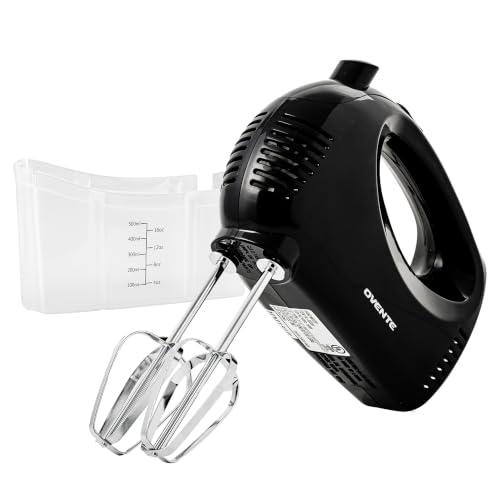
The Hamilton Beach, OVENTE, Cuisinart, and LILPARTNER all include some form of storage case. The Hamilton Beach case is snap-on and holds two beaters and a whisk. The OVENTE case is also snap-on and holds the included whisk beaters. The Cuisinart includes a sturdy snap-on case for the mixer and all accessories. The LILPARTNER’s case doubles as a scale cup, allowing you to hold water or flour during use.
The KitchenAid KHM512 does not list a storage case in its published features. It includes two stainless steel turbo beaters, which are dishwasher-safe. Without a case, you would need to find another way to store the beaters. The other four models provide a dedicated place for attachments, which may reduce the chance of losing them.
Beaters, whisks, and dough hooks
The type of attachments determines what you can mix. The KitchenAid and OVENTE include only beaters or whisk beaters, suitable for batters, whipped cream, and egg whites. The Hamilton Beach adds a whisk to its two traditional beaters. The Cuisinart goes further with extra-long beaters, a chef’s whisk, dough hooks, and a spatula. The LILPARTNER includes two dough hooks, two beaters, and a whisk.
Dough hooks are the key differentiator for bread makers. Only the Cuisinart and LILPARTNER include them. If you plan to knead dough, those two models are the only ones with the appropriate attachment. The other three are limited to lighter mixtures. The manufacturer does not publish maximum dough capacity for any model, so heavy dough may still be a challenge.
Power and Speed Control
Wattage and what it may indicate
The LILPARTNER’s 450W motor is the highest published wattage, followed by the FOHERE at 300W, the Hamilton Beach at 250W peak, the Cuisinart at 220W, and the OVENTE at 150W. The KitchenAid does not publish wattage. Higher wattage may provide more power for thick mixtures, but the manufacturer does not state torque or actual mixing force. Wattage alone does not guarantee better results.
The Cuisinart’s 220W motor includes an automatic feedback feature and SmoothStart, which uses three low speeds to reduce splattering. The Hamilton Beach’s 250W peak motor is paired with a QuickBurst button for extra power. The LILPARTNER’s 450W motor also has a turbo button. These features are published as capabilities, not as tested performance.
Speed settings and special buttons
The Cuisinart offers the most speed options with 9, plus a one-step power switch and LED display. The Hamilton Beach and FOHERE both have 6 speeds. The KitchenAid, OVENTE, and LILPARTNER each have 5 speeds. The Hamilton Beach adds QuickBurst, and the LILPARTNER adds a Turbo Boost button. The FOHERE also mentions a Turbo Boost.
More speeds can give finer control, especially when starting at low speeds to avoid splatter. The Cuisinart’s SmoothStart feature is designed for this. The KitchenAid’s speed one is for mixing nuts and chocolate chips, while speed five is for whipping meringues. The OVENTE’s speeds range from 1 (lowest) to 5 (highest). The manufacturer does not publish the RPM for any speed setting.
Which One Fits Your Kitchen
If you need a storage case and a whisk: The Hamilton Beach 6-Speed includes a snap-on case for two beaters and a whisk, plus 250W peak power and 6 speeds. It also has a Bowl Rest feature to stabilize on the bowl edge.
If you want cord management: The KitchenAid KHM512 has a lockable swivel cord to keep the cord out of your way. It offers 5 speeds and includes two stainless steel turbo beaters. It does not include a storage case or dough hooks.
If you want the lightest model: The OVENTE HM151B weighs 1.8 pounds, the lightest published weight among the five. It has 150W, 5 speeds, and a snap-on storage case. It includes two stainless steel whisk beaters.
If you need many speeds and dough hooks: The Cuisinart Power Advantage PLUS offers 9 speeds, 220W, SmoothStart, extra-long beaters, a chef’s whisk, dough hooks, a spatula, and a snap-on case. It is the heaviest at 4.0 pounds.
If you want the highest wattage and a scale cup case: The LILPARTNER 450W has a 450W motor, 5 speeds plus turbo, and a scale cup storage case. It includes two dough hooks, two beaters, and a whisk.
What We Could Not Verify
We looked for several specifications that the manufacturers do not publish. Without them, we cannot compare certain aspects.
- Actual mixing torque or force in ounce-inches or similar units.
- Noise level in decibels during operation.
- Power cord length in feet or inches.
- Maximum dough capacity or recommended flour weight.
- Beater material beyond stainless steel, such as grade or thickness.
- Whether the FOHERE dimensions are for the product or the shipping box.