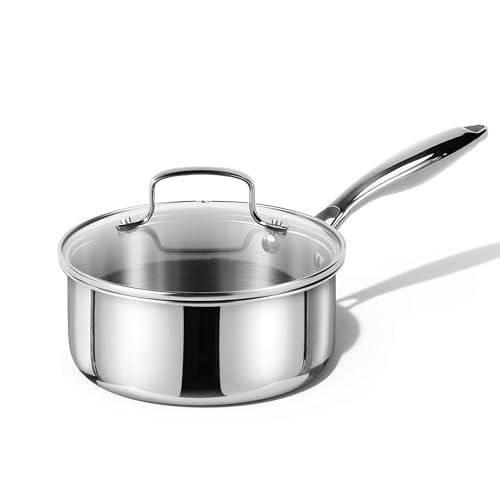
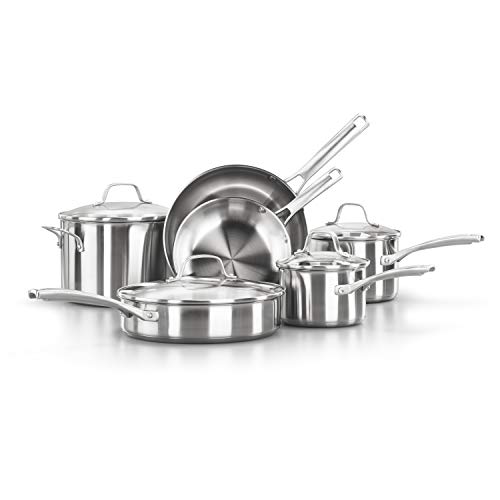
How the Five Compare on the Numbers
Seven sauce pans are on the fact sheet and every one of them is a real sauce pan, so nothing had to be dropped for being the wrong tool. Two were left off anyway. Tramontina is a 3 quart pan published at 8.25 in across, sized for a full size burner rather than the small one an apartment stove usually has. SENSARTE makes only a blanket claim, that it works on all cooktops, which cannot be placed on the ladder this page is built on.
That ladder is what each maker actually names. COOKER KING lists induction, gas, electric and ceramic. MICHELANGELO lists gas, electric, ceramic and induction. CAROTE lists gas, electric and induction and leaves ceramic out. Farberware names induction and no other cooktop. Cuisinart names no cooktop type at all, only the stove top in general, on a page about pans that work on induction.
One row in that table is the carton rather than the pan. MICHELANGELO ships three pans and three lids, so its 10 by 16 by 6 in is the box they arrive in and its 4.6 lb covers all six pieces. The other four rows of dimension fields each contain one figure that is not the pan either, and the section below explains which. The table cannot tell you the diameter of the flat base that meets the burner, which on a small apartment hob is the figure that decides whether heat reaches the sides, and not one of the seven listings publishes it.
Which Cooktops the Makers Actually Name
Four Named, Three Named, One Named, and None
An apartment stove is not one thing. It may be a glass ceramic top, a coil electric, a gas hob with small burners or a portable induction plate on a worktop. That is why the list a maker prints matters more here than the word induction on its own. COOKER KING and MICHELANGELO each name four surfaces. CAROTE names gas, electric and induction and never mentions ceramic.
Farberware goes further the other way, naming induction and nothing else, and tying the claim to its full cap base. Cuisinart names no cooktop type at all. Its bullets describe an aluminum encapsulated base, handles that stay cool on the stove top and a lifetime warranty, and the word induction never appears, which on a shortlist of induction compatible pans is the omission worth knowing about before ordering.
What a Base Has to Do to Work on Induction
Induction needs iron in the base, and the four listings that make a claim describe four different ways of getting it. COOKER KING, MICHELANGELO and CAROTE all describe a clad construction, an aluminum core between layers of stainless steel, which puts magnetic steel on the outside by design. Farberware describes a full cap base, steel layered over a thick aluminum core and fixed to the bottom of the pan.
Cuisinart describes an aluminum encapsulated base, which is the same idea under a different name, and then says nothing about magnetism. None of the five publishes the thickness of that base or the grade of the steel on it, so the difference between a clad body and a capped bottom stays a description rather than a measurement. On a small hob the practical effect is where the heat stops, and no listing addresses that.
The Oven Ceiling and the Lid Ceiling
From 350 Degrees to 900
COOKER KING publishes 900 F for the pan body, MICHELANGELO 600 F and Farberware 350 F. CAROTE and Cuisinart publish no oven figure at all. That is a spread wide enough to change what the pan is for: a 350 F ceiling covers a slow braise and rules out finishing anything under a broiler, while 900 F is a figure that only makes sense on a pan with no organic coating anywhere on it.
In a small kitchen with one oven and two or three burners, a pan that moves to the oven is doing a second job, so the ceiling is a genuine capability rather than a specification detail. It is also the figure most likely to be quietly absent, and it is absent on two of these five, including the pan with the longest warranty on the page.
The Lid Is Always the Lower Number
Two listings publish a separate figure for the lid and both are lower than the pan. COOKER KING rates its tempered glass lid to 400 F against 900 F for the body. MICHELANGELO rates its glass lids to 350 F against 600 F for the pans. That gap is the one people forget: the pan may be oven safe well beyond the point at which the lid is not, and the two figures are published in the same sentence.
Farberware publishes 350 F without separating the two, and describes a bell shaped lid with a rolled rim and a knob without saying what it is made of. CAROTE states that a lid is included and never names the material. Cuisinart describes a flavor lock lid, also without a material. So three of these five give a buyer no way to judge whether the lid can follow the pan into an oven.
Reading the Published Sizes on a Sauce Pan
One Field Is the Handle, Not the Pan
Every single pan here publishes three dimension figures where one is far longer than the others: 14 in on COOKER KING, 14.2 in on CAROTE, 13.3 in on Cuisinart and 11.7 in on Farberware. None of those is the pan. SENSARTE, which is not a pick on this page, proves it: its fields read 13.1 in by 6.3 in by 3.4 in, and its own bullet says the pan is 6.3 in in diameter and 3.4 in deep.
So the long figure is the pan plus its handle sticking out, and it is the one that matters for a crowded hob with a neighboring burner in use. The short pair is the pan itself. None of the five picks states which is which, and none of them publishes a base diameter, so a buyer sizing a pan to a small burner is working from the smaller of two fields and hoping.
Capacity, Weight and What Sits on a Small Burner
Three of these five are 1.5 qt pans, which is the size for warming milk, melting butter and one or two portions of oatmeal or sauce. Farberware is 2.1 qt. MICHELANGELO is a set of three at 1 qt, 2 qt and 3 qt with a lid each, which is the only pick that covers more than one burner size in one purchase.
Weight follows. Cuisinart publishes 1 lb, the lightest published weight here, Farberware 1.4 lb and CAROTE 1.5 lb. MICHELANGELO publishes 4.6 lb, the heaviest figure on this page, and it covers six pieces rather than one pan, so it is not comparable with the others. COOKER KING publishes no weight at all, which on a tri-ply pan with a ceramic surface is the figure a buyer would most want.
Which One Fits Your Kitchen
A small kitchen where the pan finishes in the oven. COOKER KING, for a 900 F pan body with a 400 F glass lid, a ceramic surface stated free of PFAS, PFOA and PTFE, and four cooktops named including ceramic. It publishes no weight.
Somebody replacing every small pan at once. MICHELANGELO, for 1 qt, 2 qt and 3 qt with a tempered glass lid each, four cooktops named, a 600 F pan ceiling and a 350 F lid ceiling. Its 4.6 lb and 10 by 16 by 6 in describe the carton.
Warming milk and pouring it straight into a cup. CAROTE, for a flared pour rim on a 1.5 qt three ply pan at 1.5 lb. It names gas, electric and induction, does not mention ceramic, and publishes no oven figure.
Two quarts on one small burner. Farberware, for a 2.1 qt pan on a full cap base, oven safe to 350 F, with a bell shaped lid and a rolled rim. It names induction and no other cooktop at all.
A pan lifted one handed several times a day. Cuisinart, at 1 lb with measurement markings, drip free pouring and a lifetime warranty. Read the listing first: it names no cooktop type, and describes both a stainless surface and a Quantanium nonstick one.
What We Could Not Verify
Every figure above comes from the maker’s own listing text. These are the things we went looking for and could not source in any of them.
- Not one of the seven listings publishes the diameter of the flat base that meets the burner, which is the figure that decides how a pan behaves on a small hob.
- Cuisinart never names a cooktop type, so the one claim this page exists to check cannot be confirmed from its listing at all.
- CAROTE and Cuisinart publish no oven safe temperature, so neither can be compared against the 350 F, 600 F and 900 F figures the others give.
- Three of the five never state what the lid is made of, which is what decides whether the lid can follow the pan into an oven.
- No listing publishes the thickness of its clad or capped base, so tri-ply and full cap remain descriptions rather than measurements.
- The Cuisinart listing describes a stainless steel cooking surface in one bullet and a Quantanium nonstick surface in another, and says nothing to reconcile them.