How the Five Compare on the Numbers
One listing was left out. NUOSWEK is a 60 minute wind up dial that must be wound round to 55 before it will work, ticks while it runs, and shows no time of day at all. A holiday session runs for several hours across several dishes, so a timer that tops out at an hour and has to be re armed by hand is the wrong tool for it.
That leaves five, and the figure that sorts them is whether the device also tells you the time. A holiday meal is planned backwards from a serving time, and a countdown alone does not help you decide when the potatoes go in. TempPro, KTKUDY and Nkove all publish a clock mode. Antonki and ALBAYRAK publish none, and only count.
What the table cannot tell you is how many of these you need. A holiday kitchen usually has four or five things running, and the most any single listing here manages is two countdowns. Nobody publishes a battery life, and three of the five do not state what powers them at all. Nobody publishes an alarm duration either, so how long a beep continues if you are in another room is unstated everywhere.
A Holiday Meal Is Planned Backwards
Three of the Five Also Tell You the Time
TempPro publishes the fullest clock: a calendar and clock mode with 12 and 24 hour display and month, date and year. KTKUDY publishes a 12 hour clock plus a daily alarm, and argues the point directly, saying the clock lets you check the time without reaching for a phone. Nkove publishes a clock function alongside countdown and count up in one compact device.
That matters on a day built around a serving time. If the bird comes out at four, everything else is scheduled against a wall clock rather than against a countdown, and a timer that shows both saves you looking in two places. All three also hold a memory of the last countdown, which is the other thing you want when the same twenty minutes recurs six times in an afternoon.
The Two That Only Count
Antonki publishes count down and count up with a maximum of 99 minutes 59 seconds and no clock mode of any kind. For a holiday session that ceiling is the binding constraint: a large roast runs past it, so the timer becomes a reminder for the things around the roast rather than for the roast. What you get instead is two separate units in the box.
ALBAYRAK publishes no clock and no maximum range either, because it is a fully mechanical dial in 304 stainless steel with a magnetic back and an 85 dB alarm. It needs no batteries at all, which on a day when nothing else in the house has a spare AAA is a real argument. It publishes no memory function, because a wind up dial has nothing to remember.
Two Things at Once, Two Different Ways
One Device With Two Countdowns
TempPro is the only listing in this pool that runs two countdowns from one device, stating that two alarms can be set simultaneously for separate events, each programmable up to 23 hours 59 minutes. On a stovetop with two pans on different schedules that is the single most useful thing on this page, and it is paired with a stainless steel jacket rather than the plastic the listing contrasts itself with.
It is also the largest device here at 4 by 4.5 by 1.5 inches and 0.23 pounds, with a 2.6 inch LCD. The trade is that two countdowns on one screen means two figures to read at a glance, and the listing does not say whether both are displayed at once or whether you switch between them, which is the question a busy cook would ask.
Two Devices in One Box
Antonki answers the same problem by giving you two timers. Each has a magnetic back, a fold out kickstand and a hanging hole, which is three mounting options against two on everything else here, and each ships with an AAA battery already fitted. At 0.1 pounds for the pair and 2.68 by 2.48 by 0.63 inches each, Antonki is the lightest pick here at 0.1 pounds.
Two physical timers also means two alarms you can tell apart by where the noise comes from, which a single device with two countdowns cannot do. The cost is the 99 minute 59 second ceiling on both of them, and the fact that neither shows the time. For short overlapping jobs during a long session, that is a reasonable trade.
Being Heard in a Full Kitchen
Where Anyone Publishes Decibels
Three of the five publish a figure. TempPro publishes 70 to 105 dB across high, medium and low settings, which is the widest published range and the only one with three volumes. KTKUDY publishes 70 to 90 dB and states the alarm is loud enough to be heard from another room. ALBAYRAK publishes a single 85 dB figure for its mechanical bell.
Nkove and Antonki publish no figure at all. Nkove states a loud alarm mode selected on a side switch. Antonki states a loud beeping alarm that can be heard from another room, which is the same claim KTKUDY makes with a number attached. On a day with a room full of people talking, the number is the part worth having.
Silent Modes, and the One With None
Four of the five publish a way to stop the noise, and they do it differently. TempPro adds a silent mode to its three volume settings. KTKUDY switches to a light mode instead of sound. Nkove uses a side switch between silent and loud. Antonki drops the beep and flashes a red light instead, which it names for a classroom or a baby’s room.
ALBAYRAK publishes no quiet option, and its listing gives a reason worth knowing in the excluded NUOSWEK too: a mechanical timer with no back cover is loud because there is nothing damping it. ALBAYRAK does not mention a back cover, but it does publish 85 dB and nothing about turning it down, so a mechanical bell is what you get.
Which One Fits Your Kitchen
You have two dishes on different schedules. TempPro runs two countdowns at once, each up to 23 hours 59 minutes, with a clock and calendar mode in 12 and 24 hour display, 70 to 105 dB across three volumes plus silent, a 2.6 inch LCD, a stainless steel jacket, a stand and a magnet, at 4 by 4.5 by 1.5 inches.
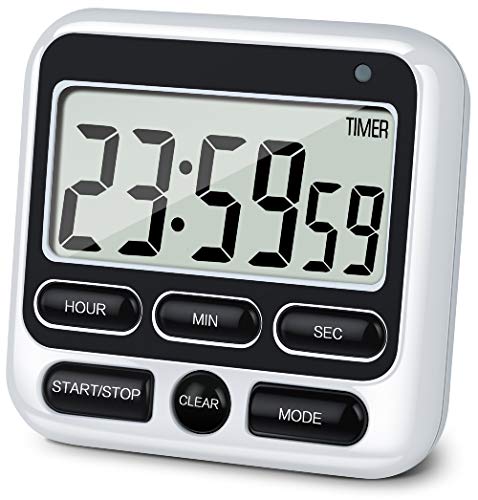
You want to set hours without button combinations. KTKUDY gives dedicated Hour, Min, Sec and Clear buttons and lets you hold one for 3 seconds to advance quickly, counting up or down to 24 hours, with a 12 hour clock, a daily alarm, 70 to 90 dB or a light mode, a 2.8 inch LCD and three rear magnets.
You want a plain three in one on the fridge. Nkove combines countdown, count up and clock in one unit at 3.1 by 0.8 by 3.1 inches and 0.14 pounds, counting to 24 hours, with a silent and loud switch on the side, a built in magnet and a memory that recalls your last setting. It publishes no decibel figure and no screen size.
You want two alarms you can tell apart by ear. Antonki ships two timers with AAA batteries already fitted, each 2.68 by 2.48 by 0.63 inches with a magnet, a kickstand and a hanging hole, a loud beep or a silent flashing red light, and 0.1 pounds for the pair. Both stop at 99 minutes 59 seconds and neither shows the time.
You do not want to think about batteries. ALBAYRAK is fully mechanical in 304 stainless steel, stated resistant to corrosion, with a magnetic back for a fridge or a microwave and an 85 dB alarm, at 2.7 by 1.7 by 2.7 inches and 0.28 pounds. It publishes no clock, no maximum range and no quiet mode.
What We Could Not Verify
A holiday session asks more of a timer than these listings answer.
- The most countdowns any single device here runs is two, and a holiday kitchen usually has more than two things going.
- TempPro does not say whether its two countdowns show on screen together or one at a time.
- No listing publishes a battery life, and three of the five do not state what powers them at all.
- No listing publishes how long the alarm sounds before it gives up, which matters if you leave the room.
- Nkove and Antonki publish no decibel figure, and Nkove publishes no screen size either.
- ALBAYRAK publishes no maximum countdown range, so how far its dial actually goes is unstated.