How the Five Compare on the Numbers
An accessible timer has to be readable from where you stand and audible from where you walk off to. Two of these five publish a figure for both. KTKUDY publishes a 2.8 inch LCD and a 70 to 90 dB alarm. Secura publishes a 7.5 inch face and about 70 decibels. ALBAYRAK publishes 85 dB and no display figure at all.
The other three leave one side unmeasured. ALBAYRAK states its alarm carries about 10 meters in low noise, with nothing about the dial face. Taylor publishes neither figure, and its loudness claim is the words super loud timer. TIME TIMER publishes a 5.5 by 7 inch body and an optional audible alert, without saying how loud the alert is.
What the table cannot tell you is how big the digits are. Not one of these sixteen listings publishes a character height, so the 2.8 inch LCD figure is the panel and not the numerals on it, and the two visual timers publish a body size while the disc inside goes unmeasured. Reading distance is the thing an accessible kitchen needs most and nobody states it.
What You Can Read Without Digits
A Disc That Shrinks Instead of a Number
Secura and TIME TIMER both answer the reading problem by removing the reading. A colored disc covers the remaining time and shrinks as the time runs out, so the information is an area rather than a figure. Secura publishes a 7.5 inch body and calls it oversize. TIME TIMER publishes 5.5 by 7 inches and a protective lens over the face.
TIME TIMER is the only listing in this pool that names who the format is for. It states the visual timer encourages organization for all ages, including those with autism, ADHD or other learning disabilities, and that a visual schedule helps anticipate the transition between rotating times. Secura makes a narrower claim, recommending itself for special education teachers and for helping children understand the passage of time.
The One Published Display Figure
KTKUDY is the only listing of the sixteen that publishes a display size. It states that large digits on the 2.8 inch LCD make time easy to check at a glance without stepping closer. That is a claim about reading distance with a figure attached to it, which is more than the other fifteen listings manage, and it is still the panel rather than the digit.
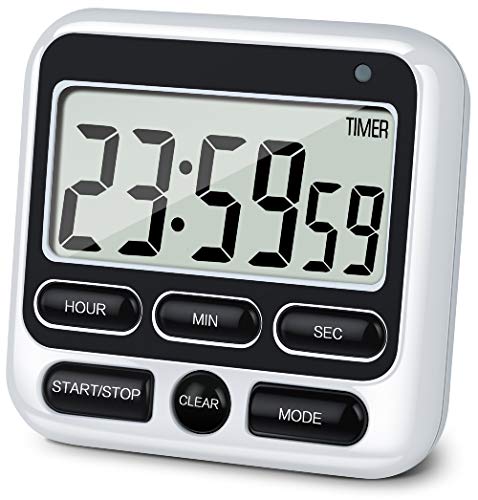
Taylor and ALBAYRAK publish nothing about their faces. Taylor states a full display with hour, minute and second timing up to 23 hours, 59 minutes and 59 seconds, which describes the fields and not their size. ALBAYRAK describes a saucer shaped stainless body and never mentions the dial markings. Both publish a body figure instead, at 3.3 by 1.94 by 3.3 inches and 2.7 by 1.7 by 2.7 inches.
Three Decibel Figures and Two Claims Without One
Seventy, Eighty Five, Ninety
Three of these five put a number on the alarm. Secura states about 70 decibels when the bell rings. ALBAYRAK states an 85 dB mechanical alarm and adds that the sound reaches a radius of approximately 10 meters in low noise conditions. KTKUDY states a 70 to 90 dB alarm in sound mode and says it is loud enough to be heard from another room.
Only one of the three says how far the sound carries, and the ALBAYRAK figure of about 10 meters is the one thing here that answers the question an accessible kitchen actually asks. KTKUDY publishes a range rather than a single figure, so 70 dB and 90 dB are both inside its claim and the listing does not say which mode produces which. Secura hedges with the word about.
An Alert That Does Not Give Up
Taylor publishes no decibel figure and makes a more useful claim about duration instead. It states the timer is loud and will continue until the user turns it off, which on a page about accessibility is worth more than a number, because an alert that ends before you reach it has not alerted anyone. KTKUDY takes the middle position and runs its alarm or flashing light for 60 seconds.
KTKUDY also states that any button stops the alert, so there is no hunting for the right one, and offers a light mode where button presses stay silent and a flashing light replaces the sound. TIME TIMER publishes an optional audible alert and silent operation and gives no duration either way. Secura, ALBAYRAK and Taylor publish nothing about turning the sound off.
Hands, Knobs and the Screw in the Battery Door
Winding to Fifty Five Before You Can Set It
Secura needs a procedure before it will work, and the listing says so twice. To activate the timer you turn the control knob clockwise to the 55 minute position, then counterclockwise to the time you want. Skip the first half and nothing rings. NUOSWEK, elsewhere in this pool, publishes the same two step instruction and a whole bullet headed with the question why not ring.
ALBAYRAK is also mechanical and also battery free, and its listing calls it a wind up timer without publishing the procedure. It publishes a dial on a saucer shaped 304 stainless body with a magnetic back, and 0.28 lb. What you do not get is the step by step instruction Secura and NUOSWEK both print, so the winding sequence is something you work out from the dial.
Batteries, and Whether You Need a Screwdriver
TIME TIMER publishes the one detail here that could stop an accessible kitchen dead. The battery compartment is enclosed by a small screw to comply with CPSIA standards, and the listing states a mini Phillips head screwdriver is needed to open and close it. It takes one AA battery, not included, so the first thing this timer asks for is a tool.
Taylor is the opposite and publishes two AA batteries included. KTKUDY runs on a single AAA and publishes a rear on off switch, so the timer can be powered down between uses without taking the battery out, which is one fewer small part to handle. Secura and ALBAYRAK need no battery and no door. On this one criterion the two mechanical picks and the switch on the back of KTKUDY all beat the screw.
Which One Fits Your Kitchen
You read the kitchen from the doorway. Secura publishes a 7.5 inch face and a disc that shrinks as the time goes, plus magnetic backing, a fold out stand and wall mounting, with about 70 decibels when the bell rings and no battery to fit.
Someone in the house needs the alarm off. TIME TIMER publishes an optional audible alert and silent operation on a 5.5 by 7 inch body with a portable handle, a protective lens and a center set knob, in 5, 20, 60 and 120 minute versions.
You want a figure for the sound and for the display. KTKUDY publishes a 70 to 90 dB alarm, a 2.8 inch LCD, a 12 hour clock with a daily alarm, four dedicated buttons, countdown memory, a 24 hour range and 0.14 lb on one AAA battery.
The alert has to last until you get there. Taylor states the alarm is loud and will continue until the user turns it off, counts up or down to 23 hours, 59 minutes and 59 seconds, doubles as a clock, and arrives with two AA batteries.
Buttons and battery doors are the problem. ALBAYRAK publishes one dial on a 304 stainless saucer body, a magnetic back, no batteries, and an 85 dB alarm stated to carry about 10 meters in low noise, at 0.28 lb and 2.7 by 1.7 by 2.7 inches.
What We Could Not Verify
Every figure above is a maker’s own published number or sentence, taken from the listing itself. These are the things we went looking for across all sixteen listings on this fact sheet and could not find.
- A digit or character height from any of the sixteen listings, including the one that publishes a 2.8 inch LCD.
- A decibel figure from Taylor, whose only loudness claim is the words super loud.
- A decibel figure from TIME TIMER, which publishes an optional audible alert and never says how loud it is.
- Any mention of a raised marker, a detent or a tactile label on a dial, in any listing here.
- A statement of the color or contrast of the KTKUDY digits, on the one listing that measures its panel.
- A maximum countdown from ALBAYRAK, the only pick here whose listing gives no time range.