How the Five Compare on the Numbers
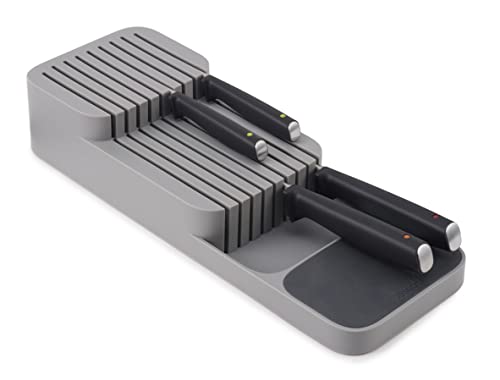
An under-cabinet run is a fixed set of openings, which makes a knife insert one of the few kitchen purchases that is genuinely a measuring job. The trouble is that almost every listing in this pool publishes the wrong figure for it. An insert’s own height tells you how tall the block is. It does not tell you how tall the drawer has to be, because the knife handles sit above the block in the grooves.
Five listings publish the opening instead, and the gap between the two figures is the point. Utoplike publishes a 1.8 inch base and asks for a drawer higher than 2.3 inches. NIUXX publishes a 2 inch block and asks for more than 2. MAD SHARK publishes 2.67 inches and asks for 2.8. Joseph Joseph publishes 3 inches and asks for 3. Bambusi publishes 2 inches and asks in words for more.
The row this table cannot fill is the slot depth. Every listing publishes an overall height and not one publishes how deep a groove is, which is what decides whether a chef’s knife with a full bolster drops in or sits proud of the block. That figure would matter more than any of the others, and it does not exist anywhere in this pool.
The Two Figures and the Gap Between Them
Half an Inch of Handle
Utoplike is the clearest case on the sheet. Its sixteen knife block is published at 16.6 by 12.2 by 1.8 inches, and the same listing asks for a drawer with an inner size larger than 17.1 inches deep by 12.7 wide and a height greater than 2.3 inches. That is half an inch of height the block does not use, and the listing explains what it is for: carved grooves and angled handle support so fingers can get to the knives.
Bambusi makes the same point in prose rather than in numbers. It publishes a 17 by 5.3 by 2 inch block and then asks you to leave room above the 2 inch base for the handles. No figure, which is a gap, but the instruction is unambiguous and it is the only listing here that explains the physics rather than just stating a requirement.
Where the Margin Runs Out
NIUXX publishes the tightest pairing in the pool. The block is stated at 16.5 inches deep by 11.8 wide by 2 high, and the requirement is a drawer interior bigger than 16.7 deep by 11.8 wide with a height greater than 2. Two tenths of an inch on the depth, nothing at all on the width, and a height requirement that equals the block. A real drawer has a back panel and a runner stop.
MAD SHARK is the opposite and publishes the most generous margin: an insert of 14.56 by 8.66 by 2.67 inches and a required interior of at least 15 by 9 by 2.8. Nearly half an inch of depth, a third of an inch of width and just over a tenth of height. On a page about fitting a fixed opening, that margin is worth more than two extra knife slots.
What Else the Fit Figures Decide
Blade Length Is a Separate Question
Two of these five publish a blade limit. NIUXX publishes twenty slots for blades less than 10.4 inches in length. Joseph Joseph publishes suitability for blades up to 9 inches. Elsewhere in the pool, Rev-A-Shelf publishes 55 slots for standard steak knives up to 14 inches. Everybody else publishes a slot count and leaves the blade to your judgement.
That matters because a slot count is not a capacity if your knives do not fit it. A 9 inch limit excludes a 10 inch chef’s knife, which is a common size, and Joseph Joseph is the only pick here that says so before you buy. Utoplike, MAD SHARK and Bambusi publish nothing about blade length at all, and Bambusi’s capacity depends on the drawer rather than on the knives.
Capacity That Depends on the Drawer
Bambusi publishes something no other listing in this pool does: capacity as a function of the opening. A 17 inch drawer holds 11 knives, and a 22 inch drawer fits all 16. Its own block is 17 inches long, so the extra five slots are only reachable in a drawer five inches longer than the block, which is an unusual and honest thing to print.
Read against the rest of the pool it is also a warning. Rev-A-Shelf publishes 55 slots across an 18.5 by 22 by 2 inch two-tier tray and says it is made for 12.5 to 18.5 inch wide drawers, trimmed to fit. High slot counts in this category assume a large drawer, and the under-cabinet runs that need this page most are not large.
The Eleven Listings That Leave You Measuring
Close, But No Requirement
SpaceAid publishes an insert 2.5 inches high, states its size as 15 by 5.9 by 2.5 inches, and then prints in capitals the instruction to measure your drawer height first. That is a listing that understands the problem and declines to solve it. madesmart publishes 15 by 8 by 2 inches and says it accommodates most standard kitchen drawers, which is a claim without a figure.
OXO publishes fields of 16.45 by 5.6 by 2.5 inches and a single sentence about saving countertop space. GHWIE publishes 3.0 by 15.6 by 1.6 inches for a seven knife dock. Both are small enough that the fit is unlikely to be a problem, and neither tells you the one thing this page is about.
The Magnetic Alternatives
Two listings answer a narrow drawer differently. ROYAL CRAFT WOOD publishes two seven slot blocks joined by built-in side magnets, and states plainly that they can be separated to fit narrower drawers, which is a genuine answer to a fixed opening. Its published fields, 3.5 by 15.55 by 1.8 inches, describe the carton rather than a block.
Lifewit publishes magnets inside the slots so knives stay put when the drawer is pulled, with fields of 9.06 by 16.54 by 1.97 inches against its own 11.6 by 16.5 by 2, and capacity for 16 knives and 1 sharpener. Neither publishes a required opening, so neither can be ranked here, and both are worth a look if the drawer you have is narrower than everything above.
Which One Fits Your Kitchen
You have measured the drawer inside and out. Utoplike publishes the requirement on all three axes, more than 17.1 by 12.7 inches and over 2.3 inches high, against a block of 16.6 by 12.2 by 1.8. Sixteen slots with angled handle support.
A wide run and a lot of knives. NIUXX publishes twenty slots plus a sharpening rod for blades under 10.4 inches, and a required interior of more than 16.7 by 11.8 inches. Two tenths of depth margin, so measure carefully.
One drawer for knives and cutlery. MAD SHARK publishes 14.56 by 8.66 by 2.67 inches against a required 15 by 9 by 2.8, with a clear lid over the tray. At 3.3 pounds it is the heaviest of these five.
A narrow drawer and short blades. Joseph Joseph publishes 15.5 by 5.5 by 3 inches, blades up to 9 inches and a minimum drawer height of 3. At 0.6 pounds it is the lightest of these five and the easiest to lift out.
You want to know what you are trading. Bambusi publishes 17 by 5.3 by 2 inches, states that a 17 inch drawer holds 11 knives and a 22 inch drawer all 16, and asks you to leave room above the base for the handles.
What We Could Not Verify
Every figure above is a manufacturer’s own published number or sentence. These are the things we went looking for across all sixteen listings and did not find.
- A slot depth on any listing, which is the figure that decides whether a wide bolster drops fully into a groove.
- A numeric clearance above the base from Bambusi, which asks for room for the handles without saying how much.
- A blade length limit for Utoplike, MAD SHARK or Bambusi, where two of the five picks publish one.
- A resolved height for Utoplike, whose dimension field reads 2.0 inches against the maker’s own 1.8.
- A washing statement from four of these five picks, with only NIUXX mentioning removable slots.
- A required drawer opening from either magnetic insert in this pool, which are the two products most likely to suit a narrow run.