How the Five Compare on the Numbers
Nine live pages on this pool already rank by cavity count, coating, footprint, weight, heat and cleaning. None of them asks how large the finished cake is. That is the gap, and on this shortlist it is the only figure that moves: four of these five are two packs of a twelve-cavity pan, so the batch total is twenty-four on four listings out of five.
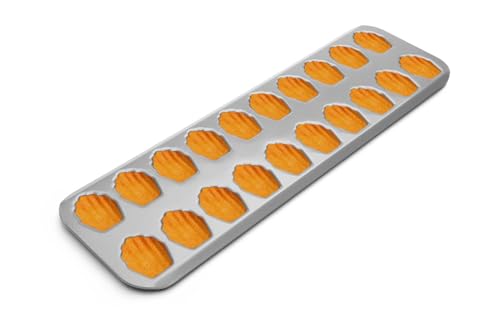
Read by cavity instead and the five separate cleanly. Fox Run publishes a mold of 1 3/4 by 1 1/4 by 1/2 inches. Shinsin publishes a well of 3 by 2 inches. BreadTalk publishes a finished cookie of 2.6 by 2.6 inches. CHENZORVAX publishes 2.6 inch cavities and Waylenbo 2.5, each as a single number with nothing behind it.
What the table cannot tell you is how much batter any of these cavities holds. A shell mold is a curved hollow, and a length and a width describe its rim rather than its volume. Only one listing publishes a depth, so for four of the five the difference between a 2.5 inch cavity and a 2.6 inch cavity could be a tenth of an inch of rim or a quite different quantity of cake.
What One Cavity Actually Makes
From a Bite to a Tea Cake
Fox Run sits at one end. Its twenty molds are published at approximately 1 3/4 inches long, 1 1/4 inches wide and 1/2 inch deep, and the listing calls them bite-sized. Nothing else here is in that class. Shinsin sits at the other end with a well given as 3 by 2 inches, and BreadTalk names a baked cookie of 2.6 by 2.6 inches, which is a round shell rather than an elongated one.
Between them, Waylenbo states a full cavity size of 2.5 inches and CHENZORVAX states 2.6 inch cavities. Both are single numbers, so whether that is a diameter, a length or a span across the ridge is not stated by either. For a weekend where the same batter goes into more than one pan, that ambiguity is the practical problem: two pans a tenth of an inch apart on paper may not bake in the same time.
The One Pan That Publishes a Depth
A madeleine is judged on its hump, and a hump needs a cavity deep enough to fill and shallow enough to dome. Only Fox Run publishes that figure, at approximately 1/2 inch, and it publishes it for the smallest cavity on the page. The four full size listings describe ridges, defined textures and a signature hump without ever saying how far down the shell goes.
BreadTalk comes closest by describing detailed ridges and a signature hump in the same bullet as its 2.6 by 2.6 inch figure, and CHENZORVAX claims consistent depth across its twelve cavities without naming it. Both are statements about the result rather than the mold. If cavity depth matters to you, one listing in five answers, and it answers for a bite size cake.
Two Pans Described in Identical Numbers
Waylenbo and CHENZORVAX State the Same Pan
Waylenbo states pans of 13.8 by 10.4 by 1 inch in 0.8 mm thickened carbon steel, twelve cavities, two per purchase, dishwasher safe. CHENZORVAX states pans of 13.8 by 10.4 inches in thick-gauge carbon steel, twelve cavities, two per purchase, dishwasher safe. Their cavity figures differ by a tenth of an inch and their descriptions are otherwise the same object.
Their published weights are not. Waylenbo publishes 0.74 pounds and CHENZORVAX publishes 1.49 pounds, and 1.49 is almost exactly twice 0.74. That reads like one listing weighing a single pan and the other weighing the pair, but neither says so, and neither weight is presented as per pan or per purchase. I have not built anything on either figure, because one of the two is describing half of what it sells.
What the Carton Figures Do and Do Not Say
BreadTalk and Shinsin publish dimension fields that describe a box rather than a pan, so they sit in the package column. BreadTalk’s box is given as 13.78 by 10.43 by 1.1 inches, which is close enough to the 13.8 by 10.4 pans Waylenbo and CHENZORVAX describe that it is probably one pan’s footprint plus packing. It is still the carton, and this page treats it as one.
Shinsin’s is harder to explain. The listing describes a pan of 15 2/3 by 7 by 2/3 inches and publishes a box of 5 by 9.5 by 1 inches, which is shorter than the pan in every direction. A carton cannot be smaller than the thing inside it, so one of those two figures is wrong and the listing gives no way to tell which. The maker’s own sentence wins here, and the box figure is reported rather than used.
What a Weekend of Batches Asks of the Pan
Dishwasher, Hand Wash, or Nothing Stated
Baking for two days means washing between batches, and the five listings answer that very differently. Waylenbo puts dishwasher safe in its opening material bullet with no hedge. CHENZORVAX states the non-stick surface withstands repeated washing and high-heat cycles without flaking, fading or corrosion, which is the strongest claim on the page about surviving repeat use.
Shinsin is the opposite: hand wash only, warm soapy water, dry thoroughly before storing, avoid aerosol cooking sprays. BreadTalk names no machine and instead gives an instruction, to dry the pan thoroughly or stand it vertically so water does not sit in the uncoated inside of the rolled edge, which it says may rust. Fox Run only says the tray is built to be easy to clean.
Heat Ceilings and the Four That Publish None
One listing in five publishes an oven temperature. BreadTalk states oven safe up to 428°F, given also as 220°C, and the two figures convert correctly. Shinsin, Waylenbo, CHENZORVAX and Fox Run publish no oven figure anywhere in their bullets, which is a strange omission on a coated pan sold for a hot oven.
The silence is not about the steel. Carbon steel is not the limiting part of any of these pans; the non-stick coating is, and all five describe that coating at length. Waylenbo calls its steel rustproof with excellent heat conduction, CHENZORVAX claims superior heat retention under repeated high-temperature use, and Shinsin claims high resistance to warping. None of the three attaches a number to it.
Which One Fits Your Kitchen
Baking with young children. Fox Run, for the twenty bite size molds at a stated 1 3/4 by 1 1/4 by 1/2 inches. Small cakes cool faster and go further around a table, and it is the only listing here that publishes all three cavity figures instead of one.
Serving madeleines with tea. Shinsin, whose well is stated as 3 by 2 inches while two rivals give a bare 2.6 and nothing else. The pan itself is stated at 15 2/3 by 7 by 2/3 inches, a long narrow tray, and it asks for hand washing.
Buying on a stated result. BreadTalk, because it publishes the baked cookie at approximately 2.6 by 2.6 inches rather than the hole it comes from, and it is the only one of the five to publish an oven ceiling at 428°F. Expect to dry it by hand.
Washing up fast between batches. Waylenbo, which clears a dishwasher in its first bullet, names a 0.8 mm gauge, and gives pan and cavity in the same sentence at 13.8 by 10.4 by 1 inch and 2.5 inch. Its published weight is the figure to distrust.
Baking with more than one person. CHENZORVAX, for the measurement markers inside each cavity. Two people filling two pans from one bowl will not portion alike by eye, and this is the only listing on the page that offers anything at all for that.
What We Could Not Verify
Everything below was looked for in all five listings and is not there:
- Any bake time or oven position, on a page where cavity sizes run from a stated 1/2 inch deep bite to a 3 by 2 inch well.
- Batter volume per cavity, which is the figure that would let these five be compared properly rather than by rim measurements.
- Whether Waylenbo’s 0.74 pounds and CHENZORVAX’s 1.49 pounds count one pan or two, on pans both makers describe in the same numbers.
- An oven ceiling for Shinsin, Waylenbo, CHENZORVAX or Fox Run, none of which publishes one anywhere in its bullets.
- Why Shinsin’s published box is smaller in every direction than the pan the same listing describes.
- A cavity depth on any of the four full size pans, so the shell ridge is described in words and never in a figure.