How the Five Compare on the Numbers
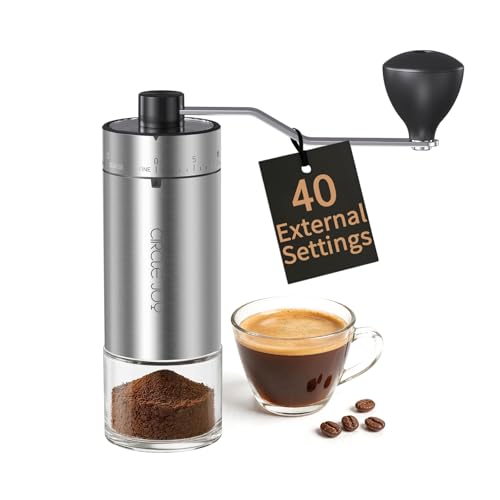
A small coffee corner gives up counter space before it gives up anything else, so the published width and depth carry the most weight in this shortlist. The HAMILADUO lists 1.9 inches of width and 6.3 inches of depth. The HZBSGZR and the CEVING Mini both list 2.3 inches of width, at 6.7 and 7.4 inches of depth respectively. The ByteX lists 2.95 by 3.74 inches, and the CIRCLE JOY lists 3.94 by 3.94 inches.
Capacity separates them next. The CEVING 60g states 60g, the largest published figure here. The CEVING Mini and the HZBSGZR each state 30g, and the HAMILADUO states 20g. The ByteX and the CIRCLE JOY publish no capacity figure, so a reader who grinds by weight has less to work with on those two. Weight is published for all five, from 0.4 pounds on the ByteX to 1.3 pounds on the HAMILADUO.
The table does not tell you how any of these grinders feels in the hand, how long a session takes, or how evenly the burr cuts at any setting. No one here has used them. It also does not resolve which published figure is the depth and which is the height, because the listings do not say. Treat every number as the maker’s own statement and nothing more.
Width and Depth in a Small Corner
What the published figures allow
The HAMILADUO lists 1.9 inches of width, the smallest published width across these five, and 6.3 inches of depth. That combination suits a narrow shelf or the gap beside a fridge, where a wider body would not sit. The trade is capacity: 20g is the smallest published figure on this sheet, so a reader brewing for two may need more than one session.
The ByteX takes a different route. At 2.95 by 3.74 inches it is the smallest published depth of the five, and at 0.4 pounds the smallest published weight. Because it is a lid for a regular mouth Mason jar, the jar supplies the body and the footprint is whatever jar you already have. No capacity figure is published, so plan by the jar you choose.
What the published figures do not allow
None of these makers publishes a footprint, a base area or a clearance figure. A width of 2.3 inches on the HZBSGZR and the CEVING Mini says nothing about how much room the crank needs to turn. The CIRCLE JOY lists 3.94 inches of width and 3.94 inches of depth, and the maker states an extra-long handle, but the listing does not say how far that handle sweeps.
The CEVING 60g lists 2.72 inches of width and 5.31 inches of depth, with a stated 60g capacity. A larger stated capacity usually means a taller or wider body, and here the published height is 7.87 inches, the largest on this sheet. If your corner has a shelf above it, that figure matters as much as the width does.
Capacity and Adjustment
How much coffee goes in at once
The CEVING 60g states 60g, the largest published capacity here, and describes the body as holding twice the beans of standard grinders. The CEVING Mini and the HZBSGZR each state 30g, and the HAMILADUO states 20g. The ByteX and the CIRCLE JOY publish no capacity figure, so a reader who weighs beans before grinding has nothing to plan against on those two.
Capacity interacts with the corner. A 60g session means fewer trips to the grinder, but the CEVING 60g publishes 5.31 inches of depth and 7.87 inches of height. A 20g session on the HAMILADUO means more sessions, but the published width is 1.9 inches. Neither is better in the abstract. The published figures simply point at different corners.
External rings and built-in knobs
The CEVING 60g, the CEVING Mini, the HZBSGZR and the CIRCLE JOY each state 40 settings. The two CEVING models describe theirs as external, reachable on a ring without opening the grinder, and the CEVING 60g states each click moves 0.05mm. The HZBSGZR and the CIRCLE JOY state 40 settings without describing the mechanism in the same terms.
The HAMILADUO uses a built-in adjustment knob and publishes no setting count. The ByteX describes removing a nut and handle, then rotating a gear-shaped piece up or down a threaded rod. Both are stated adjustment methods, and neither maker publishes a number of positions. A reader who wants a counted range has four options here, and a reader who wants a knob has one.
Which One Fits Your Kitchen
A reader with a narrow shelf. The HAMILADUO lists 1.9 inches of width and 6.3 inches of depth. Its 20g capacity is the smallest published figure here, so plan on more than one session for a full pot.
A reader who already owns Mason jars. The ByteX is a lid attachment for regular mouth jars, at 0.4 pounds and 3.74 inches of published depth. No capacity figure is published, so the jar you choose sets the batch.
A reader who grinds a large batch at once. The CEVING 60g states 60g, the largest published capacity of the five, with 40 external settings. Its published depth is 5.31 inches and its published height is 7.87 inches.
A reader who wants an external ring and a mid-size batch. The CEVING Mini states 30g and 40 external settings, with 2.3 inches of published width and 7.4 inches of published depth. The maker advises against washing it with water.
A reader who wants a long handle and a glass hopper. The CIRCLE JOY states an extra-long handle, a clear glass grounds hopper and 40 external settings. Its published width and depth are both 3.94 inches, the largest published width here.
What We Could Not Verify
Several figures a buyer would want are simply not on the sheet. These are the ones we looked for and did not find.
- No maker publishes a footprint, base area or counter clearance figure for any of these five.
- The ByteX and the CIRCLE JOY publish no bean or grounds capacity, so they cannot be ranked against the others on that measure.
- No maker states how long a full grind takes at any setting, or how many turns a dose requires.
- No maker states whether the published height includes the crank handle or measures the body alone.
- No maker publishes the burr diameter for these five, and no maker states the burr’s expected service life.
- No maker states the jar size the ByteX lid fits beyond regular mouth, and no capacity figure is given for that jar.