How the Five Compare on the Numbers
A whisk stand is a small ceramic or glass dome, so a shallow cabinet is rarely the thing that stops one fitting. What stops a buyer is that the figure is often not published where it should be. Three of these five write a height into a bullet. Two do not, and on three of them the published height field is a tenth of an inch.
The heights that are stated sit close together: 2.76 in, 2.95 in and 3 inches. Two of those three are published twice, once in metric and once in inches, which is the only way to check a figure on a product nobody can measure from a listing. The other two picks leave the question to a size attribute or to nothing at all.
What the table cannot settle is which figure to believe when a listing publishes two that cannot both be true. Makuzen states 3 inches in height in a bullet and publishes a height field of 0.1 in. One of those is the stand and the other is a data entry, and the listing gives no way to tell which except common sense about what a stand is.
The Height Field Is Not the Height
Three Listings Publish a Tenth of an Inch
Makuzen and the unbranded ceramic holder both publish a height field of 0.1 in. A whisk stand at that height would be a coaster. Makuzen’s own bullet states 3 inches in height and 2.2 inches in width, so the sentence and the field disagree by a factor of thirty, and this page follows the sentence because it is the only one describing a usable object.
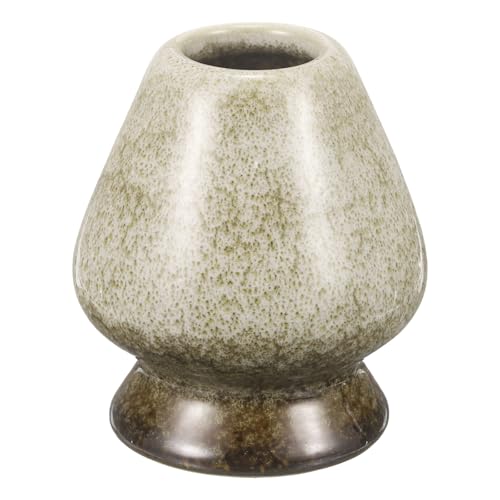
The unbranded holder has no sentence to fall back on. Not one of its five bullets carries a figure. Its size attribute reads Height 6.5, Width 5.8CM, putting the unit on the second number and leaving the first bare. Its width field of 2.6 in is what 6.5 cm converts to, which is the only reason this page treats 6.5 as centimeters at all.
Two Listings Put the Height in the Depth Field
Nwstar and HARFINGTON both state a height clearly and both publish an empty height field. Nwstar’s fields read 2.4 and 2.95 in, and 2.95 is the figure its bullet calls the height. HARFINGTON’s read 2.36 and 2.76, and 2.76 is the figure its bullet calls the height. In both cases the height is in the listing, just not in the field named for it.
That is worth saying plainly because it changes how the page is built. Order these five by their height fields and the ranking is nonsense. Order them by the maker’s own sentence and three of the five are documented and two are not. On this pool the fields are a record of how the data was entered rather than a description of the product.
Two Units Beat One
Nwstar States Centimeters and Converts
Nwstar publishes a size bullet with two figures and both units: a maximum diameter of 6.2 cm, given as 2.4 in, and a height of 7.5 cm, given as 2.95 in. Both conversions hold. That is the strongest documentation on this page, because a buyer who trusts neither number can check one against the other without leaving the listing.
What it buys the whisk is stated separately. The design bullet describes a tower shape that allows better air circulation while drying, which the maker says reduces the risk of mold and prolongs the life of the whisk, and a circular base meant as a stable platform. A tower is also the shape that carries water away from the prong bases.
HARFINGTON States Millimeters and Matches Its Own Attribute
HARFINGTON publishes a height of 70 mm, converted to 2.76 in, and an outer diameter of 60 mm, converted to 2.4 in. Its size attribute is the bare number 70, which is the millimeter height with the unit stripped off, so for once an attribute and a bullet agree. Its depth field of 2.76 in agrees as well.
Its drying claim is the simplest here: the middle is hollow, which the maker says helps the drying process and prevents scale accumulation. It says nothing about a dishwasher and nothing about a weight, and its stability claim is that the bottom is polished smoothly and finely to provide a stable support platform, which is a description rather than a figure.
What the Stand Is Actually For
Four Published Approaches to One Wet Whisk
A chasen splits when water sits in the base of the prongs, and four of these five publish something about it. Nwstar publishes airflow through a tower. HARFINGTON publishes a hollow middle. The unbranded holder publishes an elevated base with airflow channels so water drains and the whisk dries evenly. HARIO publishes a rinse bowl that is also the stand.
Makuzen is the exception. It publishes borosilicate glass, a flower shaped base, and a statement that it helps maintain the shape of the chasen when not in use. Shape is half the job. Drying is the other half, and the listing does not claim it. What Makuzen offers instead is the only holder here where the prongs are visible while they dry.
The Two That Commit to Something Extra
The unbranded ceramic holder publishes the only compatibility figure on the page: it fits most standard bamboo chasen of 80 to 120 prongs. It also states a weighted bottom against tipping and a non porous glaze that survives daily dishwasher cycles. No figure for the weight, and no figure for the glaze, but both are checkable claims about a real part.
HARIO commits to a capacity instead. It publishes 100 ml and describes a two in one piece that is a chasen stand and a rinse bowl, stated dishwasher safe, with a claim that the whisk dries evenly and keeps its shape. It is also the only pick whose height field, 2.64 in, is plausible for a stand, and the only one with no size in its own words.
Which One Fits Your Kitchen
A cabinet gap you have measured. Nwstar, a ceramic tower stating 7.5 cm or 2.95 in high and 6.2 cm or 2.4 in across, with a tower shape for air circulation, a stated reduction in mold risk and a circular base platform.
A figure you can check twice. HARFINGTON, ceramic at 70 mm or 2.76 in high with a 60 mm or 2.4 in outer diameter, hollow through the middle for drying and against scale, with a size attribute that matches its own bullet.
Watching the prongs dry. Makuzen, borosilicate glass stated at 3 inches in height and 2.2 inches in width, with a flower shaped base, stated heat resistant, and a height field of 0.1 in that this page does not use.
A whisk you already own. The unbranded ceramic holder, the only pick stating a prong range at 80 to 120, with an elevated base and airflow channels, a weighted bottom against tipping, and a stated dishwasher rating.
One piece doing two jobs. HARIO, clear glass published at 100 ml that is a stand and a rinse bowl together, stated dishwasher safe, with the only plausible height field here at 2.64 in and no size in its own words.
What We Could Not Verify
Every figure above comes from the maker’s own listing text. These are the things we went looking for and could not source in any of them.
- Not one of the five publishes a weight, including the two that claim a base that will not tip.
- Three publish a height field of 0.1 in, which cannot describe a stand.
- HARIO publishes no height, no width and no diameter anywhere in its listing.
- The unbranded ceramic holder attaches no unit to its height figure and no figure to its bullets.
- No listing publishes the shelf gap or cabinet depth it was designed to sit under.
- No listing publishes how long a whisk takes to dry on it, only that it dries more evenly.