How the Five Compare on the Numbers
Three listings were left out: a plastic board a quarter of an inch thick with fewer published features than the plastic pick here, a hardwood board that publishes no weight at all, and a walnut end grain board whose sizes and construction duplicate one already on this page. What remains is five boards at five different thicknesses in five different materials, which is as clean a comparison as this category allows.
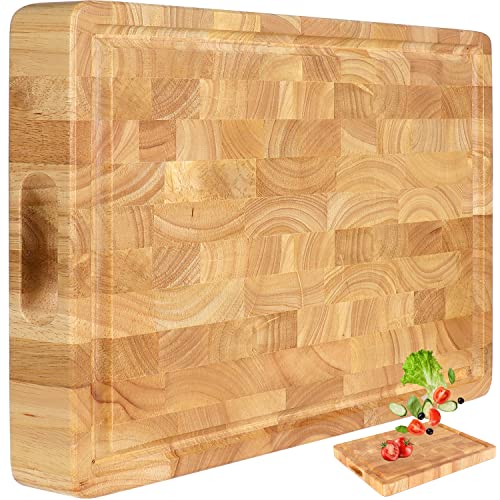
Weight is published on all five and it tracks thickness exactly. Bevel & Bond is 10 pounds, the heaviest here, at 1.75 inches of end grain maple. Realgulf is 9 pounds at 1 inch of teak, Greener Chef 6.8 at 0.75 inches of bamboo, FANICHI 6 at 1.5 inches, and OXO the lightest of the five at 1.53 pounds for half an inch of plastic. Wood weight is not optional and every one of these boards tells you so.
What the table cannot tell you is how any of these boards behaves with raw chicken on it. Only the plastic board makes a claim about porosity, and none of the four wood boards publishes anything about sanitizing, bleach tolerance or safe handling after raw meat. Nor does any wood listing state a moisture content, which is what decides whether a board cups in a dry kitchen.
Thickness Is the Argument, and One Maker Makes It
A Maker Warns About a Board Sold Beside It
Bevel & Bond puts the case in its own bullet: many boards are only 1.5 inches and prone to cracking over time, so it builds at a full 1.75 inches for stability and long term performance. That is a specific claim about a specific number, and FANICHI, three listings away in the same search results, is exactly 1.5 inches of end grain.
Whether the warning is fair is not something either listing lets you check, because neither publishes a moisture content, a glue type or a joint pattern. What it does do is make the thickness ladder on this page legible. From 1.75 inches down to half an inch, each of these five boards is a different answer to how much material a cutting surface needs, and each maker argues its own figure.
End Grain, Edge Grain and Neither
Two of the five publish a grain direction and they publish different ones. Bevel & Bond and FANICHI are both end grain, meaning the wood fibers stand upright so a blade parts them rather than cutting across them. Realgulf is edge grain teak and argues its own case, saying dense edge grain teak slows moisture intake to keep the board flat.
Greener Chef publishes no grain direction because bamboo is a laminate of strips rather than a solid timber, and OXO has none to publish. Those two also sit at the bottom of the ladder here, at 0.75 and 0.5 inches against 1.75 at the top. Grain direction and thickness are the two specifications that separate a butcher block from a cutting sheet, and only three of these five publish either.
Surface Area, and What the Extra Inches Buy
Twenty Four by Eighteen Against Seventeen by Thirteen
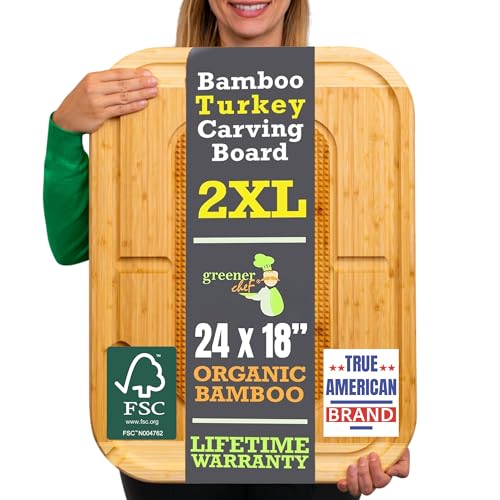
Realgulf and Greener Chef both publish 24 by 18 inches, which is a board you carve a turkey on rather than dice an onion. Bevel & Bond and FANICHI both publish 17 by 13, which is a standard large board. OXO publishes 14.78 by 10.39 inches, which is a utility board for everyday prep.
Realgulf frames its size as a workflow argument: small boards lack room for whole roasts and batch baking, and a wide surface holds roasts, vegetables and dough together. Greener Chef frames the same dimensions around presentation, calling itself a carving board and a meat platter. The same two figures, two different reasons, and the same amount of counter taken up.
Where the Juices Go
Four of the five have an answer and they are not the same answer. Greener Chef publishes a juice groove with a pour spout, so the drippings leave the board into a jug for gravy. FANICHI publishes a carved juice groove on the front face and wells on the reverse for holding diced vegetables, so one board does two jobs.
OXO publishes an integrated drip catcher and easy pour corners on a plastic board. Bevel & Bond publishes no groove at all, which on a 1.75 inch maple carving block is a deliberate choice: a flat end grain surface takes a knife better than a grooved one, and resting meat can be tipped. Realgulf also publishes no groove, and its two faces are both flat by design.
Raw Meat, Washing and the Hygiene Question
The Only Board You Can Put in a Dishwasher
OXO is plastic and non porous, stated to resist odors and not to dull knife blades, and it is the only board here that can go through a machine. Bevel & Bond states hand wash with warm soapy water, towel dry, never dishwasher and never soak. Realgulf states hand wash only. FANICHI and Greener Chef publish no washing instruction at all.
That silence matters on a page about meat boards. A wood board that has held raw chicken needs a defined cleaning routine, and two of the four wood boards here provide one. The other two publish a warranty and a species instead, and leave the most consequential instruction in the listing unwritten.
Feet, Grip Pads and One Unusual Warning
Bevel & Bond and OXO both publish feet fitted to the board, and Bevel & Bond adds the reason: airflow underneath, which on a wood board is how the underside dries. Greener Chef and FANICHI publish no feet at all, and on a 24 by 18 inch bamboo board that is a lot of surface sitting flat on a wet counter.
Realgulf publishes the most honest sentence in this pool. Its grip pads are supplied separately, you apply the adhesive yourself, and once attached they cannot be peeled off. That is a permanent modification disclosed before purchase, and no other listing here volunteers a limitation of that kind about its own accessory.
Which One Fits Your Kitchen
A board for the next twenty years. Bevel & Bond publishes 1.75 inches of end grain hard maple at 10 pounds, made in the USA, with rubber feet for airflow, a mineral oil finish already applied, and a washing instruction that says hand wash, never soak, never a dishwasher.
Chopping and holding at once. FANICHI publishes 1.5 inches of end grain at 17 by 13 inches, with a carved juice groove on one face and built in wells on the other for diced vegetables, plus inner side handles. It publishes no washing instruction and no wood species.
Keeping raw meat on its own side. Realgulf publishes 24 by 18 inches of FSC certified edge grain teak at 1 inch and 9 pounds, with two flat reversible faces for separating raw from ready to eat, no chemical coatings, hand wash only, and grip pads you attach permanently yourself.
Carving a turkey and pouring the juices. Greener Chef publishes 24 by 18 inches of organic bamboo at 0.75 inches and 6.8 pounds, with meat spikes, a juice groove and a pour spout, and a lifetime replacement warranty against cracking, warping or splitting.
Raw chicken and a dishwasher. OXO publishes 14.78 by 10.39 inches of non porous plastic at half an inch and 1.53 pounds, double sided, with an integrated drip catcher, easy pour corners, non slip feet and tapered edges that work as handles.
What We Could Not Verify
These six things decide how a meat board lasts and how safely it can be used, and the listings settle none of them.
- Wood species on one of the four wood boards. FANICHI publishes end grain and natural wood and never names the timber.
- Washing instructions on two of the four wood boards. FANICHI and Greener Chef publish none at all, on boards sold specifically for raw meat.
- Grain direction on the bamboo board. Bamboo is a laminate of strips and the listing publishes no orientation, so its behavior under a knife is unstated.
- Moisture content and glue type on every wood board here, which is what actually decides whether a board cups or the joints open.
- Whether the thickness warning is justified. One maker warns that 1.5 inch boards crack and another sells a 1.5 inch board, and neither publishes anything that would settle it.
- Any hygiene claim on the wood boards. Only the plastic board mentions porosity, and no wood listing addresses sanitizing after raw poultry.