How the Five Compare on the Numbers
Seven listings sit on the fact sheet and two are left off. Rovista publishes 42 oz, which is within two ounces of a pick already here, and EliteVibe publishes 1.6 Qt, which is the same unit another pick uses. Both are well documented and neither adds a different answer to the question this page asks, so the five below are the ones that between them cover every unit the pool uses, plus the one that publishes no capacity at all.
A first steamer is bought to feed a set number of people, and the only figure that answers that is volume. These five publish it as 44 oz, as 940 mL, as 2 cup, and as 1 Quart given also as 4 cups and 750 mL. The fifth publishes no capacity in any unit and has the largest footprint on the page, which is the gap this comparison is built around.
The table cannot convert these capacities into each other with any confidence, because a bowl volume and a usable food volume are not the same number and none of these makers says which one it is publishing. A 44 oz bowl filled to the brim will not steam 44 oz of broccoli, and only ReneeChef publishes marks inside that would let you see where the line actually is.
Four Units for One Question
The One That Publishes All Three
ReneeChef publishes its capacity as 1 Quart and then converts it in the same bullet, to 4 cups and to 750 mL. That is the only listing in the pool that does the arithmetic for the reader, and it matters because a recipe is written in cups, a package is labeled in milliliters and a pan is sold in quarts. It also publishes scales marked on both inner walls, so the figure can be used rather than trusted.
No other listing here marks the inside of the bowl. CJKKH publishes 44 oz, Sistema 940 mL and PrepSolutions 2 cup, and all three leave the reader to hold the number in their head and guess at the fill line. On a steamer, where the water goes in first and the food sits above it, that line is the whole technique.
The One That Publishes No Volume At All
GoodCook publishes its size twice, as 12 by 8 by 2.7 inches in a bullet and again in its dimension fields, and never publishes a capacity. It is the largest footprint on this page by a wide margin and only 2.7 in through, which together describe a wide flat tray rather than a bowl. Its own instruction explains the shape: add water to the bottom tray, put the steam tray on top with vegetables or fish, cover, cook.
For fish fillets laid flat that is the right geometry and a volume figure would not help much. For a starter kit it is still a gap, because there is no way to compare it with a 940 mL bowl without measuring your own vegetables first. It is also the only pick with a published adjustable vent, and at 0.7 lb the heaviest here.
What Actually Keeps Food Out of the Water
A Tray, a Basket, or Bumps in the Base
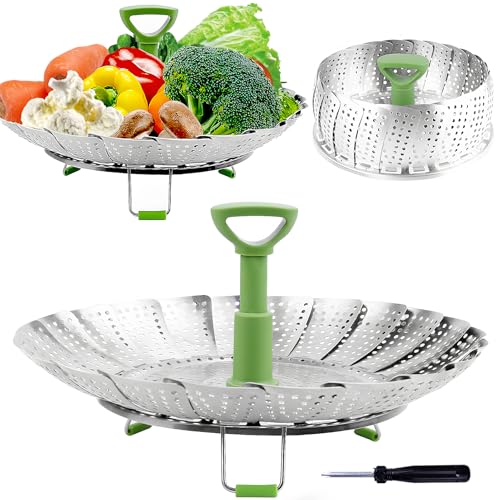
These five solve the central problem four ways, and one of them does not solve it at all. GoodCook uses a separate steam tray sitting over a water tray. PrepSolutions uses a steamer basket that also works as a colander, so the same part drains and lifts. CJKKH uses a striped bump design molded into the bottom, which raises food off the base rather than above a reservoir.
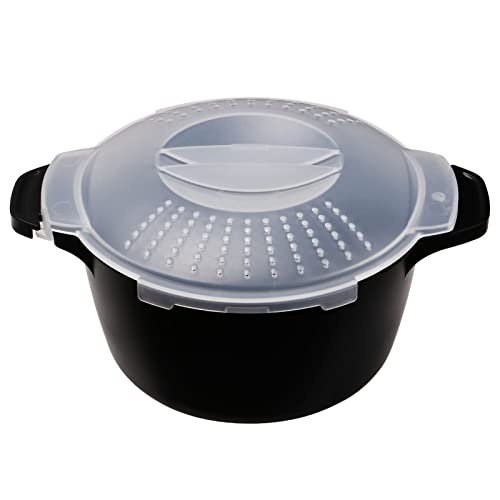
ReneeChef publishes a locking lid with small and medium holes and no raised insert of any kind. Sistema is honest about being something else entirely: a noodle bowl for cooking pasta, soup and stew with a steam release vent, and no elevating part at all. Bumps in a base and no insert are not equivalent to a tray, and the listings do not draw the distinction.
Lids That Do Different Jobs
CJKKH publishes a water storage lid with vent holes, which is a lid that holds liquid rather than only releasing steam. GoodCook publishes an adjustable vent and explains why, that it prevents the container sealing shut. ReneeChef publishes a locking lid and says it will not spill even when the bowl holds liquid, with holes sized to help pour water off.
Sistema publishes a vent on the lid and states that the bowl is microwave safe with the vent open, which is the only conditional safety statement in the pool. PrepSolutions publishes no lid description at all. Every one of these four lid designs answers a different failure, splatter, sealing shut, spilling in transit, and pouring off water.
Where the Published Figures Stop Agreeing
Three Dimensions, Three Small Disagreements
CJKKH publishes 10.5 by 5.7 by 4.3 in in its own title and text, and its dimension fields read 5.9 by 10 by 4. Every one of the three figures differs: half an inch on the length, two tenths on the width and three tenths on the depth. Individually those are rounding, and together they mean the two sets were measured separately.
This page quotes the maker’s sentence, since it is the figure attached to the product name, and records the field beside it. GoodCook is the counterexample and the only pick on this page whose two sets of figures are identical, 12 by 8 by 2.7 in in both places, which is the one thing a buyer can plan a cabinet shelf around.
Small Bowls With Bigger Bodies
PrepSolutions publishes 2 cup of capacity in a body its fields put at 4 by 7.25 by 6.25 in. Sistema publishes 940 mL in a body of 6.77 by 6.14 by 3.82 in. On those numbers the smaller published capacity sits in the taller object, which is what happens when a basket, a lid and a rim are all inside the outside measurement and none of it is labeled.
ReneeChef publishes no dimensions at all, on the listing that publishes capacity three ways. CJKKH and ReneeChef both publish no weight. So of these five, two can be planned by volume, two by footprint, and one, ReneeChef, only by volume with no idea how much cupboard it takes.
Which One Fits Your Kitchen
Cooking from a written recipe. ReneeChef, the only pick that publishes 1 Quart as 4 cups and 750 mL together, with scales marked on both inner walls and a locking lid whose holes are sized for pouring water off. It publishes no dimensions and no weight.
Steaming fish laid out flat. GoodCook, a 12 by 8 by 2.7 in tray with a separate steam tray over a water tray and an adjustable vent that stops the lid sealing shut. It publishes no capacity, and its two sets of figures agree exactly.
Lifting a hot bowl out of the microwave. CJKKH, 44 oz with heat resistant side handles curved for fingers, a water storage lid with vent holes and a striped bump bottom that keeps food off the base. Published at 10.5 by 5.7 by 4.3 in.
One serving and a colander in one. PrepSolutions, a 2 cup mini steamer at 4 by 7.25 by 6.25 in and 0.37 lb, whose steamer basket doubles as a colander, on a nonstick BPA free body. The only pick that states how many people it feeds.
Noodles, soup and the fridge. Sistema, a 940 mL bowl at 6.77 by 6.14 by 3.82 in and 0.29 lb in virgin plastic, top rack dishwasher safe and stated fridge and freezer safe. It has no part to hold food above water and does not claim one.
What We Could Not Verify
Every figure above is from the maker’s own listing. These are the things we went looking for and could not source in any of the seven.
- No listing says whether its published capacity is the bowl to the brim or the food it will actually steam.
- GoodCook publishes no capacity in any unit, on the largest footprint on this page.
- Only PrepSolutions states how many servings it is for, so the other four have to be judged by volume alone.
- CJKKH publishes 10.5 by 5.7 by 4.3 in and 5.9 by 10 by 4 in for the same bowl, with all three figures differing.
- ReneeChef publishes no dimensions and no weight at all, on the listing with the best capacity figures.
- Only ReneeChef marks the inside of the bowl, so on four of the five the water line has to be judged by eye.