How the Five Compare on the Numbers
Aybloom was left out. Its listing carries no feature bullets at all, so there is nothing to read beyond a title, and its three dimension fields sit in an order that puts 0.9 inches where a width belongs. Every other listing here publishes at least four bullets, and on a pan where the cup geometry is the whole product a listing with no description of the cups cannot be compared.
All five picks hold 24 cups, so count is not the variable. What separates them is whether the maker publishes a cup dimension at all. The three silicone pans publish a top diameter and a depth. The two steel pans publish an overall footprint and say nothing whatever about the cups, which is the figure that decides how big a mini muffin actually comes out.
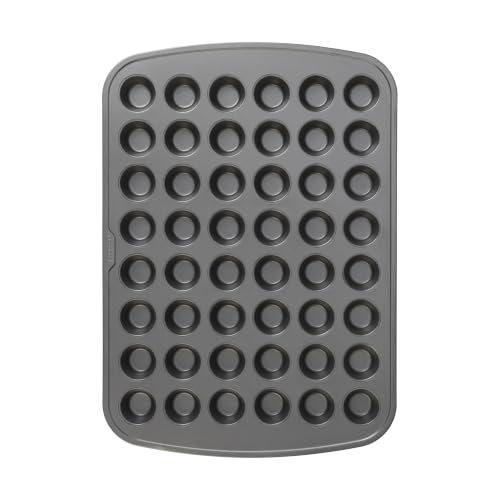
The table cannot tell you what a mini muffin from either steel pan will look like. Wilton publishes 16 inches long by 10 wide by 1 inch deep and that is the pan, not a cup; Bake Choice publishes 14.8 by 10 by 0.86 inches on the same basis. A cup can be shallow and wide or narrow and deep inside the same footprint, and the silicone listings are the only ones here that say which.
Cup Geometry Is the Product
Three Listings Publish the Cup, Two Do Not
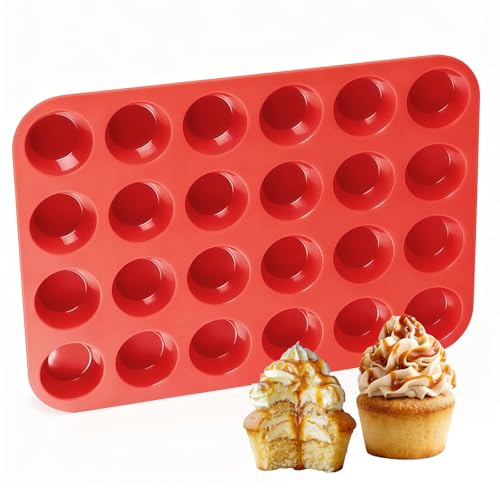
CAKETIME, Fimary and RICCLE all publish a top diameter of 1.8 inches. CAKETIME and Fimary both give a depth of 0.7 inches, and RICCLE gives 0.9 inches, which is a quarter again as deep in the same diameter. That difference changes the shape of the finished muffin from a disc to something closer to a dome, and it is the only real specification difference between the three silicone pans.
CAKETIME goes one step further and publishes a volume, 0.6 ounces per cup, which is the figure a recipe can actually be divided by. It is the only listing in this pool that does. Neither steel pan publishes a diameter, a depth or a volume, so a buyer comparing Wilton against CAKETIME has no common figure to compare them on at all.
What the Steel Pans Publish Instead
Wilton publishes the pan: 16 inches long, 10 inches wide and 1 inch deep, in alloy steel, with extended handles and a 450 F rating. That 1 inch is the depth of the pan body rather than the cup, and the difference is not trivial, because a 1 inch pan cannot hold a 1 inch cup. Its published fields read 10 by 16 by 1 inches and match the bullet exactly.
Bake Choice publishes 14.8 by 10 by 0.86 inches in its first bullet, and its published fields read 7.87 by 7.87 by 1.97 inches, which describes something square and nearly 2 inches tall. Those cannot both be a 24 cup mini muffin pan, so this page uses the maker’s own sentence and sets the fields aside as not describing the product.
Silicone, Frames, and Getting It Out of the Oven
Why Two Silicone Pans Have Metal in Them
CAKETIME is bare silicone and says so plainly in a usage tip: because the pan is flexible, put it on a metal tray or cookie sheet for support before filling it. That is an honest instruction and also an extra item you have to own. At 0.41 pounds it is the lightest pick here, and the flexibility that makes it awkward to carry is what makes a baked muffin pop out with a finger.
Fimary and RICCLE both solve the same problem the same way, with a metal reinforced frame around the silicone. RICCLE states the point directly: the frame makes it safe to lift and transfer a full pan of batter into and out of the oven. Fimary states that the frame keeps the pan in shape under high temperatures rather than warping, which is the same feature argued from durability instead.
Temperature Ranges Are Not the Same Number
The two bare and framed silicone pans that quote a range give minus 104 F up to 446 F, which covers a freezer as well as an oven, and CAKETIME lists the microwave, dishwasher, fridge and freezer alongside it. Fimary instead states 450 F, given also as 232 C, and says the pan can go from the freezer straight to the oven without naming a low limit.
Wilton states 450 F for its steel pan. Bake Choice states no temperature at all in five bullets, which is the one figure a pan really ought to carry, and instead spends its guidance on washing. Four of five publishing a limit is better than this pool usually manages, and the 446 against 450 gap is small enough not to matter in a domestic oven.
Fitting the Oven, and Keeping the Pan
Footprint Against a Compact Cavity
Wilton is 16 inches long and 10 wide, the largest stated footprint here, and its extended handles add to that in use because you have to be able to grip them. The two framed silicone pans are 15.3 by 9.2 inches, which is smaller in both directions. Bake Choice states 14.8 by 10 inches, so it is shorter than Wilton and the same width.
CAKETIME publishes no footprint at all, only the cup figures, and its own dimension fields described a carton and were dropped. Since it also has to sit on a tray you already own, the effective size of the CAKETIME setup is the size of that tray, which is not a figure any listing can give you. That is the practical cost of a pan with no frame.
Liners, Washing, and What Wears Out
Bake Choice includes 200 liners and then asks you to use them, and separately asks you to hand wash with a soft sponge and avoid the dishwasher to protect the coating. That is a coated steel pan being honest about its coating. RICCLE states that its cups take most standard cupcake liners, which matters because silicone cups are a different shape from paper ones.
CAKETIME and Fimary both state dishwasher safe outright, which silicone can support in a way a coating cannot. Wilton says nothing about washing across five bullets despite selling a coated steel pan, and RICCLE says nothing either despite four bullets covering the oven, the microwave and the freezer. Neither silence is fatal, but both are gaps on the question people ask second.
Which One Fits Your Kitchen
Deeper mini muffins, and two pans at once. RICCLE is two framed silicone pans of 24 cups each at 15.3 by 9.2 inches, with a 1.8 inch top diameter and a 0.9 inch depth, a quarter again on both silicone rivals. It is rated from minus 104 F to 446 F and takes most standard cupcake liners.
One silicone pan that lifts without help. Fimary is 24 cups at 15.3 by 9.2 inches with a metal reinforced frame, a 1.8 inch cup top and a 0.7 inch depth, rated to 450 F and stated dishwasher safe, at 0.74 pounds. It goes from freezer to oven and folds into a tight cupboard.
Dividing a recipe by the cup. CAKETIME is the only pick that publishes a cup volume, 0.6 ounces, alongside a 1.8 inch top and a 0.7 inch depth. At 0.41 pounds it is the lightest here, it is oven, microwave, dishwasher, fridge and freezer safe, and it has to sit on a metal tray you supply.
A steel pan with something to hold. Wilton is 24 cups of alloy steel at 16 inches long, 10 wide and 1 inch deep, with extended handles and a 450 F rating, made without PFAS. Its published fields match its own bullet exactly, and it never publishes a cup diameter or depth.
Starting from nothing at all. Bake Choice is a 24 cup steel pan stated at 14.8 by 10 by 0.86 inches with 200 mini cupcake liners in the box. At 1.19 pounds it is the heaviest pick here, it asks for hand washing to protect the coating, and its published fields do not match its own bullet.
What We Could Not Verify
These are the figures that decide what comes out of the pan, and the steel listings publish almost none of them.
- Wilton and Bake Choice publish no cup diameter, no cup depth and no cup volume, so the size of a finished muffin is unknown on both.
- Only CAKETIME publishes a volume per cup, 0.6 oz, so four of five cannot be measured against a recipe.
- Bake Choice’s published fields of 7.87 by 7.87 by 1.97 inches cannot describe a 24 cup pan and contradict its own stated 14.8 by 10 by 0.86 inches.
- Bake Choice publishes no temperature figure at all, the only pick here that does not.
- CAKETIME publishes no pan footprint, and since it needs a support tray its real size depends on a tray no listing describes.
- Wilton and RICCLE both publish no washing instruction, on a coated steel pan and a silicone pan respectively.