How the Five Compare on the Numbers
Seven live pages already rank this pool: by the size each maker writes in its own words rather than in a field, by whether the basket closes and how the lid is fixed, by height, by how many separate places one purchase creates, by the washing instruction, by how the basket comes to you, and by material. The height page says in its own first line that width is what people search for and then sets width aside.
A utility drawer is the case where width is the whole question, and these five make it harder than it looks. One publishes a width that is only the top of the basket. One publishes a width in its fields that is its height in its own sentence. One publishes no size in words at all and asks you to look at a photograph instead.
What the table cannot tell you is what the Meyeyaia basket measures at its base, because the listing publishes one width for a basket it describes as wider at the top. It also cannot tell you what the RT&BS basket measures in the maker’s own words, because that listing has none: its first bullet asks you to check the size in the second product image before buying.
Which Figure Is the Width
Three Listings Agree With Themselves
Meyeyaia and Domensi both put the whole size in the title or the first bullet and publish the same three figures in their fields: 10.23 by 2.36 by 2.28 inches, and 10.25 by 3.25 by 2.5 inches, with Domensi giving the metric equivalent as 26 by 8 by 6 cm. On a pool where the parent page found most listings publishing a carton, two listings that agree with themselves is worth noting.
Mainstay is the third kind of agreement: its dimension fields were pulled as a carton reading 3.27 by 10.51 by 3.23 inches, and its fourth bullet says each plastic tray measures approximately 10 inches long by 3 inches wide by 2 1/2 inches deep. Those two are consistent with a set of three nested trays in a box, which is the best a multipack listing usually manages.
One Reverses Width and Height
iDesign publishes a clean sentence: the bin measures 16 by 4 by 3 inches high. Its dimension fields read 3.0, 16.0 and 4.0, which puts 3 inches in the width slot and 4 inches in the height slot, the opposite way round from the maker’s own sentence. For a drawer that reversal is the difference between a basket that clears a 3.5 inch gap and one that does not.
We have used the sentence, so the iDesign basket is 4 inches wide and 3 inches high on this page. It is the one basket here with built-in handles and a stated stacking feature, which the maker says works first inside kitchen drawers. It is also the only one declared food safe and fridge and freezer safe, and the only one that forbids the dishwasher outright.
A Published Width With Two Values
The Only Listing That Says It Tapers
Meyeyaia publishes the lowest width figure on this page at 2.36 inches, and then publishes the reason that figure cannot be trusted as a single number: a tapered design, wider at the top and narrower at the bottom, which the maker says maximizes storage in drawers and cabinets. The 2.36 inch figure is one of two widths and the listing gives only one of them.
That does not make it the wrong basket. It makes the figure a ceiling rather than a footprint, which is the opposite of what a drawer measurement usually is. Twelve trays arrive for 1.05 lb, so each is very light, and the surface is stated to clean with a damp cloth or a light rinse. No drainage, no heat claim and no load figure appear anywhere.
What a Taper Costs and Buys
A tapered tray gives back volume at the bottom, where small items actually sit, and takes less room at the base of the drawer. A straight-walled tray does the reverse. Neither Domensi nor Mainstay says which shape it is, and both publish a single width, so a reader has to assume straight walls and accept the risk of being wrong by whatever the taper would have been.
Domensi is the one that publishes a reason to want the walls perforated rather than solid: a hollow design the maker says can drain water from tableware and kitchen utensils, which turns the tray into a drying rack. It also claims a certain load-bearing capacity in those words, with no figure attached, and that is the only load language in this group.
The Basket That Publishes No Size at All
A Photograph Instead of a Figure
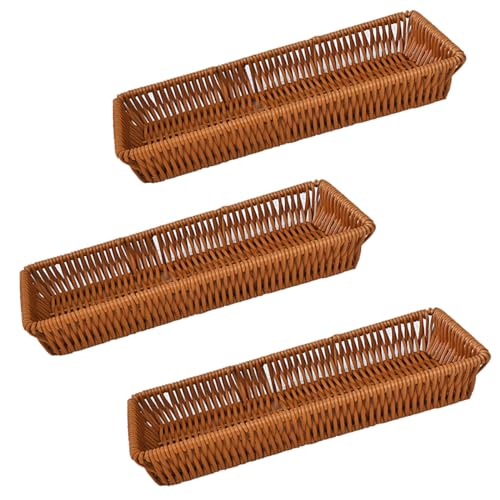
RT&BS opens with an instruction rather than a specification: check the basket size in the second image before buying, because the maker sells several sizes and colors. Nothing in the five bullets gives a figure for the basket you are ordering. The dimension fields read 10.63 by 3.74 by 1.57 inches, and with no sentence to check them against there is no way to tell which size they belong to.
What the listing does publish is material detail nobody else here matches: handwoven from recyclable food-grade polypropylene fibers, breathable, UV resistant and resistant to high temperatures of 120 C, with the appearance of rattan and the washability of plastic. At 1.57 inches it also publishes the lowest height in this group, which suits a drawer that will not close over anything taller.
A Carton and an Approximation
Mainstay is the opposite failure and the more forgivable one. Its fields are a carton, its own sentence is hedged with the word approximately, and the figures it gives are round numbers: 10 inches long, 3 inches wide, 2 1/2 inches deep. Rounded figures are a warning in a drawer, because 3 inches stated approximately could be 3.2 inches in the hand.
For 0.29 lb across three trays it is the lightest purchase here, which tells you the plastic is thin. The listing spends four of its five bullets on uses rather than specifications, including protecting model railway cars in a drawer, and publishes no washing instruction, no material grade and no load claim of any kind.
Which One Fits Your Kitchen
The drawer gap is under three inches. Meyeyaia. Twelve trays published at 10.23 by 2.36 by 2.28 inches, with the base narrower than that because the maker states the walls taper. Nothing else here publishes a figure that low.
You want the tray to drain as well as hold. Domensi. Twelve PP plastic trays at 10.25 by 3.25 by 2.5 inches, with a hollow design the maker says will drain water from tableware and utensils.
A long drawer and only one basket needed. iDesign. 16 by 4 by 3 inches in the maker’s own words, clear and stackable with built-in handles, food safe and freezer safe. Do not put it in the dishwasher.
The drawer barely closes as it is. RT&BS. Published at 10.63 by 3.74 by 1.57 inches in its fields only, handwoven polypropylene, breathable and rated to 120 C. Accept that no bullet on the listing confirms those three figures.
Three trays and nothing to think about. Mainstay. Approximately 10 inches by 3 inches by 2 1/2 inches each, 0.29 lb for the set. Accept that every figure on the listing is rounded.
What We Could Not Verify
These are the specifications we went looking for in all five listings and did not find.
- What the Meyeyaia basket measures at its base, given the maker states the walls taper.
- Any size in RT&BS’s own words, since its first bullet refers you to a product image instead.
- Whether Domensi, Mainstay or RT&BS has straight or tapered walls, which none of the three states.
- A load figure from any of the five, including the one claiming a certain load-bearing capacity.
- A washing instruction, a material grade or a load claim from Mainstay.
- Why iDesign’s fields put 3 inches in the width slot when its own sentence says 4 inches wide.