How the Five Compare on the Numbers
Eight live pages already rank this pool: by published weight, by blade length, by overall length, by whether the published figure is the blade or the whole tool, by what the handle is made of and what shape it is given, by what the maker tells you to do after washing, by whether the handle is drilled to hang, and by published height. The washing instruction and the handle material are both taken.
What none of them reads is the line where the blade meets the handle, which on a tool used in buttercream is where the cleanup problem actually lives. Two of these five describe that join: one calls it seamless and one says the blade is attached with two sturdy rivets. The other three say nothing about it at all.
What the table cannot tell you is whether a seamless join is actually seamless, because VRUIFA publishes the claim and no figure, no photograph reference and no material for the handle it is seamless with. Nor can it tell you what the other three listings look like at that line, since not one of them mentions the handle and the blade in the same sentence.
Where Frosting Collects
One Seamless Join and One Riveted One
VRUIFA puts it in a bullet headed safe and easy to maintain: food-grade materials, and a seamless connection between the blade and the handle. On a tool that spends its life in buttercream that is the single most useful sentence in this pool, because a seam is a trap and a rivet head is two more. It is the only seamless claim among these five.
Ateco goes the other way and is equally explicit: a lovely natural wood handle with the blade attached with two sturdy rivets. That is a durability answer rather than a cleaning one, and it is honest about the trade. Two rivet heads and a wood-to-steel line are three places frosting can sit, and the same listing publishes no washing instruction at all.
Three That Do Not Say
XEKIGU, Amabl and OXO never mention the join. All three describe the handle and the blade separately and leave the line between them unstated, which on a three piece set is three unstated joins. What they publish instead is the cleaning outcome: XEKIGU calls the blade non-stick, Amabl says rinse with water after each use, OXO says dishwasher safe.
Those three sentences are not equivalent. A dishwasher statement covers the whole tool including whatever the join is made of. A rinse instruction is a weaker claim and Amabl’s is the only one on this page that stops short of a machine. A non-stick blade claim says nothing about the handle end, which is where the problem was.
Wood, Plastic and the Handles Nobody Names
The Only Wood Handle Here
Ateco is the only one of these five to name a handle material, and it names the one that complicates a cleanup routine: natural wood. Wood and a dishwasher are not friends, and the listing does not raise it, publishing no washing instruction of any kind across five short bullets. It does publish the blade precisely, at 1.25 inches by 7.625 inches, which no other listing here manages.
Amabl names plastic and describes it in more detail than anyone describes anything: a bumpy non-slip surface and a concave thumb rest. That is a shape claim rather than a cleaning one, and a bumpy surface is a texture frosting sits in. The same listing is the one asking for a rinse rather than a machine, and the two facts belong together.
Three Handles With No Material
VRUIFA publishes handle colors, orange, yellow and blue, and no material. OXO publishes soft and non-slip, which describes a feel rather than a substance. XEKIGU publishes non-slip and ergonomic and nothing else. Three listings out of five describe a handle you will hold every time and will not say what it is.
That matters here more than it would elsewhere, because the seamless claim VRUIFA makes is a claim about two materials meeting and only one of them is named. Steel to steel, steel to plastic and steel to silicone behave differently at a join over a hundred washes, and this pool supports no comparison of them at all.
Figures That Describe the Box
Two Cartons Among Five Listings
XEKIGU and Amabl are three piece sets whose dimension fields were read as cartons: 1.2 by 15.0 by 0.1 inches and 3.13 by 9.01 by 0.1 inches. Both are real published figures for a box and neither describes a spatula. XEKIGU publishes no size sentence at all, so its blade lengths of 6, 8 and 10 inches are the only sizes it offers.
VRUIFA and OXO publish fields that behave: 1.3 by 14.5 by 0.1 inches and 1.25 by 12.5 by 0.88 inches. The OXO figure is the only one in this group with three plausible numbers for a single tool, and its 0.88 inch figure is the handle rather than the blade, which is why it is the one listing here a shallow drawer has to be measured against.
A Straight Blade on an Offset Page
Two products in this pool were left out deliberately. Tablecraft publishes a 6 inch straight icing spatula with an ABS handle, a blade of 6 inches by 1.25 inches and an overall figure of 11.25 by 0.75 by 1.25 inches, which is the most completely specified tool in the pool. It is also straight rather than offset, so it is the wrong tool for this page.
The other Ateco listing, a 4.5 inch blade with the same wood handle and the same two rivets, publishes a weight field that was nulled as near zero. Including both Atecos would have made the page about blade length, which another live page already owns, so the medium one is here and the small one is not.
Which One Fits Your Kitchen
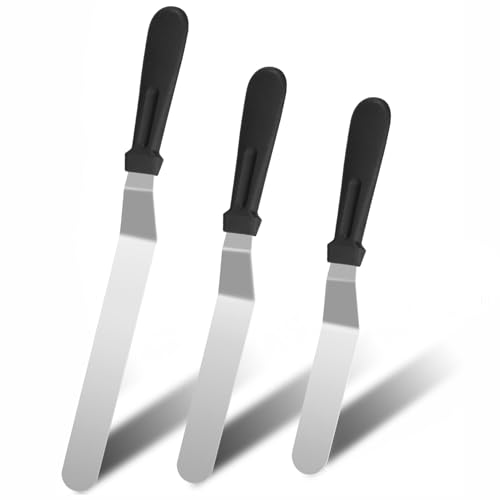
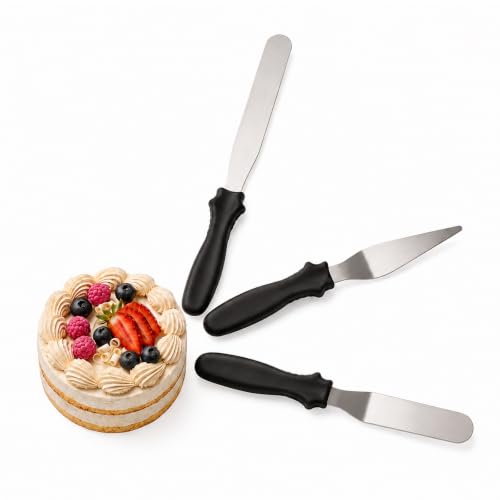
You want nothing for frosting to sit in. VRUIFA. The only listing here publishing a seamless connection between blade and handle, in three angled blades at 6, 8 and 10 inches, published at 1.3 by 14.5 by 0.1 inches.
You want the blade to outlast the icing. Ateco. A tapered ground stainless blade of 1.25 by 7.625 inches on a natural wood handle with two sturdy rivets, at 0.16 lb. No washing instruction is published.
You want the blade itself to release. XEKIGU. Three angled blades at 6, 8 and 10 inches with the blade stated non-stick, non-toxic and tasteless. Its only figures are a carton of 1.2 by 15.0 by 0.1 inches.
You rinse at the sink rather than loading a machine. Amabl. Three 8 inch blades in angled, straight and tapered profiles, a concave thumb rest, and the instruction to rinse with water after each use.
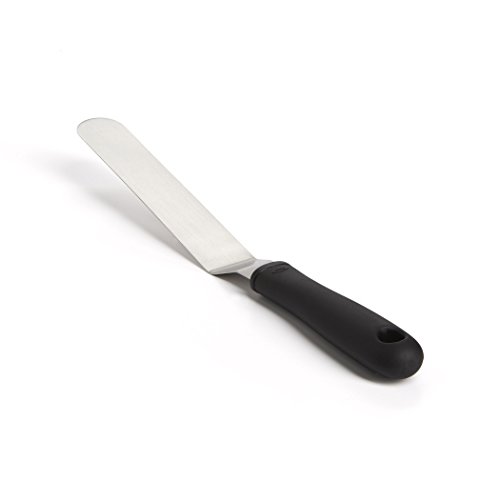
You want one blade and no thinking. OXO. A flexible stainless bent blade with a soft non-slip handle, stated dishwasher safe, published at 1.25 by 12.5 by 0.88 inches and 0.22 lb.
What We Could Not Verify
These are the specifications we went looking for in all five listings and did not find.
- How the blade meets the handle on the XEKIGU, Amabl or OXO, none of which mentions it.
- What the VRUIFA, XEKIGU or OXO handle is made of, since all three publish only a feel or a color.
- Any washing instruction from Ateco, whose handle is natural wood.
- A blade width from four of the five, with only Ateco publishing one at 1.25 inches.
- A blade length from OXO, which publishes an overall figure and no blade figure.
- Any weight at all for the VRUIFA set, in a field or a bullet.