How the Five Compare on the Numbers
Six live pages already rank this pool by adjustable width, by the clearance above the rack, by footprint, by what holds it steady, by how much of it is given to tools and by the parts list. None of them asks the question a family station asks first, which is how much the rack will actually take before it stops being a rack and starts being a pile.
The answer is published in three currencies that do not convert. ADBIU states 100lb. Tomorotec states 70 lbs. Simple Trending counts 10 recessed plate spaces and 5 cup holder positions. JASIWAY counts 7 standard plates and 2 small cups. Sakugi counts six baskets and publishes no rating and no plate count at all.
Nothing in this pool publishes both a pound rating and a plate count, so the two halves of the table cannot be put on one scale. A rack rated 100lb may hold fewer plates than one rated nothing, because the rating describes the frame and the count describes the slots. Choosing here means choosing which of the two questions you actually have.
Capacity Published Three Different Ways
Pounds, Which Describe the Frame
ADBIU states a loading capacity up to 100lb and calls the rack huge and massive in the same bullet. Tomorotec states that it easily supports up to 70 lbs with all rods in use, which is the only load figure in this pool that names a condition. Both numbers describe what the structure will bear, not how many items find a home on it.
The Tomorotec figure is the more interesting of the two because of what it is attached to. Its height field reads 0.5 in: this is a roll-up mat of 304 stainless rods with silicone edges, and it claims 70 lbs. The three-tier steel tower claims 100lb. The gap between those two products is enormous and the gap between their ratings is not.
Counted Slots, Which Describe the Rack
Simple Trending publishes 10 recessed spaces for plates, 5 cup holder positions and a utensil caddy with drainage holes. JASIWAY publishes up to 7 standard plates and 2 small cups. These are the only two listings in these five that tell you what fits, and they are both the small racks, sized 10.5 inches and 9.8 inches across.
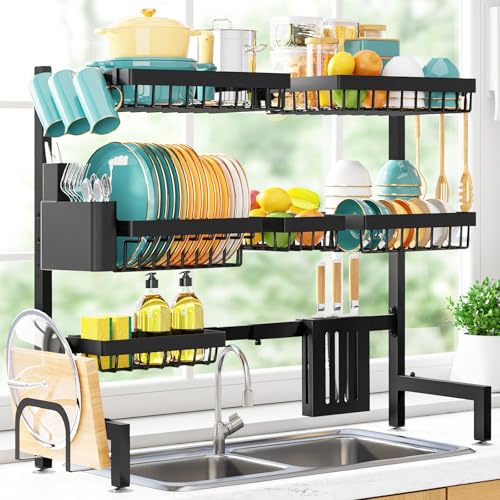
Sakugi sits between the two currencies and publishes neither. Its size field reads Ultra with six baskets, and its bullets name one utensil holder, a cutting board holder, a knife holder and five utility hooks. That is a parts list rather than a capacity, and on the largest rack of these five it is the figure most obviously missing.
Two of These Tell You Not to Buy Them
JASIWAY Rules Out Your Household
Its fourth bullet states that the compact capacity is designed for 1-2 people, holds up to 7 standard plates and 2 small cups, and then says in capitals that it is not for large families or big sinks. That is the clearest statement of scope in this pool, and it disqualifies the product from this page’s own premise while being the most honest listing of the five.
It is worth keeping on the page for exactly that reason. A family station will have a day when only two plates need drying, and a 13.4 inch by 9.8 inch rack that sits inside the basin is the right tool for that day. What it will not do is take a roasting dish, a chopping board and eight plates at once, and it says so.
ADBIU Publishes Its Own Return Rate
Its first bullet states that in the past month 50% of return orders were due to the rack being too large or too high, quotes buyers saying it sat too close to the cupboard, and asks you to check the size to avoid return trouble. No other listing in this pool volunteers a statistic against itself.
The figures behind it are the reason. ADBIU asks for a height of 34.2 to 37.4 inches over the sink plus at least 20 inches of clear room above that. On a standard run of wall cabinets that is not available, which is why this rack has the largest published capacity here and the fewest kitchens it fits.
Where These Listings Disagree With Themselves
ADBIU Cannot Decide How Many Tiers It Has
The title says 2 Tier. The first bullet calls it a 3 tier dish rack, the third calls it a 2025 3-Tier Huge and Massive Version, and the second tells you to choose the maker’s 2 tier rack instead if you lack the room. On the tier count, which is the first thing a buyer reads, the listing contradicts itself twice.
The dimensions wobble too. The title and the size field both give 31 to 39.4 inches long and 34 to 38 inches high, while the dimensions bullet gives 32.6 to 39.4 inches long and 34.2 to 37.4 inches high. I have used the bullet figures in the table, because the brief here is to follow the maker’s own sentence when the fields and the words disagree.
Sakugi’s Dimension Fields Are a Placeholder
All three of its published dimension fields read 33.0, which is the signature of a field nobody filled in. Its own title and bullets give 31.5 inches to 39.5 inches long, 12 inches wide and 30.5 inches high, so the real figures exist and I have used those. The 33.0 triple is discarded here and should be ignored wherever you see it.
Tomorotec has a subtler version of the same problem. Its title and size field say 17.7 by 15.5 inches, while its first bullet lists three available sizes: 17.7 by 12.5, 17.7 by 15.5, and 21 by 15.5 inches. Any automatic reading of that bullet picks up the smallest variant rather than the one on sale, so the size in the table is the one the title names.
Which One Fits Your Kitchen
The station that has to clear a whole family dinner. ADBIU. It publishes 100lb, the largest load rating on this page, three tiers and a ten-item parts list, if your kitchen has the 34.2 to 37.4 inches of height plus 20 inches above it.
The counter that needs the rack to disappear. Tomorotec. A roll-up mat of 304 stainless rods rated 70 lbs with all rods in use, heat safe as a trivet, and stated suitable for both hand and machine washing.
The sink with a low cabinet above it. Sakugi. Six baskets, a knife holder, a cutting board holder and five utility hooks across a span of 31.5” to 39.5”, published at 30.5 inches high rather than ADBIU’s 37.4.
The household that wants the count, not the rating. Simple Trending. It publishes 10 recessed plate spaces and 5 cup holder positions on a frame that extends from 14.25 inches to 25.7 inches and sets up in under 30 seconds.
The two-person weeknight load. JASIWAY. It states 7 standard plates and 2 small cups for 1-2 people, and says plainly that it is not for large families, which is the most useful sentence in this pool.
What We Could Not Verify
Everything above is from the makers’ own listings. These six things I looked for and none of these five publishes.
- Any load rating for Sakugi, Simple Trending or JASIWAY.
- Any plate or cup count for ADBIU, Tomorotec or Sakugi.
- Any listing that publishes both a pound rating and a counted capacity.
- Whether ADBIU is a two-tier or a three-tier rack, which its own text answers both ways.
- Any steel grade for Simple Trending, and any grade beyond stainless steel for JASIWAY.
- The condition behind ADBIU’s 100lb, where Tomorotec at least names all rods in use.