How the Five Compare on the Numbers
Every pastry mat sold claims to have measurements printed on it. Almost none says what they are. Across these five, one listing publishes the ruler range and the circle diameters as figures, one names four categories of printing without a single number, and the other three write markings in inches and centimeters and leave it there.
The second thing to check is whether the mat itself is measured. Four of these five publish a working area. The fifth publishes none at all, and the three numbers filed against its size belong to the rolling pin packed in the same box. A mat with no size cannot be matched to a counter.
What the table cannot settle is how legible any of this printing is, because none of these listings states a line weight, an ink, or whether the markings survive a dishwasher cycle. Three of the five say the mat may go in a machine and not one of them says what happens to the rulers after it does. That is the single most useful unpublished fact on this page.
What Each Mat Prints on Its Own Surface
One Listing Gives the Scale in Numbers
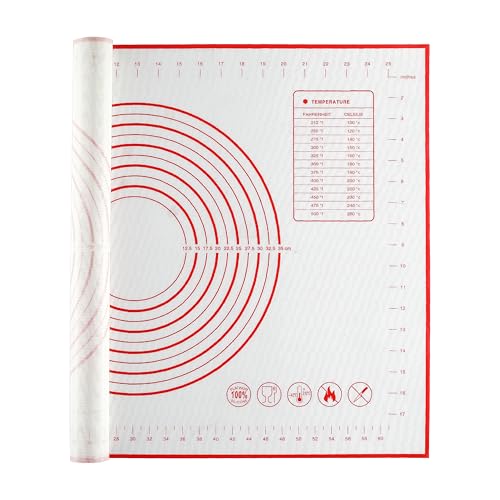
JJOO publishes its printing as a specification rather than a promise. Rulers along the edges run 0 to 25 inches and 0 to 42 cm. Circular guides run 5 to 14 inches, which covers a tart base and a family pizza. A temperature conversion chart for ovens sits on the same surface. Those three lines are checkable before anything is bought.
That is the whole argument for this mat on this page. Its working area is stated at 27 by 19 inches, it publishes 0.42 lb, and it names fiberglass reinforcement in the silicone. It publishes no thickness figure and no dishwasher route, so it trades two upkeep answers for the only complete answer about the printing.
One Describes Four Kinds of Printing and No Size
AMUZHI lists more printed features than anything else in this pool: inch and cm rulers, circle guides, a temperature reference and volume conversion charts, on a fiberglass-reinforced silicone sheet. Not one of those carries a figure, and the listing never says how large the mat is. No field, no bullet, no title number.
What is filed against its size, 1.0 by 16.7 by 0.1 inches, is the seamless steel rolling pin sold with it. The 0.92 lb weight covers the pin and the mat together, which the data flags as impossible for the published outline, and rightly: a steel tube and a silicone sheet cannot both live inside those three numbers.
Two Mats, One Brand, and 0.3 Millimeters Between Them
0.7mm on One Listing and 0.4mm on the Other
QUELLANCE appears twice here because its two mats publish genuinely different figures. The 20 by 28 inch mat is published at 0.7mm and described as twice a standard 0.3mm sheet, reinforced so it will not rip or roll up at the edges. The 24 by 16 inch mat is published at 0.4mm and that is presented as a feature.
Both arguments hold and they point opposite ways. A 0.7mm sheet lies flat under a pin and resists creeping. A 0.4mm sheet rolls into a drawer and weighs 0.26 lb. The awkward part is the 0.3mm standard the thicker listing cites, since the same brand’s other mat sits only 0.1 millimeters above it.
What a Raised Lip Does That Thickness Does Not
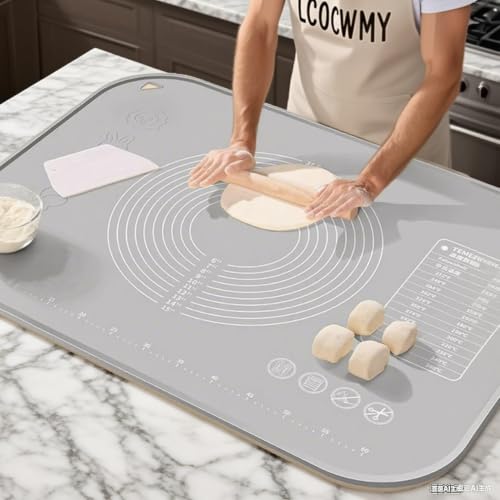
LCOCWMY solves a different problem. It publishes a raised edge at 6mm and states the purpose plainly, to stop water escaping while dough is kneaded. Thickness stops a mat moving. A lip stops the counter getting wet, and on a 31 by 24 inch sheet that is a real saving on the daily wipe down.
It costs weight. LCOCWMY publishes 1.1 lb, against 0.26 lb for the 0.4mm sheet, and that is the price of a bigger mat with a wall around it. It is also the only listing here that publishes hanging holes, so the mat can go back on a hook wet instead of into a drawer.
Where the Published Temperatures Do Not Convert
230 Degrees Celsius, Written Two Different Ways
Three of these five publish a heat ceiling and every one of them gives the same Celsius figure, 230 C. AMUZHI converts that to 446 F, which is right. LCOCWMY and QUELLANCE both convert it to 450 F, which is the same number rounded up to something friendlier. Four degrees will not ruin a pie crust, and the pattern still matters.
It matters because these listings are the only source of truth on a product nobody can inspect before buying. Where a maker rounds a conversion for readability, other figures on the same listing deserve the same scepticism. AMUZHI is the one here that did the arithmetic and published the awkward number instead.
A Cold End That Cannot Be Right
LCOCWMY publishes its range as -40 C to 230 C, then gives the Fahrenheit equivalents as -100 F to 450 F. Minus 40 is the one point where the two scales meet: -40 C is -40 F. So -100 F is not a conversion of anything on that line, and one of the two cold figures is simply wrong.
QUELLANCE publishes -45 degrees F and gives -43 C beside it, which converts correctly and is a sensible freezer figure. This page cites both listings as published and leans on neither cold figure, because a mat is rarely asked to do anything at -40 anyway. The lesson is about the listing, not the freezer.
Which One Fits Your Kitchen
A baker who rolls to a size every week. JJOO publishes rulers from 0 to 25 inches and 0 to 42 cm and circle guides from 5 to 14 inches on a stated 27 by 19 inch surface. Nothing else here lets you check the printing before it arrives.
Someone tired of wiping the counter. LCOCWMY publishes a 6mm raised edge on a 31 by 24 inch mat, plus hanging holes and a dishwasher claim. It publishes 1.1 lb, which is the weight of a big sheet with a wall around it.
A cook whose mat keeps sliding. QUELLANCE publishes 0.7mm on its 20 by 28 inch mat and states that a standard sheet is 0.3mm. Markings appear on each side, and it is the only pick here called both microwave and dishwasher safe.
A kitchen with one free drawer. The 24 by 16 inch QUELLANCE mat is published at 0.4mm and 0.26 lb, and the listing says that thinness is why it stores small. It also publishes the full range, -45 degrees F to 450 degrees F.
Anyone buying the pin at the same time. AMUZHI pairs a fiberglass-reinforced printed mat with a seamless 16.7 inch steel pin and states both are dishwasher safe. Buy it knowing the mat size is not published, and measure your counter first.
What We Could Not Verify
Everything above comes from the makers’ own published text. These are the things that text does not contain.
- The size of the AMUZHI mat. No field, no bullet and no title figure gives it, and the fields describe the pin instead.
- The thickness of the JJOO, LCOCWMY and AMUZHI mats. All three say they are thicker than standard and none publishes a figure.
- The circle diameters printed on four of the five. Only JJOO states them, at 5 to 14 inches.
- Whether the printed rulers survive repeated dishwasher cycles. Three listings allow the machine and none addresses the ink.
- Whether the JJOO mat may go in a dishwasher at all. It describes cleaning and never names a route.
- The weight of the AMUZHI mat on its own. Its 0.92 lb figure covers a silicone sheet and a steel pin together.