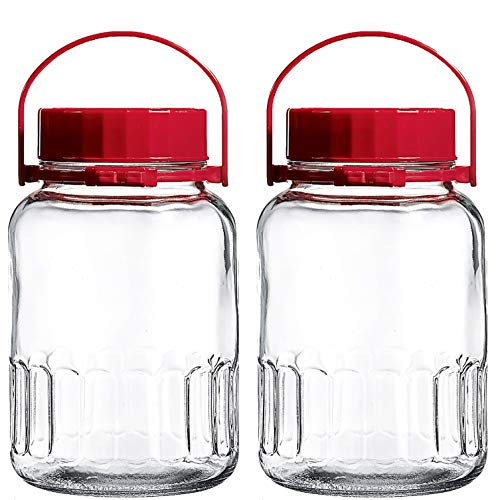
How the Five Compare on the Numbers
Every listing in this pool leads with capacity, and capacity is the one figure that tells you least about portioning a week of food. A quart jar and a half gallon jar both hold what they say. What decides whether cooked food goes in without a funnel, and comes out with a spoon rather than a chopstick, is how wide the top of the jar actually is.
Five listings here put a number on that opening. They publish 2.75 in, 3 in, 3.74 in, 4 in and 4.3 in, which is a spread of more than an inch and a half across the mouth. Eleven other listings in the pool say wide mouth and publish no figure at all, so the number exists on fewer than a third of them.
What the table cannot tell you is the shape of the shoulder below the opening. A jar can publish a 4.3 in mouth and still narrow sharply under it, which is what traps a spatula. None of the sixteen listings publishes an internal profile, a neck diameter or a straight sided claim, so the number in the opening row is the only part of the geometry any of these makers commits to.
The Opening Is the Figure That Decides the Work
From 2.75 Inches Across to 4.3 Inches
YINGERHUAN publishes 2.75 in on its 16 oz jars, which is the smallest opening figure of these five. ComSaf publishes 3 in on a quart. Anwoi publishes 3.74 in, AGTRADE 4 in and Qianfenie 4.3 in. Qianfenie is also the only maker that says what the figure buys you, describing an opening wide enough to fit a hand for filling or cleaning.
That matters more for prep than for pickling. A brine and a sliced cucumber will go through any of these. A portion of chili, a cooked grain salad or a set custard will not go through the narrow ones without running down the outside, and the jar then has to be wiped before the lid goes on. The figure is a labor spec, not a volume spec.
A Regular Mouth Listing That Calls Itself Wide
The YINGERHUAN listing is titled Regular Mouth Mason Jars and its own bullet is headed REGULAR MOUTH, then opens with the words wide opening and gives 2.75 in. Two sentences later it says the wide mouth allows easy access to the bottom of the jar. The same listing tells you twice that the mouth is regular and twice that it is wide.
That is not a small ambiguity if you already own lids. Regular and wide mouth mason lids are not interchangeable, and a buyer replacing a gasket or a fermentation cap needs to know which thread the jar carries. The published figure settles it, because 2.75 in is a regular mouth measurement, but the words in the listing do not.
What One Purchase Actually Delivers
Four Small Jars or Two Large Ones
YINGERHUAN and Anwoi both ship four jars. ComSaf, AGTRADE and Qianfenie ship two. Multiplied out, the four packs give 64 oz and 128 oz of total capacity and the two packs give 64 oz, 128 oz and 270 oz. Two very different purchases arrive at the same total, and the pool never makes that comparison for you.
For portioning, the count is worth more than the total. Four 32 oz jars from Anwoi is four dinners; one AGTRADE jar of 135 oz is a batch that still has to be decanted into something. ComSaf says as much in its own words, calling its two jar box a starter set for trying meal prep rather than a system for running it.
The Published Weight Belongs to the Box
Weight is published for all five, and it is the pack weight rather than the jar weight in every case. YINGERHUAN publishes 1.0 lb for four 16 oz glass jars with metal lids. Anwoi publishes 2.0 lb for four 32 oz jars with hinged glass lids and gaskets. Neither figure is consistent with the glass those listings describe.
Compare them with the two that look right. Qianfenie publishes 5.0 lb for two 64 oz jars and AGTRADE 5.18 lb for two gallon jars, which are the sort of numbers thick glass produces. This page therefore does not rank anything by weight and does not call any of these five light or heavy, because two of the five figures cannot be believed.
Where the Published Figures Contradict Each Other
One Carton Figure Discarded and One Kept
The ComSaf package figures read 3.94 x 3.94 x 66.14 in. A two jar box cannot be over five feet along one edge, and the same listing publishes 2.12 lb, so the third figure is discarded here. The two 3.94 in figures are plausible for a quart jar footprint and are left in the table as what they are, a package figure rather than a jar.
The other three package figures hold up. YINGERHUAN publishes 3.2 x 3.2 x 5 in, which is one 16 oz jar rather than a box of four, and is listed as the package all the same. Anwoi publishes 11.42 x 11.42 x 7.87 in, which is a carton of four upright jars. Qianfenie publishes 6.3 x 6.29 x 6.8 in for two.
Qianfenie Publishes Two Sizes for the Same Jar
The Qianfenie size field says 6.8 inches high by 6.3 inches wide. Its fourth bullet says each jar measures 6.7 inches high by 5.7 inches wide. Those are the same jar described twice, and the two descriptions disagree by 0.1 in on height and 0.6 in on width. The house rule is to use the maker’s own sentence, so the bullet figures are the ones this page treats as the jar.
The gap is small enough to look like rounding and large enough to matter on a fridge shelf, where 0.6 in across two jars decides whether a third fits beside them. Anwoi has the same problem in a worse form: its size field publishes 6.7 x 7.3 in for a pack of four, which is neither one jar nor a box of four, and nothing in the listing explains it.
Which One Fits Your Kitchen
The single portion cook. YINGERHUAN gives four 16 oz jars with screw lids and a published 2.75 in opening. That is the right count for four lunches and the wrong opening for anything thicker than a sauce, so plan on a narrow spatula and a wipe before the lid goes on.
The weekend batch cook. Anwoi gives four 32 oz jars with a published 3.74 in opening and hinged lids that stay attached to the jar. Four dinner portions in one purchase, and no small metal band to lose down the back of a drawer between Sundays.
The cook who measures as they fill. Qianfenie is the only pick that publishes marks on the glass, in milliliters and ounces, on a 64 oz jar with a 4.3 in opening. If you portion by volume rather than by eye, it is the only one of the five that lets you do it in the jar.
The brine and stock maker. AGTRADE gives two 135 oz jars with plastic pour spout lids, a handle and a published 4 in diameter. It is a decanting vessel rather than a portion, and the pour spout is the reason to choose it over the other gallon jars in this pool.
The buyer who wants the maker to be straight. ComSaf states a 3 in mouth, states that the jars carry no measurement marks, states that the lids are consumable parts and warns against sudden temperature changes. Two jars is a small purchase, and it is the only listing here that tells you what it does not do.
What We Could Not Verify
These are the things a meal prep buyer needs and no listing in this pool publishes.
- No listing publishes the internal neck diameter below the opening, which is what a spatula actually has to clear.
- No listing publishes a weight for one empty jar, only a figure for the whole pack.
- Two of the five pack weights, at 1.0 lb for four 16 oz jars and 2.0 lb for four 32 oz jars, cannot be the glass described.
- No listing states a freezer temperature limit, although three of the sixteen mention freezing.
- Only ComSaf and Qianfenie say anything about temperature change, and neither gives a figure in degrees.
- No listing states the thread type, so whether a spare lid from another brand will fit is unknown.