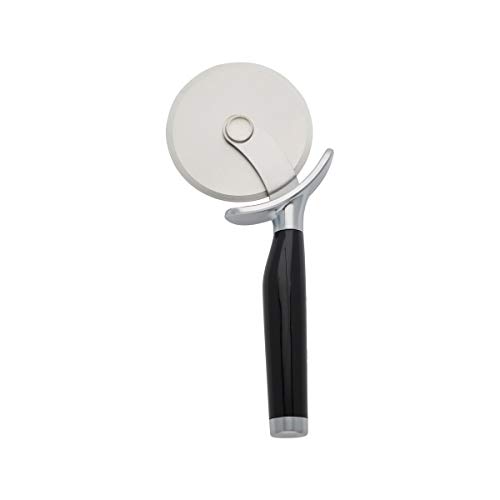
How the Five Compare on the Numbers
Sixteen pizza cutters sit on this fact sheet and most of them publish a blade figure and stop there. OXO gives a 4 in wheel and a thumb guard. KitchenStar gives a 9 in cutter with a cover. Winco gives a 2.5 in blade on a polypropylene handle at 0.1 lb. Good figures, and none of them answers the question a whole weekend of pizzas asks.
That question is what happens to the joint. A wheel cutter turns on a post through a slot that fills with cheese and oil, and by the fourth pizza the difference between tools is whether the maker will let you open it. Two of these five say they come apart, one has nothing to come apart, one names every part around the wheel, and one tells you not to put the handle in the machine.
What the table cannot tell you is how any of these blades is ground, how long an edge lasts, or whether a reassembled wheel spins as freely as it did new. It also cannot settle the two listings that argue with themselves: Kitchy on a 0.31 lb weight against fields describing something much larger, and RADA on an 11.25 in field against the 7 5/8 in its own bullet states.
What Happens When Cheese Gets Into the Joint
The Two That Come Apart
Kitchy is the most specific maker here about the act of cleaning. Its bullet reads that the cutter disassembles for thorough cleaning and is dishwasher safe, in three simple steps. That is a count, not a method, and the listing never says which three parts separate or whether anything has to be unscrewed, but it is a commitment that the tool is meant to be opened rather than rinsed and hoped over.
Mindful Design makes the same promise in softer words, that the slicer disassembles easily for thorough cleaning, ensuring hygiene and longevity. It pairs that with a blade cover built into the body and three published dimension fields, 0.85 by 4.0 by 4.0 in, at 0.2 lb. It is the lightest of these five, and on a page about upkeep the lack of any named material is the thing it does not tell you.
The One With No Joint At All
Hans Grill takes the problem away instead of solving it. Its bullet states that the one piece design and dishwasher safe construction make it easy to clean, with no hard to reach crevices, and that reads as a fair claim for a rocker blade: a single piece of food grade stainless with a handle across the top and a safety cover over the edge. Nothing turns, so nothing clogs.
The cost is size and mass. It publishes 0.88 lb, the heaviest of these five, and a 14 in cut per pass that wants a board or a peel wide enough to take it. Its dimension fields read 14.0 by 14.0 in with no height published, so the second of those two figures could be the blade, the handle span or the carton, and the listing does not say.
What the Parts Are Made Of
Four Steels on One Listing
Yinghezu is the only maker on this page that treats the cutter as an assembly. It states 430 stainless for the gasket at the wheel and joint, 201 stainless for the screw post and the nut, and 410 stainless for the connecting shaft of the handle, and adds that the hardness of the parts is improved by a normalizing process. The handle is ABS with an anti skid frosted finish.
That level of detail is unusual and it is also incomplete in a specific way. Naming a screw post and a nut tells a reader that the wheel is held on by a fastener, which is exactly how a cutter is opened for cleaning, and then the listing never says the assembly may be undone. What it does publish plainly is the size: a 4 in wheel on a 9.33 in tool, and 0.38 lb.
The Cast Aluminum Handle and Its Handwash Rule
RADA is the only listing of the five that sets a limit rather than making a claim. The handle is described as a handwash only silver handle made from permanently cast brushed aluminum with a satin finish, and the wheel as 300 series high nickel stainless steel with a one sided tapered ground blade. A satin finish on cast aluminum is exactly the surface a dishwasher detergent dulls, so the restriction is consistent with the material.
For a weekend of pizzas that is the slow option, and it is worth knowing before rather than after. The other four all state dishwasher safe, so RADA asks for a sink and a cloth every time the 3 in wheel comes back to the counter. No cover or blade guard is published for it either, so between uses the ground edge sits in the drawer uncovered.
Where the Published Figures Stop Making Sense
A Weight Against Its Own Dimensions
Kitchy publishes 0.31 lb alongside dimension fields of 11.8 by 12.4 by 3.0 in. Those two cannot describe the same object: a solid thing of those proportions would weigh many times that. The maker’s own words point the other way as well, describing a cutter that comfortably fits in the palm of your hand and also in your cutlery drawer, which is not an object a foot across in two directions.
The likeliest reading is that the fields are a shipping measurement and the weight is the tool. This page quotes the figure and does not rank on it, which matters here because the same listing publishes no wheel diameter either. Kitchy describes a large cutting wheel and stable vertical pressure and leaves the actual figure out, so its cut per pass is unknown.
Seven and Five Eighths Against Eleven and a Quarter
RADA publishes a dimension field of 4.0 by 11.25 by 0.63 in and a first bullet that reads as a 7 5/8 in overall length pizza cutter with a 3 in cutting wheel. Both figures are in the same listing and only one can be the tool. Where the fields and the maker’s own sentence disagree, this page follows the sentence, so RADA is read here as a 7 5/8 in cutter.
That choice changes how the tool reads. At 7 5/8 in with a 3 in wheel it is a cutter worked close to the board rather than one leaned over a large pie, and the 0.26 lb it publishes fits that reading far better than an 11.25 in field does. Only Yinghezu, at 9.33 in, states its own overall length in words as well.
Which One Fits Your Kitchen
A weekend with four or five pizzas. Kitchy, because it is the one listing that commits to a number of steps for taking the tool apart, and pairs that with a dishwasher claim and a blade guard. Accept that it publishes no wheel figure.
One cutter for a small kitchen. Mindful Design, at 0.2 lb with fields of 0.85 by 4.0 by 4.0 in, a cover built into the body and a stated easy disassembly. It names no material at all, which is the trade for the compact shape.
Cutting several pizzas in a row. Hans Grill, a one piece 14 in rocker with a safety cover and no joint to clog. At 0.88 lb it is the heaviest here, and it needs a board wide enough to rock across, which no figure on the listing describes.
A reader who wants to know what they own. Yinghezu, for 430, 201 and 410 steels named part by part, an ABS handle with an anti skid finish, a finger guard, a 4 in wheel and 9.33 in overall. It never says the assembly comes apart.
A cook who washes up by hand anyway. RADA, a 3 in high nickel wheel with a one sided tapered ground blade on a cast aluminum handle, made in the USA, stated at 7 5/8 in overall. The handwash rule is the price, and no cover is published.
What We Could Not Verify
Each of these is something I went to the five listings for and did not find.
- Which parts Kitchy’s three simple steps separate, and whether any tool is needed to do it.
- Whether Yinghezu’s screw post and nut are meant to be undone by the owner, given that the listing names them and then says nothing about disassembly.
- Any blade thickness figure, on any of the five, so wheel drag through a thick crust cannot be compared.
- A dishwasher temperature or cycle, which is the missing half of the claim on Yinghezu’s ABS handle.
- What the second 14.0 in figure on the Hans Grill listing measures, since no height is published beside it.
- Whether RADA’s 300 series wheel may go in the dishwasher on its own, since the restriction published is written about the handle.